
Consulting firms often begin with spreadsheets and basic accounting tools because they are simple and low-cost. During the early stage, these systems may appear to be enough for tracking invoices, expenses, payroll, and project income. However, growth changes financial operations quickly. As more clients, projects, and staff are added, manual systems start creating delays and reporting gaps. This is where AI accounting software becomes important.
Modern consulting firms now manage recurring billing, project-based revenue, remote teams, contractor payments, and real-time financial reporting. Spreadsheets struggle to handle this level of activity accurately.
Many firms also face problems with duplicate entries, reporting delays, and weak cash flow visibility when using outdated systems. The shift toward AI accounting software is increasing across professional service firms because financial accuracy and reporting speed now affect decision-making directly.
Strong systems also matter for better compliance, forecasting, and client profitability tracking. For firms handling several clients at once, proper accounting for consulting business operations requires more than manual bookkeeping.
What You Will Learn From This Blog
- Why consulting firms outgrow spreadsheets over time
- Common financial problems caused by basic accounting systems
- Where AI accounting software fits within consulting operations
- Important features consulting firms should look for before upgrading
- How CRM and project tools connect with accounting systems
- Signs that indicate it is time to replace manual accounting methods
- How better accounting systems improve reporting accuracy and cash visibility
- Why accounting for consulting business requires scalable financial processes
Understanding the Need for Scalable Accounting in Consulting Business
Growing Client Volume
As consulting firms expand, the number of invoices, contracts, and payment schedules also increases. Manual systems become harder to manage because every client may have different billing terms and project timelines.
Proper accounting for consulting business operations requires systems that can manage large volumes without delays.
Complex Revenue Tracking
Consulting firms often earn income from retainers, milestone billing, advisory services, and recurring contracts.
Tracking these revenue streams manually can create reporting errors. AI accounting software organizes revenue data automatically and reduces confusion during reporting periods.
Multi-Project Financial Management
Many consulting firms handle several projects at once. Tracking project expenses, labor costs, and profitability manually becomes difficult when data sits across multiple spreadsheets. Firms need centralized systems for accurate financial visibility.
Demand for Real-Time Reports
Business owners now expect quick access to cash flow reports, profit margins, and expense summaries.
Spreadsheet-based systems usually require manual updates before reports become available. This delays important financial decisions.
Higher Compliance Requirements
As firms grow, tax reporting and compliance responsibilities increase. Incorrect entries and missing records may create filing issues.
Better accounting systems reduce the risk of compliance errors and support cleaner audit preparation.
Remote Work and Team Access
Modern consulting teams often work remotely. Spreadsheets shared through emails can create version conflicts and data confusion.
Cloud-based AI accounting software allows controlled access for teams working from different locations.
Key Limitations of Spreadsheets in Consulting Financial Management
Manual Data Entry Risks
Spreadsheets rely heavily on manual updates. Even small typing mistakes can affect invoices, reports, and forecasts. These errors may remain unnoticed for long periods.
Lack of Real-Time Visibility
Spreadsheets usually show outdated numbers unless updated constantly. Consulting firms often need daily visibility into revenue, expenses, and outstanding payments to maintain financial control.
Weak Collaboration Control
Multiple team members editing the same spreadsheet can create duplicate data and missing records. Version control becomes difficult as firms grow.
Limited Automation
Basic spreadsheet systems cannot automate recurring invoices, expense categorization, or payment reminders effectively. This increases administrative workload for finance teams.
Difficulty Tracking Profitability
Consulting firms need accurate project-level profitability analysis. Spreadsheets make it difficult to combine labor costs, expenses, and revenue into one reliable report.
Security Concerns
Financial spreadsheets shared through email or local storage may face security risks. Sensitive client payment details and payroll records require stronger protection systems.
Where AI Accounting Software Fits in Scaling Consulting Business Operations
Automated Invoice Processing
AI accounting software can create recurring invoices, track due dates, and send reminders automatically. This reduces manual billing work and shortens payment collection cycles.
Expense Classification
Consulting firms handle travel costs, software subscriptions, contractor payments, and office expenses regularly. AI-based systems classify expenses automatically and reduce bookkeeping time.
Cash Flow Monitoring
Cash flow visibility becomes critical as operational costs increase. AI accounting software provides updated cash position reports that help firms monitor available funds more accurately.
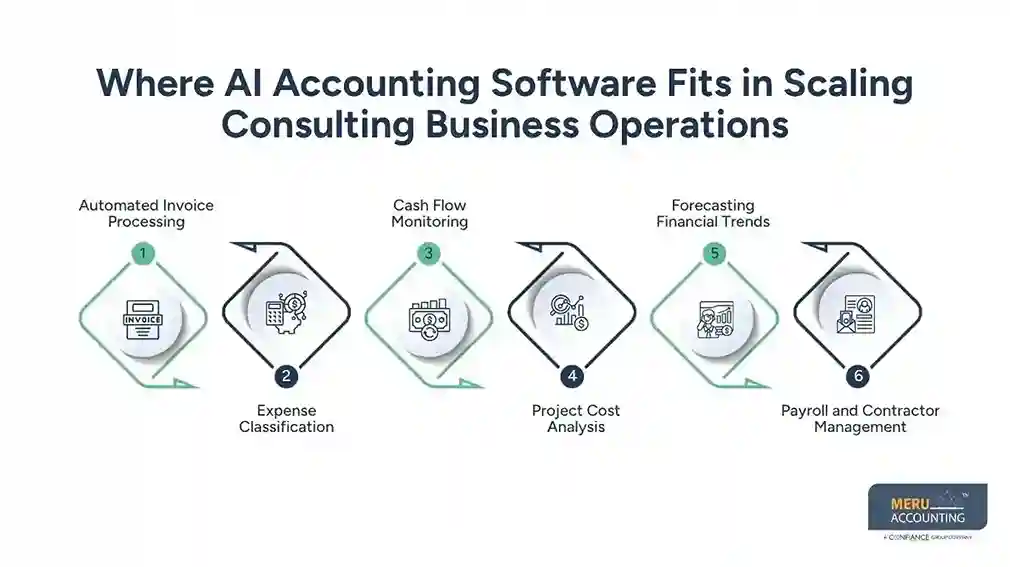
Project Cost Analysis
Growing consulting firms need better project-level reporting. AI tools combine billing data, labor expenses, and operating costs to show actual project profitability.
Forecasting Financial Trends
Modern accounting systems analyze historical data patterns and generate financial forecasts. This allows firms to prepare for slower revenue periods or rising operational costs.
Payroll and Contractor Management
Firms often work with remote consultants and freelance professionals, which increases the complexity of payroll and contractor management.
AI-driven systems help simplify payroll calculations, contractor payments, and tax reporting in accounting for consulting businesses.
Benefits of AI Accounting Software for Growing Consulting Firms
Faster Financial Reporting
Manual reporting may take days to complete. AI accounting software generates reports quickly by processing transactions automatically throughout the month.
Better Accuracy in Records
Automation reduces repetitive data entry mistakes. More accurate records improve financial reporting quality and reduce correction work later.
Improved Decision-Making
Firms need clear financial information before hiring staff, expanding services, or adjusting pricing to maintain profitability and control costs in accounting for consulting businesses. Updated financial reports support stronger planning and decision-making.
Reduced Administrative Work
Finance teams spend less time entering receipts, organizing invoices, and updating spreadsheets manually. This allows more focus on analysis and planning.
Stronger Compliance Management
Tax records, payment histories, and audit documents remain organized within one system. This reduces compliance pressure during filing periods.
Better Client Profitability Insights
Consulting firms often work with clients that generate different profit margins. AI-driven reporting allows firms to identify high-value and low-margin engagements more clearly.
Integrating AI Accounting Software with CRM and Project Management Tools
Client Billing Synchronization
CRM systems contain client contracts, billing schedules, and payment terms. Integration allows accounting systems to generate invoices using updated client information automatically.
Project Cost Tracking
Project management tools record employee hours, deadlines, and resource allocation. Connecting this data with accounting systems improves project profitability analysis.
Better Resource Planning
Integrated systems show which projects generate strong returns and which projects consume excessive resources. This supports better staffing decisions.
Improved Financial Visibility
When CRM, project management, and accounting platforms work together, consulting firms gain a complete financial overview within one dashboard. This unified view reduces the need to switch between multiple tools for basic financial understanding.
Reduced Duplicate Entries
Manual movement of data between systems often creates duplicate records. Integration reduces repetitive data entry and improves reporting consistency.
Faster Client Reporting
Consulting firms frequently share project updates and billing reports with clients. Integrated systems make this reporting process faster and more accurate.
Key Features Consulting Firms Should Look for in AI Accounting Software
Automated Bank Reconciliation
Modern accounting systems should match bank transactions automatically. This reduces manual review time and improves accuracy.
Multi-User Access Control
Growing consulting firms require controlled access for finance staff, project managers, and leadership teams. Permission-based access improves security.
Project-Based Reporting
In accounting for consulting businesses, project-level revenue and cost analysis is essential for evaluating performance across clients and service lines. Strong reporting tools help identify the most profitable areas of the business.
Cloud-Based Access
Remote teams require secure access from different locations. Cloud-based AI accounting software supports flexible operations and centralized data management.
Real-Time Dashboards
Business owners should be able to review cash flow, outstanding invoices, and expense summaries quickly through live dashboards. Real-time reporting allows faster financial reviews and better short-term planning decisions.
Integration Capability
The accounting system should connect easily with payroll systems, CRM platforms, banking tools, and project management applications. Strong integration reduces duplicate data entry and creates more consistent financial reporting across departments.
Case Scenarios: When Consulting Firms Should Upgrade Accounting Systems
Increasing Invoice Delays
If invoices are sent late because finance teams manually prepare them, the accounting system may no longer fit business needs. Delayed invoicing can also affect cash inflow and create payment collection problems over time.
Frequent Reporting Errors
Repeated spreadsheet mistakes, missing entries, and incorrect reports indicate that financial operations have become too large for manual systems. These reporting errors may also affect budgeting, forecasting, and tax preparation accuracy.
Difficulty Managing Multiple Projects
Consulting firms managing several projects at once often struggle with profitability tracking using spreadsheets alone. Project expenses, staff costs, and client billing become difficult to monitor accurately without centralized systems.
Slow Month-End Closing
If monthly financial closing takes too long, it usually signals weak automation and outdated accounting processes. Delayed financial closing can also slow down management reviews and important business decisions.
Lack of Cash Flow Clarity
Business owners should always know their current financial position. Poor cash visibility often creates operational risk. Without updated cash flow reports, firms may struggle to plan hiring, expansion, or operational spending properly.
Expansion Into New Markets
Consulting firms entering new regions or adding service divisions require scalable accounting systems for better operational control. Growing operations also increase compliance, payroll, and reporting responsibilities across multiple business areas.
Why Meru Accounting Is the Right Partner for Consulting Firms
Industry Knowledge
Meru Accounting understands the financial structure of accounting for consulting business, including project billing, recurring contracts, payroll management, and profitability tracking across multiple client engagements.
This experience helps in setting clear accounting systems for different consulting models.
Modern Accounting Technology
Our team works with advanced AI accounting software platforms that support automation, financial reporting, and cloud-based access for growing firms. We also ensure smooth setup so firms can start using systems without disruption to daily work.
Customized Financial Solutions
Every consulting business operates differently. Meru Accounting provides accounting solutions based on operational size, reporting needs, and service structure. This approach ensures firms do not use one fixed system that does not match their workflow.
Better Reporting Support
We provide accurate financial reporting that allows consulting firms to monitor revenue, expenses, and cash flow more effectively. Reports are structured in a way that supports clear financial review during decision-making.
Scalable Accounting Processes
As consulting firms expand, accounting complexity increases. Meru Accounting creates structured systems that grow with the business. This reduces the need for frequent system changes during business expansion.
Compliance and Tax Support
Our experts manage bookkeeping, reporting, tax compliance, and financial organization to reduce administrative pressure on consulting firms. We also help firms stay prepared for audits and regulatory checks with proper records.
Our Expert Perspective
Over the past few years, we have observed many consulting firms shifting away from spreadsheet-based systems toward automated accounting platforms as financial work becomes more complex and data-heavy.
Firms managing multiple clients and projects at the same time often face reporting delays, missing entries, and less accurate profitability tracking when they rely on manual tools.
From our experience working with consulting businesses, the biggest change after adopting AI accounting software is stronger financial visibility across the organization.
Business owners gain quicker access to accurate reports, better control over project costs, and clearer tracking of cash inflows and outflows. This leads to more structured planning, fewer financial surprises, and stronger confidence while making decisions related to hiring, pricing, and expansion.
Key Takeaways
- Consulting firms often outgrow spreadsheets as operations expand
- AI accounting software reduces manual accounting workload
- Real-time reporting allows faster financial decision-making
- Project profitability tracking becomes easier with automated systems
- Integrated accounting systems reduce duplicate data entry
- Cloud-based systems improve access for remote consulting teams
- Better financial visibility supports long-term business growth
- Accounting for consulting business requires scalable reporting systems
- Consulting firms should upgrade systems before financial errors increase
- Meru Accounting provides structured accounting support for consulting firms
FAQs
AI accounting software uses automation and data analysis to manage accounting tasks like invoicing, expense tracking, reporting, and reconciliation with less manual work.
As consulting firms grow, spreadsheets become difficult to manage because of increasing invoices, projects, expenses, and reporting requirements.
The software automates repetitive tasks like data entry and bank reconciliation, which lowers the chance of manual mistakes.
Yes. Most modern systems combine project revenue, labor costs, and expenses to show accurate profitability reports.
Consulting firms often handle project-based billing, recurring contracts, and service-based revenue, which requires specialized financial tracking and reporting systems.