Ever looked at a profit and loss statement and wondered what all those numbers actually mean? Or heard someone talk about debits, credits, and liabilities and felt lost in the conversation? You’re not alone. Accounting has its own language, but you don’t need an accounting degree to understand it. This guide to accounting for dummies starts with the fundamentals and explains them in everyday terms.
From recording a sale to tracking a loan, every transaction follows certain rules. These basic accounting principles help keep financial records consistent and make reports easier to understand. We’ll break down 10 of these principles with practical examples so you can see how they work in real business situations.
What You Will Learn From This Blog
- What accounting means and why businesses need it.
- 10 basic accounting principles and how they work.
- How the accounting equation tracks business finances.
- Common accounting terms every beginner should know.
- How to read the three main financial statements.
- When a business may need help from an accountant or bookkeeper.
What Is Accounting and Why Does It Matter for Businesses?
Accounting is the process of recording, sorting, checking, and reporting a business’s financial activity. It gives owners a clear view of income, costs, assets, debts, and profits.
For example, a small store may record daily sales, rent, payroll, supplier bills, and loan payments. These records help the owner see how much money the business earns and spends. They also help the owner plan for future costs.
Accounting matters because it helps businesses:
- Track income and costs: See how much the business earns and spends over time.
- Measure profit: Find out whether sales cover costs and leave money to grow.
- Manage cash flow: Know when money is due in and when bills must be paid.
- Meet tax rules: Keep clear records to support tax returns and other filings.
- Make sound choices: Use real numbers to plan budgets, hire staff, or buy new tools.
In short, accounting turns daily business activity into useful financial data. It helps owners make choices based on facts rather than guesswork.
optional anymore
on running the business
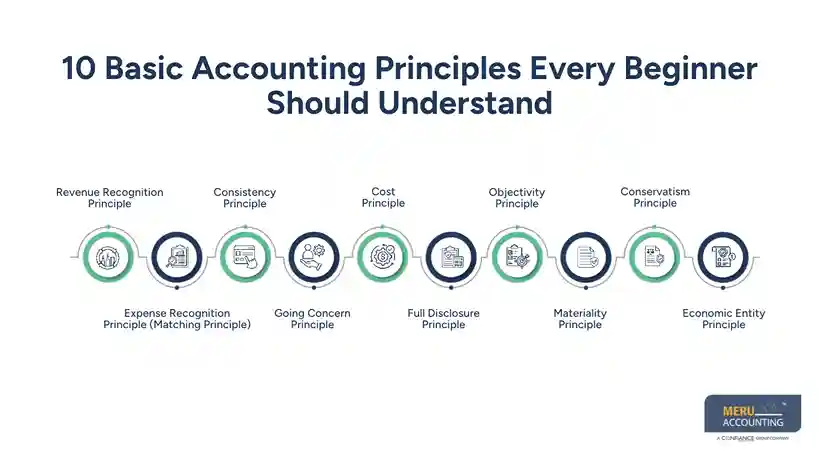
10 Basic Accounting Principles Every Beginner Should Understand
The basic accounting principles guide how businesses record and report financial activity. They help keep records clear, fair, and useful. Here are 10 key principles explained with simple examples.
1. Revenue Recognition Principle
The revenue recognition principle says a business should record revenue when it earns it, not just when it gets paid.
For example, a marketing firm completes a project worth $3,000 in March but receives payment in April. Under accrual accounting, it records the $3,000 as revenue in March because that is when it completed the work.
This rule helps show when a business has earned money, even if the cash comes later.
2. Expense Recognition Principle (Matching Principle)
The matching principle says a business should record costs in the same period as the revenue they help earn.
For example, a store buys products for resale in January and sells them in February. The cost of those goods is recorded when the related sale takes place, subject to the rules for inventory accounting.
This gives a more useful view of profit because the income and related costs appear in the same period.
3. Consistency Principle
The consistency principle means a business should use the same accounting methods from one period to the next.
For example, if a company uses the same method to value its stock each year, it is easier to compare results. A change may still be needed, but the company should have a valid reason and report it when required.
Consistency helps owners, lenders, and investors spot changes in results without confusion from shifting methods.
4. Going Concern Principle
The going concern principle assumes that a business will keep running for the near future and does not plan to shut down.
For example, a company that buys a delivery van for long-term use may spread its cost over its useful life rather than record the full cost as an expense at once.
This principle affects how assets, debts, and long-term costs are shown in financial reports. If a business may not be able to keep operating, it may need a different basis for reporting.
5. Cost Principle
The cost principle says that an asset is first recorded at the amount paid to buy it, including costs needed to get it ready for use.
For example, if a business buys office equipment for $8,000, it records the asset at its purchase cost. Its value in the books may change over time due to depreciation or other rules.
This gives a clear starting point for asset records and helps support the figures with proof of purchase.
6. Full Disclosure Principle
The full disclosure principle says a business should share key facts that may affect how people read its financial reports.
For example, if a company is facing a major lawsuit that could lead to a large cost, it may need to report details in its financial statement notes.
This helps lenders, owners, and investors make choices with a clear view of the risks. The goal is to avoid leaving out facts that could change how someone views the business.
7. Objectivity Principle
The objectivity principle means accounting records should rely on facts and proof, not personal views.
For example, a business buys a laptop for $1,500. The bookkeeper records the cost based on the invoice or receipt, not on what the owner thinks the laptop is worth.
Source records such as bills, bank statements, receipts, and contracts help support entries and make reviews easier.
8. Materiality Principle
The materiality principle says that a business should give more attention to items that could affect a user’s view of its finances.
For example, a large company may record a low-cost office item as an expense rather than track it as a long-term asset. The amount is too small to change the reader’s view of the reports.
Materiality depends on the size and nature of the item. A cost that is small for one company may be important for a much smaller business.
9. Conservatism Principle
The conservatism principle calls for care when estimates are uncertain. A business should not overstate assets or income or understate debts and costs.
For example, if a customer has missed several payments and may not pay the full amount due, the business may need to record an allowance for expected credit losses.
This approach helps prevent financial reports from showing a more positive picture than the facts support.
10. Economic Entity Principle
The economic entity principle says that business records must stay separate from the owner’s personal finances.
For example, if an owner uses a personal bank account to pay a business bill, the payment must be recorded as a business cost, and the owner’s contribution or loan must be tracked in the right way.
Mixing personal and business costs makes it harder to track profit, prepare tax records, and review cash flow. Separate bank accounts and clear records help avoid this problem.
Note: These principles are common accounting concepts. The exact rules and terms may vary based on the accounting framework a business follows, such as U.S. GAAP.
Understanding the Accounting Equation
The accounting equation is one of the first ideas to learn in accounting for dummies. It shows how a business’s assets relate to its debts and owner’s equity.
The Accounting Equation
Assets = Liabilities + Equity
Assets | Liabilities | Equity |
$50,000 | $20,000 | $30,000 |
What the business owns | What the business owes | Owner’s share of the business |
Example: If a business has $50,000 in assets and owes $20,000 in debt, its owner’s equity is $30,000.
$50,000 = $20,000 + $30,000
Here is what each part means:
- Assets: Things a business owns, such as cash, stock, equipment, and money due from customers.
- Liabilities: Money a business owes, such as loans, unpaid bills, and wages due.
- Equity: The owner’s share of the business after debts are taken out.
For example, if a business has $50,000 in assets and $20,000 in debts, its equity is $30,000.
The equation must stay balanced after each recorded transaction. It is the basis of double-entry accounting and helps check that the books are in order.
Basic Accounting Terms Every Beginner Should Know
Learning a few common terms makes accounting much easier to follow. These words also appear in financial reports, tax records, and business discussions.
Accounting term | Simple meaning |
Debit | An entry on the left side of an account |
Credit | An entry on the right side of an account |
Revenue | Money earned from sales or services |
Expenses | Costs paid or owed to run a business |
Accounts receivable | Money customers owe the business |
Accounts payable | Money the business owes suppliers |
General ledger | The main record of all accounts |
Journal entry | A record of a financial transaction |
Cash flow | Money moving in and out of a business |
Net income | Revenue left after expenses and other costs |
One key point: debit does not always mean an increase, and credit does not always mean a decrease. Their effect depends on the type of account.
How to Read the Three Main Financial Statements
Financial statements show how a business is doing. Each report answers a different question.
1. Income Statement
The income statement shows a business’s revenue, costs, and profit or loss over a set period.
For example, if a business earns $80,000 in revenue and has $55,000 in expenses, its net income is $25,000, before any other items not included in those figures.
Use this report to check if sales are high enough to cover costs.
2. Balance Sheet
The balance sheet shows what a business owns and owes on a set date. It also shows the owner’s equity.
It follows the accounting equation and helps show the company’s financial position. A lender may review this report to see whether a business has enough assets to meet its debts.
3. Cash Flow Statement
The cash flow statement tracks cash moving in and out of a business. It groups cash activity into three areas:
- Operating activities: Cash from daily business work.
- Investing activities: Cash used to buy or sell long-term assets.
- Financing activities: Cash from loans, debt payments, and owner funding.
A business can show a profit on its income statement and still have cash flow problems if customers pay late or large bills come due.
Outsourced Accounting and Bookkeeping Services by Meru Accounting
Knowing the difference between assets and liabilities is one thing; making sure every transaction is recorded in the right account is another. A missed expense, an incorrect journal entry, or an unreconciled bank balance can affect financial reports and give business owners the wrong picture of their finances.
At Meru Accounting, we help businesses put sound accounting practices into action through dedicated accounting and bookkeeping support. Our services cover the day-to-day work behind accurate financial records, including:
- Transaction Recording and General Ledger Management: Record business income, expenses, purchases, and payments under the right accounts.
- Accounts Payable and Receivable: Track vendor bills, customer invoices, outstanding balances, and payment activity.
- Bank and Credit Card Reconciliation: Match recorded transactions with bank and card statements to identify errors and missing entries.
- Journal Entries and Adjustments: Record accruals, prepayments, depreciation, and other adjustments needed for accurate financial reports.
- Financial Statement Preparation: Prepare income statements, balance sheets, and cash flow statements to help owners understand business performance.
- Accounting Cleanup and Catch-Up: Review past records, correct posting errors, and bring overdue books up to date.
Whether you need help maintaining daily books or preparing reliable financial statements, Meru Accounting provides outsourced accounting support at a fraction of the cost of building an in-house accounting team.
Our Expert Insight
One accounting habit worth developing early is knowing when to question a number rather than simply accepting what appears in a report. For example, a sudden rise in office expenses may be due to a one-time equipment purchase, a duplicate entry, or a change in monthly costs. Each has a different impact on the business.
At Meru Accounting, we believe financial reviews should go beyond checking totals. Looking at unusual changes, comparing monthly figures, and tracing large transactions back to their source can reveal issues that routine data entry may miss.
Our advice: Don’t just ask whether your books balance. Ask whether the figures make sense, whether they match the supporting records, and whether they reflect what actually happened in your business.
Key Takeaways
- Accounting helps businesses track income, costs, assets, debts, and profit.
- The basic accounting principles guide how financial activity is recorded and reported.
- The accounting equation links assets, liabilities, and equity.
- Debits and credits are key parts of double-entry accounting.
- The income statement, balance sheet, and cash flow statement each serve a different purpose.
- Clear records help business owners make sound choices and prepare for tax work.
- Professional accounting support can help keep books accurate as a business grows.
FAQs
The 10 principles covered in this guide are revenue recognition, expense recognition, consistency, going concern, cost, full disclosure, objectivity, materiality, conservatism, and economic entity. They guide how businesses record and report financial activity.
Yes. You can start with basic terms, the accounting equation, debits and credits, and the three main financial statements. A few simple business examples can help you understand how each part works.
Think of debits as entries on the left and credits as entries on the right. Each transaction must have equal debit and credit amounts. Their effect depends on the account type.
The three main financial statements are the income statement, balance sheet, and cash flow statement. They show profit or loss, financial position, and cash movement, respectively.
Bookkeeping focuses on recording and sorting daily financial transactions. Accounting goes further by reviewing those records, preparing reports, analyzing results, and helping owners make financial decisions.
optional anymore
on running the business