
Accounting for hotels plays a key role in keeping financial records clear, accurate, and easy to understand. As hospitality businesses grow, financial recording becomes more detailed because income sources, expenses, and operations increase in number and complexity.
Many small hotel owners start with basic tracking, but expansion demands better systems and expert handling. In this stage, accounting is not only about recording numbers but also about understanding performance across departments and locations.
When hotels grow from a single property to multiple branches, financial control becomes harder. This is where professional Hotel Accounting Services start becoming important. These services bring structure to financial records and reduce errors in reporting.
In this blog, we will understand how hotel financial management changes during growth, what challenges arise, and how professional support makes a difference.
What You Will Learn From This Blog
- How Accounting for hotels changes as a business expands
- Why do small hotel accounting methods stop working during growth
- Key financial challenges faced by growing hotels
- Role of Hotel Accounting Services in Financial Accuracy
- Importance of cash flow control and revenue tracking
- Practical examples of hotel financial management
- How expert support can bring order to complex hotel accounts
Understanding the Changing Needs of Accounting For Hotels During Expansion
Growing Number Of Transactions
As hotels expand, daily transactions increase. Room bookings, food sales, events, and vendor payments all rise in volume. At this stage, accounting for hotels must handle more data without delay or confusion.
Multiple Revenue Streams
Hotels earn income from rooms, restaurants, banquets, and online travel platforms. Each source needs separate tracking. Financial recording becomes more structured as departments grow and operations diversify.
Increased Reporting Needs
Managers need reports for each department. Basic tracking is no longer enough. Profit and cost details must be shown clearly for each segment so decisions can be based on accurate numbers.
Need For Real-Time Records
Delayed entries can lead to wrong decisions. Growing hotels need faster updates in records. This is why financial systems shift toward digital tools and structured processes to keep data updated.
Role Of Professional Support
At this stage, many hotels begin using Hotel Accounting Services to maintain accuracy. These services bring trained staff and better systems to manage financial complexity during expansion.
How Small Hotels Manage Accounting Before Business Growth
Manual Record Keeping
Small hotels often rely on notebooks or very basic spreadsheets for daily use. Financial recording at this stage is simple and limited to daily income and expense tracking only.
Limited Financial Structure
There is usually no clear separation between different hotel departments or units. Accounting for hotels remains focused on overall cash flow only, without detailed breakdowns.
Owner-Based Control
The hotel owner often manages all financial records personally on a daily basis. This keeps financial tracking simple but also time-consuming and highly dependent on individual effort.
Basic Expense Tracking
Expenses like staff wages, utility bills, and supply purchases are recorded in a very basic way. Financial recording does not yet include deep analysis or detailed departmental breakdown.
Low Dependency On Software
Most small hotels do not use advanced accounting tools or digital systems. As a result, accounting remains manual, less detailed, and more prone to missed entries or delays.
Informal Revenue Tracking
Income from rooms, food sales, and small services is often recorded without strict categorization. This makes it harder to understand which areas are performing well.
Lack Of Standard Reporting
Financial reports are rarely prepared in a structured format. Decisions are often based on rough estimates rather than clear financial insights.
Minimal Compliance Awareness
Tax filing and compliance tasks are handled in a simple way without detailed planning. This can create issues when regulations become stricter with growth.
Why Accounting For Hotels Becomes More Complex as Businesses Grow
Expansion Of Operations
With rapid business growth, hotels add more rooms, additional services, and new locations. This increases the overall workload on financial recording systems and requires better coordination across multiple departments.
Multiple Staff And Departments
Different teams manage different services across the hotel structure. Payroll tracking and departmental cost allocation become more detailed as operations expand across larger and more diverse teams.
Higher Transaction Volume
Accounting for hotels must process hundreds of daily financial transactions quickly and correctly, including room bookings, food sales, and vendor payments, without delay. This also increases the need for faster and more accurate recording systems.
Online Booking Systems
Hotels use platforms like Booking and Expedia for reservations and sales. Payment matching and reconciliation become more detailed and require careful tracking of every booking source.
Need For Compliance
Tax rules and financial reporting standards become stricter as hotels grow. Financial records must follow proper legal requirements and reporting formats to avoid penalties and compliance errors.
Key Accounting Challenges Faced By Expanding Hospitality Businesses
Revenue Reconciliation Issues
Accounting for hotels must match room bookings with actual payments received from multiple sources. Without proper systems, financial records can show errors and mismatches that affect accuracy.
Expense Tracking Across Departments
Food, housekeeping, and maintenance costs must be tracked separately for better clarity. This makes financial recording more detailed as each department requires proper cost allocation.
Payroll Complexity
As staff increases, salary calculations become harder and more time-consuming. Financial systems must accurately include shifts, overtime, allowances, and other employee benefits.
Cash Flow Gaps
Delayed payments from travel platforms can create temporary cash flow gaps in operations. Financial planning must carefully manage inflows and outflows to avoid liquidity pressure.
Data Accuracy Problems
Manual entries often lead to mistakes and missing information in records. This is why Hotel Accounting Services are preferred by growing hotels for more reliable financial control.
How Hotel Accounting Services Help Improve Financial Accuracy During Growth
Structured Financial Systems
Hotel Accounting Services introduces organized systems for tracking income and expenses across all operations. Better control over daily transactions ensures clearer financial records and improved consistency.
Error Reduction
Professional teams reduce mistakes in entries and reports through careful review and validation processes. Financial data becomes more reliable with fewer discrepancies in reporting outputs.
Faster Reporting
Reports are generated on time with improved accuracy and structured formatting. Management receives updated financial information that supports quicker and more informed decisions.
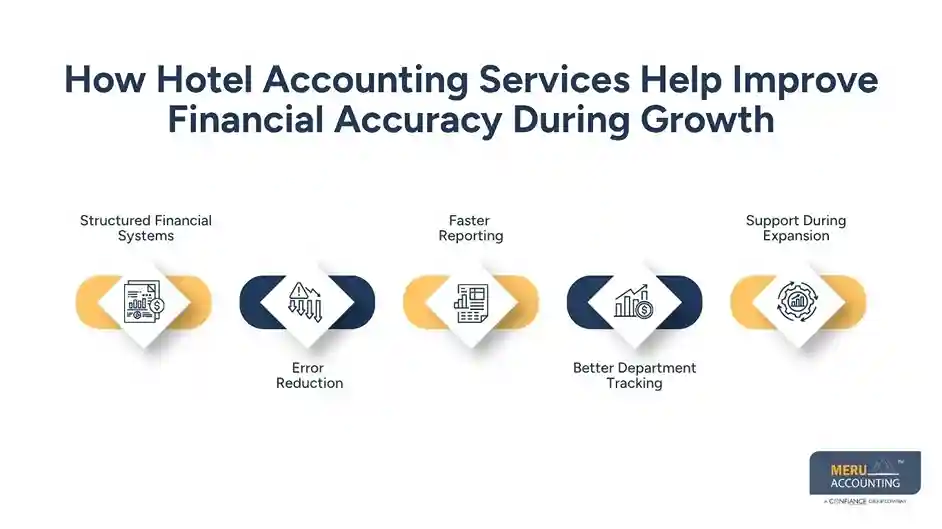
Better Department Tracking
Each department gets separate financial records. Accounting for hotels gains stronger clarity, allowing management to understand profit and cost behavior across multiple operational areas.
Support During Expansion
When hotels open new branches, Hotel Accounting Services ensures a smooth financial setup across locations. Financial systems are aligned from the beginning to avoid confusion during scaling.
Importance of Revenue Management and Financial Tracking For Growing Hotels
Room Revenue Tracking
Hotels must track occupancy and pricing carefully across different room categories and seasons. Financial systems ensure room income is recorded correctly with proper classification.
Food And Beverage Records
Restaurant sales form a large part of hotel income streams. Detailed tracking of each sale ensures accurate financial reporting and better visibility of daily earnings.
OTA Payment Matching
Payments from online platforms must match bookings without discrepancies. Reconciliation processes ensure every reservation aligns with received payments from travel partners.
Seasonal Revenue Patterns
Hotels earn differently in the peak and off-season across the year. Financial analysis helps identify these changes and supports better planning for future operations.
Profit Analysis By Segment
Each service must show profit separately for better decision-making. Accounting for hotels becomes more useful for planning when each revenue stream is analyzed clearly.
Improving Cash Flow Management Through Professional Hotel Accounting Services
Timely Payment Tracking
Hotel Accounting Services ensure payments are recorded without delay across all transactions. Financial accuracy increases as income entries stay updated and properly matched with records.
Expense Planning
Hotels can plan costs better using detailed financial reports and structured data insights. Accounting for hotels becomes more controlled with clearer visibility of spending patterns.
Supplier Payment Management
Vendor payments are tracked properly with organized schedules and clear documentation. This avoids confusion in financial records and reduces the risk of missed obligations.
Salary Planning
Payroll schedules are managed in advance with structured timelines and accurate calculations. Financial stability improves as employee payments remain consistent and well-planned.
Cash Flow Forecasting
Future income and expenses are estimated using historical data and booking trends. Financial planning becomes more strategic with better visibility of cash movement patterns.
How Meru Accounting Supports Hospitality Businesses
Meru Accounting provides expert financial support for hotels at different stages of growth, focusing on accuracy, structure, and consistent record handling across all operations.
Our team brings strong industry knowledge to manage hospitality accounts in a way that aligns with real hotel workflows, covering room income, food sales, vendor costs, and daily transactions.
Advanced software tools are used to connect different systems, ensuring smooth coordination between bookings, expenses, and financial reporting. Support also includes OTA reconciliation, where payments from booking platforms are matched correctly with hotel records to maintain accuracy in Accounting for hotels.
As businesses expand, services scale across multiple properties without disruption in financial processes. Clear and reliable reporting formats help management understand performance easily, making financial decisions more structured and timely.
Key Takeaways
- Accounting for hotels becomes more complex as hotels expand
- Small hotel methods are not enough for growing operations
- Hotel Accounting Services bring structure and accuracy
- Revenue tracking is important for financial control
- Cash flow management becomes critical during expansion
- Professional support reduces errors and improves reporting
- Proper systems help hotels make better financial decisions
Our Expert Perspective
From our expert perspective, accounting for hotels changes significantly when a hospitality business expands beyond a single property.
Rising transaction volumes, multiple revenue channels, and larger teams often create confusion in financial records during growth phases. Structured systems and professional Hotel Accounting Services bring clarity, consistency, and stronger control over financial operations.
From our expert perspective, the real focus should not remain limited to recording numbers but extend to understanding overall business health in a simple and consistent manner.
Strong financial systems allow better visibility across departments and support more stable decision-making as hotel operations scale.
FAQs
As hotels grow, transactions increase, and multiple income sources appear. This makes Accounting for hotels more detailed and structured.
These are professional services that manage hotel financial records, reporting, and reconciliation tasks related to Accounting for hotels.
Yes, but only for small operations. As the hotel grows, Accounting for hotels requires better systems for accuracy.
It helps understand income from rooms, food, and other services. This is a key part of Accounting for hotels.
They track payments, expenses, and forecasts to ensure smooth cash flow. This strengthens Accounting for hotel management.