Accounting in hotel businesses is very different from accounting in most other industries because hotels deal with daily guest activity, changing prices, and many types of income at the same time. Unlike a simple product sale business, accounting in hotel businesses must track room bookings, food sales, events, and services every single day with high accuracy.
In this blog, we will explain why accounting and bookkeeping in hotel businesses follow special methods and why standard accounting rules are not enough for hotel operations. You will also understand how hotel accounting procedures help in managing complex financial activity in hotels and why proper systems are important for accuracy and control.
What You Will Learn From This Blog
- What hotel accounting means and how it works
- Why accounting in hotels is different from normal businesses
- How hotels manage multiple income sources
- Why daily tracking is important in hotel finance
- How modern systems improve accuracy in reporting
- Common challenges in hotel financial management
- How professional support improves hotel accounting quality
What Is Hotel Accounting Procedures?
Daily Recording Of Transactions
To understand what is hotel accounting procedures, it includes recording all daily financial activity, such as room bookings, restaurant bills, and service charges. Since hotels have high daily transactions, records must be updated without delay.
Revenue Classification System
Hotels divide income into categories like rooms, food & beverage, spa, and events, which helps explain what is hotel accounting procedures in daily operations. Hotel accounting procedures ensure each source is tracked separately for clarity.
Expense Tracking Methods
All operational costs like staff wages, utilities, cleaning, and supplies, are recorded carefully. This helps in understanding real profit margins and reflects what is hotel accounting procedures in financial analysis.
Guest Billing And Settlement
Bills are generated for each guest’s stay, including taxes and additional services. Proper billing is a key part of hotel accounting procedures.
Financial Reporting Structure
Reports are prepared daily, weekly, and monthly. This helps hotel managers make quick financial decisions.
How Accounting In Hotel Industry Differs From Standard Business Accounting
Multiple Revenue Streams
In normal business accounting, income is often from one or two sources. In contrast, accounting in hotel businesses handles many income streams at once.
Hotels earn from rooms, food, events, spa, laundry, and other guest services, all at the same time, which highlights what is hotel accounting procedures in a real-world setting. This makes tracking income more detailed in accounting and bookkeeping in hotel businesses.
Daily Financial Movement
Hotels deal with continuous check-ins and check-outs, making hotel accounting procedures more active and time-sensitive.
Every day brings new bookings, cancellations, and payments, so records must be updated without delay to maintain accuracy in accounting in hotel businesses.
Dynamic Pricing Structure
Room rates change based on season, demand, and events, which further explains what is hotel accounting procedures in dynamic pricing environments. This makes accounting and bookkeeping in hotel businesses more complex than fixed-price businesses.
Because prices shift often, hotels must carefully record each transaction to ensure correct revenue reporting under hotel accounting procedures.
High Volume Of Transactions
Hotels process hundreds of small transactions daily, requiring structured systems under hotel accounting procedures.
These include room charges, restaurant bills, and service fees, which together create a large and detailed financial flow in accounting and bookkeeping in hotel businesses.
Service-Based Revenue Complexity
Unlike product sales, hotel revenue includes services that are consumed instantly, requiring accurate tracking.
Since services like spa or room service are not stored or resold, every charge must be recorded immediately in accounting and bookkeeping in hotel businesses.
Department Wise Revenue Separation
Hotels divide income into departments like rooms, food, and services. This helps in clear financial tracking under hotel accounting procedures. It also allows management to see which area generates the most profit.
Real Time Billing Requirements
Billing must happen instantly when guests use services. Delays can create confusion in accounting and bookkeeping in hotel businesses and affect financial accuracy.
Seasonal Occupancy Fluctuations
Hotel income changes with tourist seasons and local events. This variation makes hotel accounting procedures more detailed and planning-focused, highlighting what is hotel accounting procedures in seasonal environments.
What Makes Accounting In Hotel Operations More Complex Than Other Businesses?
Constant Guest Activity
Guests check in and out every day, creating continuous financial entries in accounting in hotel businesses.
This nonstop movement of guests means financial records must be updated in real time to avoid errors or missing entries.
Mixed Revenue Categories
Hotels earn from rooms, food, travel services, and events, all managed through hotel accounting procedures.
Each category has different pricing, timing, and tax rules, which makes tracking income more detailed in accounting and bookkeeping in hotel businesses.
Seasonal Demand Changes
Revenue changes heavily during peak and off-season periods, requiring flexible financial planning.
These shifts directly impact occupancy rates and pricing, which must be reflected accurately in hotel accounting procedures.
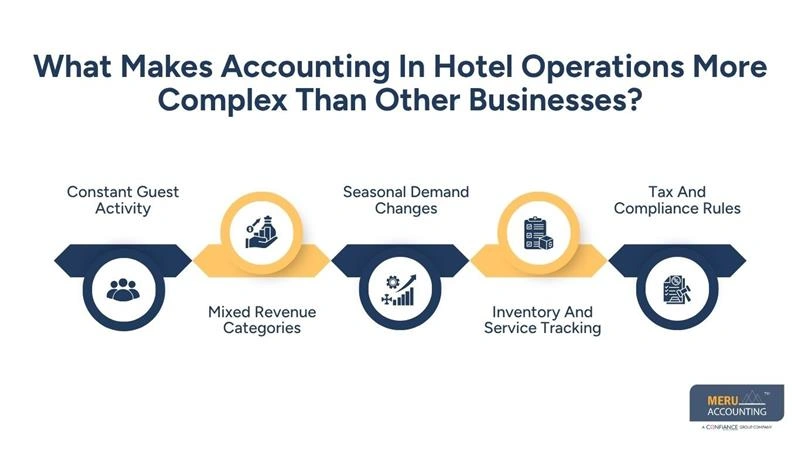
Inventory And Service Tracking
Hotels must track both physical inventory (like food supplies) and services offered to guests.
This includes monitoring stock usage daily while also recording service delivery within accounting and bookkeeping in hotel businesses.
Tax And Compliance Rules
Hotels must follow strict tax rules based on location, services, and guest categories, which further defines what is hotel accounting procedures.
Different taxes apply to rooms, food, and extra services, making compliance a key part of hotel accounting procedures.
What Challenges Are Unique To Accounting In Hotel Management?
High Transaction Errors Risk
Due to large daily data, errors can occur if accounting and bookkeeping in hotel businesses is not properly managed.
Even a small mistake in entry or billing can affect total revenue reporting and create confusion in financial records.
Staff Coordination Issues
Multiple departments like front desk, kitchen, and housekeeping must share financial data correctly, which is a practical example of what is hotel accounting procedures.
If communication is not clear between teams, it can lead to missing charges or duplicated entries in hotel accounting procedures.
Real-Time Reporting Needs
Hotel managers need updated financial data to make quick decisions.
Delays in reporting can affect pricing decisions, staffing levels, and daily operational planning in accounting in hotel businesses.
Complex Billing Structures
Discounts, packages, and seasonal offers make hotel accounting procedures more detailed.
Each offer must be split correctly into different revenue parts to maintain accurate financial reporting.
Cash And Digital Payment Mix
Hotels handle both cash and digital payments, increasing reconciliation work.
This mix requires careful daily checking to ensure all transactions match recorded entries in accounting and bookkeeping in hotel businesses.
How Do Hotel Accounting Procedures Handle Multiple Revenue Streams?
Separate Revenue Categories
Each income source is tracked separately under hotel accounting procedures. This helps in clear identification of where the income is coming from and improves accuracy in accounting in hotel businesses.
Department-Wise Reporting
Rooms, food, and services are treated as different profit centers. This structure allows management to evaluate performance and control costs for each department more effectively.
Integrated Accounting Systems
Modern systems combine all revenue streams into one dashboard. This reduces manual work and ensures that all financial data is connected within accounting in hotel businesses.
Daily Reconciliation Process
All income sources are matched daily to avoid mismatch in accounting and bookkeeping in hotel businesses. Regular checks help detect errors early and maintain reliable financial records under hotel accounting procedures.
Performance Analysis
Each department’s performance is reviewed separately for better decision-making. This allows hotels to focus on improving weaker areas while maintaining strong revenue sources.
Why Is Daily Transaction Tracking Important In Accounting In Hotel Businesses?
Prevents Revenue Loss
Daily tracking ensures no income is missed in accounting in hotel businesses. It helps capture every charge, including small services, that might otherwise be overlooked.
Improves Accuracy
Frequent updates reduce chances of errors in financial records. When entries are recorded daily, it becomes easier to verify and correct mistakes early.
Supports Quick Decisions
Hotel managers rely on daily data for pricing and staffing decisions. Accurate daily reports help adjust room rates and staff levels based on demand.
Strengthens Financial Control
Regular tracking improves control over expenses and income. It allows management to monitor spending closely and avoid unnecessary costs.
Enhances Reporting Quality
Daily records improve monthly and yearly financial reports under hotel accounting procedures. Well-maintained daily data leads to more reliable and clear financial statements.
How Does Accounting In Hotel Industry Manage Room, Food, And Service Revenue?
Room Revenue Tracking
Each booking is recorded with price, taxes, and duration in accounting in hotel businesses. This ensures that every stay is properly billed and reflected in financial reports without any missing entries.
Food And Beverage Accounting
Restaurant sales are tracked separately from room income. This helps in understanding the performance of the food department and maintaining clear records under hotel accounting procedures.
Service-Based Income Recording
Services like spa, laundry, and events are recorded individually. Each service charge is added to the guest account or recorded separately to maintain accuracy in accounting and bookkeeping in hotel businesses.
Package Billing Management
Hotels often offer combined packages that require careful splitting of revenue. These packages must be divided into room, food, and service portions to ensure proper reporting under hotel accounting procedures.
Tax Application Accuracy
Different services may have different tax rates under hotel accounting procedures. Accurate tax calculation is important to meet compliance rules and avoid errors in accounting in hotel businesses.
What Systems Are Used In Modern Accounting In Hotel Businesses?
Property Management Systems
These systems handle bookings and billing in real time. They connect guest check-ins, room charges, and payments directly with accounting and bookkeeping in hotel businesses for accurate records.
Cloud Accounting Software
Cloud tools help manage accounting in hotel businesses from anywhere while simplifying what is hotel accounting procedures. They allow secure access to financial data and make it easier to update records without delays.
Automated Reporting Tools
Reports are generated automatically for faster analysis. This reduces manual work and improves the accuracy of financial reports under hotel accounting procedures.
Integration With POS Systems
Restaurant and service payments are linked directly to accounting systems. This ensures that every transaction is recorded instantly in accounting and bookkeeping in hotel businesses without manual entry.
Real-Time Dashboards
Managers can view financial performance instantly using dashboards. These dashboards help track revenue, expenses, and trends quickly for better decision-making.
How Do Hotel Accounting Procedures Ensure Accurate Financial Reporting?
Standardized Reporting Formats
Hotel accounting procedures follow consistent reporting formats for clarity, which helps define what is hotel accounting procedures in reporting. This consistency makes it easier to compare financial data over time and detect any unusual changes in accounting in hotel businesses.
Internal Auditing Systems
Regular audits ensure accuracy in financial data. Frequent checks help identify errors, prevent fraud, and maintain trust in hotel accounting procedures.
Department-Wise Reports
Each department submits its financial summary separately. This allows better tracking of income and expenses across departments within accounting in hotel businesses.
Use Of Accounting Software
Automation reduces manual errors in accounting and bookkeeping in hotel businesses and supports what is hotel accounting procedures. Software also speeds up data processing and improves the reliability of financial reports.
Compliance With Financial Rules
Hotels follow tax and financial reporting laws strictly. Proper compliance helps avoid penalties and ensures that hotel accounting procedures meet legal standards.
How Meru Accounting Supports Hotel Businesses
Meru Accounting provides specialized support for accounting in hotel businesses with structured systems designed for hospitality needs. Our team understands how hotel accounting procedures work in real operations, not just theory.
We help hotels with:
- Daily transaction recording
- Revenue classification systems
- Payroll and staff cost tracking
- Financial reporting and analysis
- Software setup and migration support
Our experience with global hotel clients helps improve accuracy and reduce reporting delays. We also integrate modern accounting tools to simplify hotel accounting procedures and improve decision-making speed.
Our Expert Perspective
From our experience, most hotels do not struggle with revenue generation—they struggle with financial clarity. Accounting in hotel businesses becomes difficult when daily data is not organized properly. When hotel accounting procedures are applied correctly, hotels gain better control over pricing, staffing, and profitability.
We have seen that hotels using structured systems reduce financial errors significantly and improve long-term stability. The key is consistency in tracking and reporting.
Key Takeaways
- Hotel accounting is more complex than standard business accounting
- Daily tracking is essential for accuracy
- Multiple revenue streams require structured systems
- Technology improves reporting and control
- Proper procedures reduce financial errors
- Hotels need specialized accounting methods for better results
FAQs
Hotels handle daily guest activity, multiple income streams, and changing prices, making accounting in hotel businesses more complex.
They help track all income and expenses properly and ensure accurate financial reporting.
Ideally, every day, since hotels have continuous financial activity.
Room bookings, food and beverages, events, spa services, and other guest services.
Yes, modern tools reduce errors and improve speed in hotel accounting procedures.