
Financial tracking is a key part of every business. It shows how cash moves, how profit builds up, and how growth takes shape over time. One of the first key choices a business makes is how it records money. The topic of single entry vs double entry accounting is not just about basic record keeping. It shapes how clear, correct, and useful financial data will be for daily use and long-term plans.
For industry-specific needs, this choice matters even more. A retail shop, a SaaS firm, and a factory all handle money in very different ways. Each one has its own flow of cash, costs, and risks. That is why skilled accounting services are so important. They help match the right system with the right type of business so records stay clean and useful.
In this blog, we will break down both methods in simple terms, show how they work, and explain why this choice plays a big role in business success across industries.
What You Will Learn From This Blog
Here is what you will learn in this guide in a clear and simple way:
- What single entry and double entry systems mean in daily use
- How both systems work in real business settings
- Why single entry vs double entry accounting matters across industries
- How better systems lead to cleaner and safer financial records
- Why expert accounting services help firms make the right choice
- Common mistakes firms make when picking an accounting method
- How the wrong choice can slow down growth and cause confusion
By the end, you will clearly see how accounting systems shape business health in simple but strong ways.
Understanding the Basics of Single Entry Accounting
Single entry accounting is the most simple way to track finances. Each deal is recorded only one time. This method is often used by small shops, solo workers, and new firms that have very few transactions.
Most records are kept in a notebook, cash book, or basic sheet. It mainly tracks cash in and cash out, without deep detail about assets or liabilities.
Key points of single entry accounting:
- Very easy to set up and use
- Basic record keeping with low effort
- Focus only on cash flow in and out
- No full balance sheet view
- Limited tracking of financial health
This system is helpful at the start, but it has clear limits. It does not give a full view of business financial health. It is hard to track errors or missing data.
That is why many firms move away from it as they grow. In single entry vs double entry accounting, this method is best only for very small setups or early stage work.
Understanding the Basics of Double Entry Accounting
Double entry accounting is a more full and structured system. Every deal is recorded two times. One part is debit, and the other part is credit. This keeps all books balanced and easier to check.
For example, if a firm gets cash from a sale, it records both income and cash gain. This gives a clear and full view of money flows in the business.
Key points of double entry accounting:
- Every deal has two linked records
- Books always stay balanced
- Better and more full financial reports
- Easy to find and fix errors
- Strong support for audits and taxes
This system is the base of most modern finance work. Most firms that use expert accounting services depend on double entry because it is safe, clear, and easy to scale.
In single entry vs double entry accounting, this method gives a deeper and more trusted view of business health.
Why the Choice Matters for Industry-Specific Accounting Services
Each industry runs in its own way. There is no single accounting system that fits all firms. The way money moves in a shop is very different from how it moves in a tech firm or factory.
For example:
- Retail stores deal with daily sales, stock, and returns
- SaaS firms deal with plans, renewals, and monthly billing
- Factories deal with raw goods, labor cost, and output tracking
- Service firms deal with project billing and client payments
Because of these clear differences, the choice in single entry vs double entry accounting becomes very important.
Industry-focused accounting services help firms pick the right system based on real needs. A simple setup may work for freelancers, but it often fails for firms with complex money flows.
Double entry systems are often better for structured industries because they support tax rules, audits, and clear reporting needs.
Benefits of Using Double Entry Systems in Accounting Services
Most expert accounting services recommend double entry accounting for firms that plan to grow. It gives more control, more clarity, and better long-term support.
Better accuracy: Every deal is recorded twice, which makes errors easier to find and fix.
Clear money view: Firms can see what they own, what they owe, and how value changes over time.
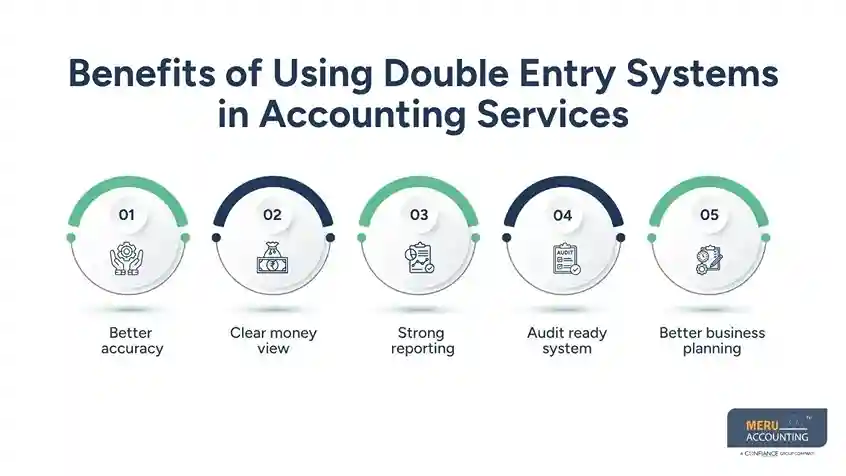
Strong reporting: It helps create clear profit and loss reports, balance sheets, and cash views.
Audit ready system: Clean and balanced records make audits faster and less stressful.
Better business planning: Owners can make smarter plans using clear and trusted data.
In single entry vs double entry accounting, double entry is clearly stronger for long-term use and growth.
Common Mistakes Businesses Make When Choosing Accounting Methods
Many firms make simple but costly mistakes when choosing an accounting method. These mistakes often show up later when the business grows.
Staying too long with single entry: Some firms delay change even when their work becomes more complex.
Not matching system to industry: Each industry has different needs, but this is often ignored.
Missing tax and legal needs: Tax rules often need full and clear financial records that a single entry cannot give.
Not using expert help: Without strong accounting services, firms may pick systems that do not fit growth needs.
These mistakes can lead to stress, confusion, and weak financial control.
Understanding single entry vs double entry accounting early helps avoid these problems and keeps business growth smooth.
How Accounting Services Help Businesses Make the Right Choice
Expert accounting services guide firms in a simple and practical way. They do more than just record numbers. They help build systems that support daily work and future growth.
They study key factors like:
- Size of the business
- Type of industry
- Number of daily transactions
- Tax and compliance rules
- Growth plans
Based on this, they suggest the right system for each case.
In most growing firms, double entry is preferred because it scales well and stays clean even as data grows fast.
Good accounting services help avoid confusion and reduce risk. This is very helpful when comparing single entry vs double entry accounting in real work settings.
Make the Right Choice with Meru Accounting’s Accounting Services
Strong financial systems help firms grow with less stress and more control. Meru Accounting offers structured support that fits different industries and business sizes.
Our accounting services focus on real business needs, not one fixed model. We first study how a firm works, then guide whether single entry or double entry is best.
We also help firms:
- Build clean and simple accounting systems
- Shift from basic to full accounting setups
- Keep accurate and up to date records
- Improve reports for better planning and control
- Support tax and audit needs with clear data
With this support, firms can clearly understand single entry vs double entry accounting and choose a system that fits both today and future growth.
Our Expert Insight
In real business practice, accounting is not just record keeping. It is a core part of how a firm understands cash flow, profit, and risk. Many small firms start with simple tracking because it feels easy and quick to manage. But as soon as daily transactions increase, small gaps in data begin to appear. This is where single entry vs double entry accounting becomes a key decision point for long-term control and clarity.
From a professional view, most growing firms benefit more from structured systems that support clear checks and full financial views. Strong accounting services help firms pick the right method based on real business size, industry type, and reporting needs. In most cases, double entry systems give better accuracy and stronger support for tax, audit, and planning needs, which leads to safer and more stable growth over time.
Key Takeaways
- Single entry is simple but limited in depth and control
- Double entry gives full, balanced, and clear records
- The choice of single entry vs double entry accounting depends on industry type
- Growing firms usually need double entry systems for safety and scale
- Expert accounting services help reduce risk and improve decisions
- Industry needs play a big role in system choice
- Good systems support tax work, audits, and long-term planning
FAQs
Single entry records each deal once, while double entry records each deal twice to keep books balanced and complete.
Small firms may start with single entry, but many switch to double entry as their work grows and gets more complex.
It gives better accuracy, full reports, and strong support for audits and tax work.
Accounting services study business needs and guide firms toward the best system based on size and industry.
Yes, many firms switch as they grow, and expert help makes the change smooth and safe.