
Accurate financial reports are not just about writing down transactions. Businesses need to check that each segment is correct and follows the rules. Financial audit support helps finance teams find mistakes before the audit starts. This means fewer fixes later and faster, better reports.
Many companies spend a lot of time fixing errors, looking for missing papers, and sorting out problems during reporting time. This slows things down and makes work harder for finance teams. Good financial audit support keeps records in order, improves controls, and makes reports better. In this blog, we’ll show how the right audit help can save time and make reporting smoother.
What You Will Learn From This Blog
- Understand the role of financial audit support in financial reporting.
- Learn why businesses face rework during financial statement preparation.
- Discover how organized audit support improves reporting accuracy.
- Explore practical ways to strengthen audit readiness.
- Learn how documentation reduces reporting delays.
- Understand the value of internal controls during statement preparation.
- Find out how professional accounting support improves compliance.
- Learn best practices to reduce errors before external audits.
What Is Financial Audit Support?
Financial audit support refers to the activities that help businesses prepare accurate financial records with supporting documents and reports before or during the need for audits.
A financial audit process generally includes:
- Preparing reconciliations for key balance sheet accounts.
- Organizing supporting financial documents.
- Reviewing accounting entries for accuracy.
- Checking compliance with accounting policies.S
- Solving discrepancies before the audit begins.
- Maintaining proper documentation for audit evidence.
- Assisting auditors by providing requested information promptly.
Instead of treating audits as a last-minute exercise, businesses that invest in financial audits create processes that are productive.
Why Accurate Audit Support Matters
Financial statements show the financial health of a business. Investors, managers, and various regulators all use them for important decisions. Even small accounting mistakes can cause big problems in reporting.
Errors like wrong journal entries, missing invoices, or accounts that don’t match often need to be fixed back-to-back during financial reporting. A good financial audit finds these problems early, so finance teams can fix them before the deadline.
Common Activities Included in Financial Audit Support
The scope of financial audit goes beyond simply answering auditors’ questions. It includes many routine accounting activities that improve financial reporting based on the demand.
Common responsibilities include:
- Reviewing general ledger balances.
- Reconciling bank and balance sheet accounts.
- Verifying supporting schedules.
- Checking fixed asset records.
- Reviewing revenue recognition.
- Validating expense classifications.
These activities improve trust and confidence in statement preparation while reducing other issues.
Why Businesses Are Investing in Financial Audit Support
Growing businesses often manage transactions that are high in volume, multiple bank accounts, and also changing regulatory requirements. Without structured processes, finance teams spend significant time correcting mistakes apart from other important processes.
A professional financial audit helps businesses:
- Improve reporting accuracy.
- Reduce manual corrections.
- Strengthen compliance.
- Complete reporting deadlines on time.
- Support smoother and more reliable external audits.
- Build confidence in reported financial information.
Why Financial Statement Preparation Often Requires Rework
Financial statement preparation depends on accurate accounting records. When underlying accounting processes contain errors, finance teams spend additional time making corrections before financial statements can be finalized.
Several common challenges contribute to unnecessary rework.
Incomplete Account Reconciliations
Account reconciliations are essential because they make sure that the numbers in your accounting records match up with important documents. When these reconciliations are left unfinished till the last minute, finance teams have to scramble with various issues while preparing accurate reports.
This extra workload often leads to delays and creates a lot of stress during an already hectic reporting period. Having regular audit support encourages businesses to implement accurate processes where needed. This way, issues are caught early, making the whole reporting process smoother and less stressful when deadlines approach.
Missing Supporting Documentation
There is a need for evidence supporting reported balances. Missing invoices, payment records, or approval documents often force finance teams to spend time on information needed.
Poor document management creates unnecessary delays because every missing document requires additional investigation.
Well-organized financial audit support establishes documentation standards that make information easier to locate as demand for various processes increases.
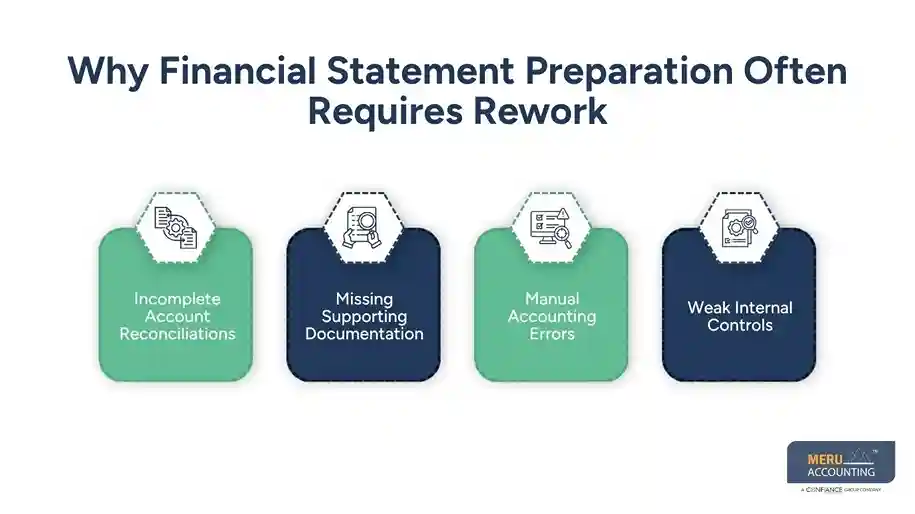
Manual Accounting Errors
Manual journal entries remain one of the most common sources of reporting adjustments.
Examples include:
- Duplicate transactions.
- Incorrect account coding.
- Data entry mistakes.
- Wrong reporting periods.
- Misclassified expenses.
- Calculation errors.
Each correction increases the amount of work required before statement preparation can be completed.
Regular reviews performed through financial audit identify these issues much earlier in the accounting cycle.
Weak Internal Controls
Internal controls help ensure accounting activities follow approved procedures.
Without effective controls:
- Transactions may be approved incorrectly.
- Expenses may be recorded twice.
- Unauthorized adjustments may occur.
- Documentation may become inconsistent.
These weaknesses often result in multiple audit findings and additional reporting adjustments.
Strong financial audit support strengthens review procedures and encourages consistent accounting practices across departments.
optional anymore
on running the business
How Financial Audit Support Improves Financial Statement Preparation
The greatest benefit of financial audit is preventing problems before they affect reporting. Instead of correcting errors after financial statements have been drafted, businesses improve the quality of accounting records throughout the reporting cycle.
Early Identification of Accounting Issues
One major advantage of financial audit is continuous review of financial information.
Finance professionals regularly examine:
- Ledger balances.
- Supporting schedules.
- Journal entries.
- Account reconciliations.
- Variance reports.
Small discrepancies are identified quickly before they develop into larger reporting issues.
This proactive review significantly reduces rework during statement preparation because fewer corrections remain outstanding at period-end.
Better Documentation Throughout the Year
Financial reporting depends heavily on supporting evidence.
Rather than collecting documents shortly before an audit, businesses using financial audits organize records continuously.
Examples include:
- Vendor invoices.
- Customer agreements.
- Bank confirmations.
- Tax documents.
- Fixed asset records.
- Payroll reports.
- Contract documentation.
Proper documentation allows finance teams to complete statement preparation more efficiently because supporting information is immediately available whenever questions arise.
Improved Account Reconciliations
Accurate reconciliations form the foundation of reliable financial reporting.
Financial audit support encourages businesses to reconcile important accounts on a monthly basis rather than waiting until year-end.
Regular reconciliations help identify:
- Outstanding transactions.
- Duplicate entries.
- Recording errors.
- Timing differences.
- Missing adjustments.
As reconciliation quality improves, financial statement preparation becomes faster, more accurate, and far less stressful.
Strengthening Internal Controls
Internal controls help businesses maintain reliable accounting records throughout the financial year. Strong review procedures reduce mistakes before they appear in reports. A financial audit helps management verify that accounting activities follow established policies and approval processes.
Some important internal control practices include:
- Reviewing journal entries before posting.
- Separating accounting responsibilities.
- Monitoring unusual transactions.
- Performing regular management reviews.
- Maintaining approval records.
- Restricting unauthorized system access.
When these controls operate consistently, financial statement preparation becomes smoother because fewer reporting adjustments are required.
Better Compliance with Accounting Standards
Financial reporting must comply with applicable accounting standards and regulatory requirements. Incorrect accounting treatment can lead to significant adjustments during an audit.
A financial audit helps businesses review accounting policies regularly and verify that transactions are recorded correctly. This includes reviewing revenue recognition, expense allocation, depreciation methods, accruals, and financial disclosures.
Maintaining compliance throughout the reporting cycle reduces the likelihood of last-minute corrections during statement preparation.
Best Practices to Reduce Rework During Financial Statement Preparation
Reducing rework requires consistent accounting discipline rather than additional work at year-end. Businesses that follow structured financial processes usually complete reporting more efficiently.
Maintain Monthly Closing Procedures
Many reporting problems begin with delayed month-end activities. Waiting until year-end to review transactions creates unnecessary pressure on finance teams.
An effective monthly closing process should include:
- Completing bank reconciliations.
- Reviewing general ledger balances.
- Recording accruals.
- Clearing suspense accounts.
- Reviewing unusual transactions.
- Updating supporting schedules.
Regular financial audits encourage businesses to complete these activities every month, reducing reporting challenges later.
Standardize Financial Documentation
Well-organized documentation saves valuable time during reporting and auditing.
Businesses should maintain consistent records for:
- Purchase invoices.
- Customer invoices.
- Loan agreements.
- Payroll records.
- Tax filings.
- Fixed asset registers.
- Inventory reports.
- Bank statements.
When documents remain organized throughout the year, statement preparation requires fewer interruptions because supporting evidence is already available.
Review Financial Reports Before the Audit
Internal financial reviews identify reporting issues before auditors begin their examination.
Management should review:
- Balance sheet schedules.
- Income statement trends.
- Cash flow movements.
- Significant journal entries.
- Related-party transactions.
- Variance reports.
Regular financial audit support helps businesses perform these reviews systematically, reducing the number of audit adjustments later.
Use Experienced Accounting Professionals
Complex accounting transactions often require technical expertise. Experienced accounting professionals understand reporting standards, documentation requirements, and audit expectations.
A professional financial audit helps businesses interpret accounting guidance correctly while reducing the risk of reporting errors. This allows internal finance teams to focus on business operations instead of correcting avoidable mistakes.
Why Businesses Choose Meru Accounting for Financial Audit Support
Effective financial reporting depends on accurate accounting records and organized documentation. Meru Accounting helps businesses strengthen their reporting processes through reliable financial audit support tailored to different industries and business sizes.
Businesses choose Meru Accounting because we provide:
- Experienced accounting and audit professionals.
- Structured financial review processes.
- Assistance with reconciliations and documentation.
- Support for financial statement preparation.
- Understanding of accounting standards and compliance requirements.
- Timely responses that support during audit engagements.
- Practical guidance that is sensible and helps improve internal financial processes.
Our professionals work closely with finance teams to improve reporting quality, reducing unnecessary issues. Whether your business is preparing for an annual audit or strengthening internal reporting processes, we provide dependable support with utmost efficiency.
From Our Expert Perspective
From our experience, most delays in reporting don’t start during the audit—they begin months earlier when things like reconciliations, paperwork, and transaction checks are put off. Many businesses focus on finishing financial statements quickly instead of fixing the accounting process behind them. Regular financial audit support helps finance teams spot small problems before they turn into big issues. Companies that review their records all year usually have fewer audit changes, better compliance, and faster financial reporting. Good reports come from organized accounting work, not last-minute fixes.
Key Takeaways
- Financial audit support helps reduce reporting errors before audits begin.
- Regular reconciliations improve statement preparation.
- Organized documentation reduces time spent locating records.
- Strong internal controls improve financial reporting accuracy.
- Monthly financial reviews prevent year-end reporting challenges.
- Expert accounting professionals improve reporting quality.
FAQs
Financial audit support means preparing reconciliations along with organizing documents and reviewing accounting records. It is very useful for businesses to keep their financial information accurate.
It catches accounting mistakes early, improves paperwork, strengthens reconciliations, and ensures compliance. It helps reduce paperwork and helps with further processes.
Rework mostly happens because of incomplete reconciliations, documents that are missing, with some manual errors, and also with inconsistent accounting methods.
Most should review reconciliations, schedules, and reports every month. Regular checks help at various levels and also with deadlines.
Yes. Experienced accountants can support audits by reviewing records, fixing discrepancies, and helping throughout the reporting and audit process.
optional anymore
on running the business