The mining sector runs on high-value projects, strict compliance needs, and complex cost structures. In such a setup, accounting for mining companies becomes a core part of financial control and long-term planning. Many firms are now moving toward external financial teams to manage records, reporting, and compliance tasks with better accuracy.
Accounting for mining companies is not only about recording transactions. It includes cost tracking of extraction, equipment use, site operations, labor allocation, and environmental reporting. When handled with care, it gives clear insight into profit flow and risk points.
In recent years, firms have started to rely on structured mining accounting practices supported by outsourced experts to manage rising reporting needs and global standards.
What You Will Learn From This Blog
- How accounting for mining companies works in complex mining operations
- Why internal systems often fall short in mining finance work
- Key benefits of outsourcing financial processes
- How compliance and tax rules are managed in mining finance
- Role of ERP tools in modern mining accounting
- Importance of ESG and sustainability reporting in mining finance
- How Meru Accounting provides structured financial support
Introduction To Accounting For Mining Companies
Accounting for mining companies involves managing highly detailed financial processes due to the complex nature of mining operations. These include tracking extraction costs, machinery usage, transport, and labor expenses across multiple sites and project stages.
Since costs differ based on location and production phase, mining accounting relies on structured cost centers to ensure accurate allocation and a clear view of project profitability rather than broad estimates.
Revenue recognition in mining projects is also more structured compared to many other industries. Income may come from raw mineral sales, long-term supply agreements, or contract-based deliveries, which makes timing and recognition critical. Accounting for mining operations ensures revenue is recorded in line with production cycles and contractual terms, reducing mismatches between actual output and reported financial results.
In addition, Mining business accounting covers asset and equipment management, financial risk monitoring, and reporting control. Heavy machinery and long-life assets are tracked for depreciation, maintenance schedules, and replacement planning to avoid unexpected losses.
At the same time, financial risks such as commodity price changes, weather disruptions, and regulatory updates are monitored through forecasting models. Strong systems in this area also ensure accurate reporting for investors and regulators by maintaining clear, well-documented financial records that improve trust and compliance.
Why Traditional Mining Accounting Systems Often Fall Short
Manual Data Handling Errors
Traditional systems depend heavily on manual entry, which increases the chance of small mistakes in large mining datasets. In mining business accounting, these small errors can grow into major financial gaps due to the scale of operations.
Lack of Real-Time Financial Data
Many older systems do not provide instant updates across mining sites, which creates delays in financial visibility. This slow flow of information makes it harder to react quickly to changes in production costs, equipment usage, or site-level spending, leading to less accurate day-to-day financial control.
Poor Integration With Site Operations
Mining sites often operate in remote areas where field data is not properly linked to finance systems. This creates gaps in mining accounting and leads to incomplete or delayed reporting.
High Internal Cost Structure
Running a full in-house finance team increases fixed expenses due to salaries, software tools, training, and compliance requirements, which is a common challenge in accounting for mining companies with multi-site operations.
Over time, maintaining a large internal setup becomes costly, especially for operations spread across multiple mining sites with complex reporting needs.
Limited Compliance Tracking
Traditional systems often fail to keep up with changing tax, safety, and environmental rules. In mining business accounting, this increases the risk of penalties and reporting issues.
Major Benefits of Outsourced Accounting For Mining Companies
Lower Operational Costs
Outsourcing reduces the need for large internal finance teams. With accounting for mining companies, firms only pay for required services, which lowers fixed costs. Mining accounting becomes more flexible and budget-friendly.
Access To Skilled Experts
Outsourced teams bring industry-specific knowledge. Accounting handled by experts improves accuracy in financial data processing, reporting consistency, and cost classification. This is especially important in mining operations, where rules vary across regions.
Improved Internal Reporting Accuracy
External teams use structured review systems and standardized processes to ensure day-to-day financial data is recorded correctly. This strengthens internal reporting accuracy, helping management track costs, production expenses, and profitability more reliably.
Stronger Compliance And Audit Readiness
Outsourced accounting ensures financial records are well-organized, properly documented, and aligned with regulatory standards. This makes audits smoother and reduces the risk of compliance issues, penalties, or reporting delays.
Clear Investor And Stakeholder Reporting
Accurate financial reporting helps mining companies communicate performance clearly to investors, lenders, and stakeholders. Structured reports improve transparency and support better decision-making for funding and long-term partnerships.
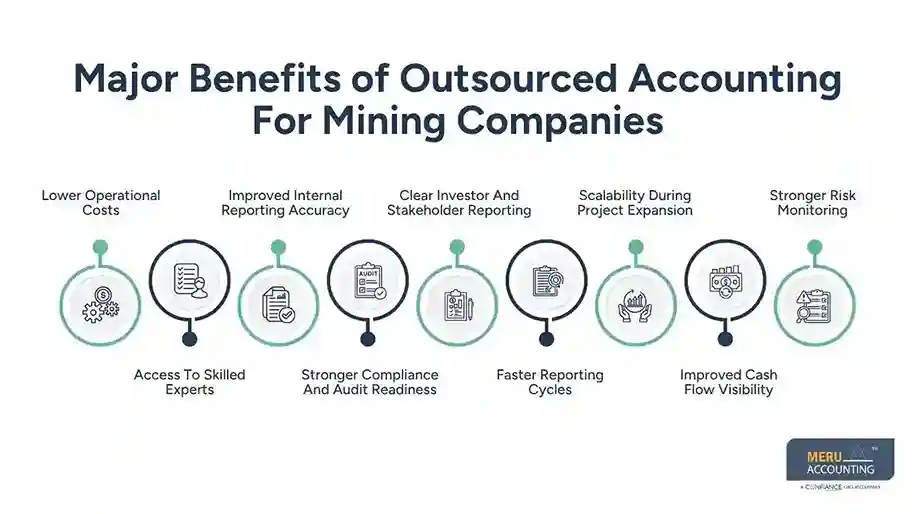
Faster Reporting Cycles
Outsourced systems often use automated tools. This helps deliver faster monthly and quarterly reports. Quick reporting supports better decision-making across mining operations.
Scalability During Project Expansion
Mining projects expand and contract over time. Outsourced support adjusts easily to project size, avoiding hiring delays and training costs during different production phases.
Improved Cash Flow Visibility
Clear tracking of inflows and outflows helps improve financial planning. Mining firms can better manage liquidity across multiple sites and long production cycles.
Stronger Risk Monitoring
Outsourced teams help identify financial risks such as commodity price fluctuations, operational disruptions, and cost overruns. This supports better forecasting and financial stability.
How Mining Accounting Supports Regulatory And Tax Compliance
Global Tax Rule Management
Mining firms operate across multiple countries with varied tax systems. Accounting systems ensure accurate handling of all regional tax obligations. Experts manage filings according to local rules and deadlines efficiently.
Audit Ready Financial Records
Regulators often require detailed audits for compliance and verification purposes. Proper systems ensure records remain clean, structured, and fully organized. This reduces audit delays, penalties, and potential compliance-related risks.
Environmental Reporting Compliance
Mining firms must report environmental impact. In mining accounting, financial systems include cost tracking for environmental activities, ensuring compliance with sustainability laws.
Accurate Royalty Calculations
Governments charge royalties on mineral extraction based on production volumes. Accounting for mining companies ensures precise royalty calculation and reporting. Errors in mining business accounting can lead to serious legal issues.
Transparent Investor Reporting
Investors require clear and accurate financial data for decision-making. Structured reporting builds trust through reliable and transparent financial insights. Accurate systems support investor confidence and long-term business growth.
Integration of ERP Systems With Outsourced Mining Accounting Services
Centralized Data Management
ERP systems collect data from all departments across mining operations. This creates a single unified source of financial and operational information.
Real-Time Financial Tracking
Modern ERP systems record and update financial data instantly across connected mining sites and departments. This gives teams a clear view of current costs, production value, and cash flow without waiting for manual updates or batch reports.
Automation of Routine Tasks
Tasks like payroll, invoicing, and reconciliations can be automated efficiently, reducing manual effort in accounting for mining companies and improving processing speed.
In mining business accounting, automation reduces manual workload and improves processing speed.
Better Coordination Between Teams
ERP systems connect finance departments with mining operations seamlessly. This ensures financial data reflects real site activities and operations.
Data Security And Control
Mining firms handle highly sensitive financial and operational information daily. ERP systems strengthen security and restrict unauthorized access to financial records.
How Accounting For Mining Companies Enhances Sustainability Reporting And ESG Compliance
Tracking Environmental Costs
Mining operations impact land, water, and natural resources significantly. Financial systems track environmental spending such as land restoration and waste control.
Social Responsibility Reporting
Companies must report community impact and workforce development activities clearly. Financial records include social programs and employee welfare spending details.
Governance Transparency
Strong reporting builds trust with stakeholders and regulatory authorities. Financial systems ensure clear disclosures that support governance standards effectively.
Carbon Emission Cost Tracking
Carbon reporting has become a key requirement for mining firms globally. Accounting systems track emission-related costs and environmental compliance expenses accurately.
Investor ESG Requirements
Accounting for mining companies helps investors evaluate ESG performance effectively. Structured reporting ensures accurate sustainability data for better investment decisions.
Meru Accounting Support For Mining Companies
Meru Accounting provides structured financial services designed for industries with complex operations like mining.
We specialize in providing outsourced financial systems for mining companies, helping reduce internal workload and improve reporting accuracy. Our team manages financial processes with a strong focus on compliance, cost tracking, and overall financial clarity.
Our services include:
- Project-based cost tracking for mining sites
- Tax and compliance support across regions
- ERP integration for real-time reporting
- Audit preparation and documentation control
- ESG and sustainability financial reporting
With strong experience in the mining industry, Meru Accounting supports accounting for mining companies through clear records, better control, and long-term financial planning. Our approach is built to support accuracy, control, and long-term financial planning.
Our Expert Perspective
From our perspective, outsourced accounting is becoming essential for mining companies due to the complexity of multi-site operations and strict compliance requirements. It helps improve financial accuracy, cost control, and timely reporting across all mining activities.
With structured mining accounting systems and ERP integration, companies gain real-time visibility and better decision-making support. Overall, accounting for mining companies is most effective when handled through expert-driven, scalable financial processes.
Key Takeaways
- Accounting for mining companies is complex due to multi-site operations and high-value assets
- Traditional systems often fail in accuracy and speed
- Outsourcing improves cost control and reporting quality
- ERP integration strengthens real-time financial tracking
- ESG reporting is now a key part of mining finance
- Structured systems reduce risk and improve investor trust
FAQs
Financial records should be updated regularly, often daily or weekly, to keep project costs and income accurate and under control.
Mining accounting is needed to manage complex costs, equipment tracking, and compliance with tax and safety rules.
Outsourcing reduces cost, improves accuracy, and gives access to skilled finance experts for mining operations.
Key data includes production costs, equipment usage, labor expenses, sales records, and compliance-related spending.
Yes, modern accounting for mining companies includes environmental and social reporting for compliance and investors.