
Travel agency accounting plays a key role in keeping travel businesses financially stable and accurate. Every booking, cancellation, supplier bill, and commission must be tracked with care. Without proper systems, small mistakes can quickly grow into larger financial issues.
In the travel industry, transactions happen across multiple channels such as online bookings, agents, and direct customers. This makes financial management more complex than in many other service sectors. Many agencies also struggle with delayed reconciliations and unclear cash flow visibility.
This is where structured travel accounting practices and skilled outsourced teams bring value. They bring discipline in recording, checking, and reporting financial data, which helps agencies maintain clean books and better financial control.
What You Will Learn From This Blog
- Key financial challenges faced in travel agency accounting
- How booking complexity affects financial records in travel accounting
- Common issues in payments, refunds, and vendor settlements
- How outsourced teams manage accounting tasks with accuracy
- Why structured systems are important for travel business growth
- Role of automation in modern accounting systems
- Important KPIs that help monitor financial health
- How firms like Meru Accounting handle travel financial operations
Understanding Travel Agency Accounting and its Importance For Business Growth
Travel agency accounting deals with many moving parts such as ticket sales, hotel bookings, tour packages, and service fees. Each transaction follows different timing rules and conditions, which makes recording more complex when systems are not properly structured. The variation in booking cycles and payment schedules often increases the need for careful tracking and organized financial records.
Revenue in this sector comes from multiple sources, including commissions, markups, and service fees. Accurate revenue tracking ensures agencies understand real earnings instead of estimated figures. Clear financial records also support better business decisions related to pricing, vendor selection, and service expansion, since owners can rely on real data rather than assumptions.
At the same time, compliance requirements must be followed, especially when dealing with international clients and different tax structures across regions. Maintaining proper records also improves cash flow visibility, since customer payments and supplier payouts often do not align in timing. Strong financial tracking helps ensure smoother operations and reduces uncertainty in daily financial management.
Common Travel Agency Accounting Challenges Businesses Face
Managing Multiple Revenue Streams And Booking Transactions
Travel agency accounting becomes complex when revenue comes from flights, hotels, packages, and add-on services. Each stream has different billing rules and timelines, making tracking difficult.
Tracking Customer Payments, Refunds, And Cancellations
In travel accounting, cancellations and refunds are common. If not recorded correctly, agencies may show incorrect profit figures or face reconciliation issues.
Handling Vendor Payments And Supplier Reconciliations
Agencies often work with airlines, hotels, and tour providers. In financial management for travel businesses, delayed vendor reconciliation can create mismatched financial records and disputes.
Managing Commissions And Agent Settlements
Commission structures differ across partners. Travel accounting requires proper tracking of agent payments to avoid overpayment or underpayment errors.
Maintaining Accurate Financial Records
Incomplete or delayed entries in financial records for travel businesses can lead to reporting gaps. This affects both tax filing and internal financial planning.
How Outsourced Accounting Teams Solve Travel Agency Accounting Challenges
Improved Financial Record Management
Outsourced professionals update travel agency accounting records in real time using structured workflows. This approach reduces errors while improving data consistency across systems. Faster reporting cycles also support better financial decision-making for management.
Reducing Errors in Bookkeeping And Reporting
High transaction volumes in travel operations often lead to manual errors in bookkeeping within travel accounting systems.
Standardised review systems help minimise discrepancies and improve overall accuracy in financial reporting. Strong process controls also enhance financial visibility and stability.
Streamlining Accounts Payable and Receivable Processes
Structured scheduling of payables and receivables improves clarity in payment management. Better organization of cash inflows and outflows strengthens cash flow visibility across business operations. Improved planning also supports smoother financial execution during peak seasons.
Ensuring Timely Financial Reporting
Faster closing cycles enable travel agencies to access financial reports without delays. Real-time reporting improves responsiveness to business changes and operational demands. Better reporting speed also helps management make quicker, data-driven decisions.
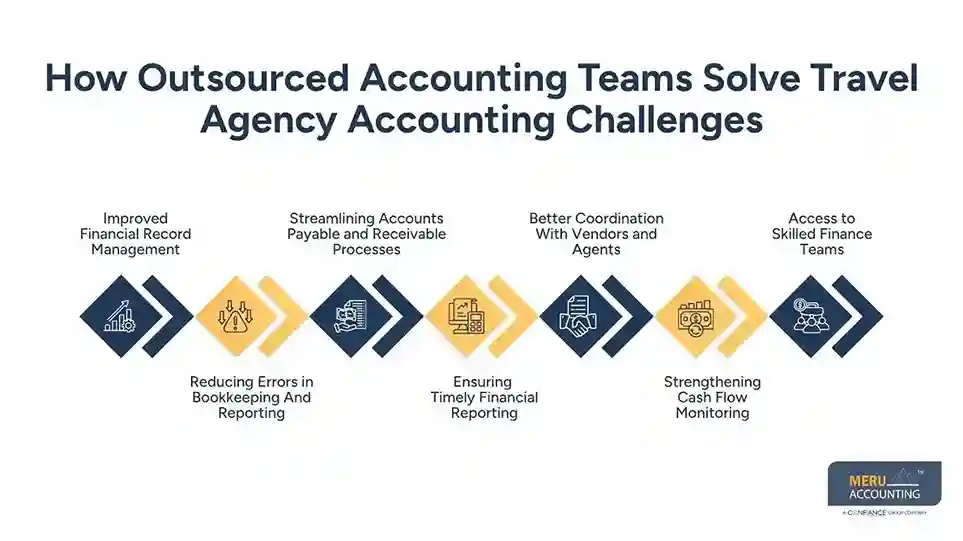
Better Coordination With Vendors and Agents
Communication between agencies and vendors becomes smoother when accounting tasks are handled by experienced professionals who understand industry flow and transaction patterns.
Strengthening Cash Flow Monitoring
Continuous tracking of cash inflows and outflows improves liquidity management. Better financial visibility reduces uncertainty in day-to-day operations. Scalable monitoring systems also support business growth during expansion phases.
Supporting Audit Preparation and Compliance
Proper documentation and organized records make audits easier to manage. Outsourced teams maintain structured files that help reduce delays during compliance checks and financial reviews.
Why Outsourcing Travel Agency Accounting is a Smart Business Decision
Cost Control And Resource Savings
Maintaining an internal finance team can be expensive. Outsourcing financial operations reduces staffing costs and infrastructure needs. This allows agencies to manage expenses better without affecting daily service quality.
Access To Skilled Accounting Professionals
External teams specializing in travel accounting bring experience from multiple travel businesses.
This helps improve accuracy, reporting quality, and financial structure. Agencies benefit from industry knowledge without spending time on long hiring processes.
Scalability During Peak Travel Seasons
Travel demand fluctuates throughout the year. External accounting teams adjust workloads based on booking volume without affecting performance. This ensures smooth financial operations even during busy travel periods.
Reduced Internal Workload
Agency owners can focus on customer service while financial tasks are managed externally, reducing operational pressure. This also helps internal staff spend more time on sales and client support activities.
Improved Financial Transparency
Clear reports make it easier to track profit, loss, and cash flow at any time. Better visibility into financial data helps management make faster and more informed decisions.
Role of Automation in Modern Travel Agency Accounting Systems
Automated Booking Integration
Modern travel agency accounting systems connect directly with booking platforms, reducing manual entry work. Direct integration ensures every booking is captured without delays or missed entries.
Real-Time Transaction Recording
Automation ensures that financial entries are recorded immediately after booking confirmation. Faster recording improves overall speed and keeps financial data consistently updated.
Error Reduction In Data Entry
Automated systems reduce manual workload and improve consistency in financial records. This leads to higher accuracy while freeing up time for analysis and strategic planning.
Faster Reconciliation Process
Automation speeds up reconciliation by matching transactions automatically across systems. This reduces month-end delays and improves reporting efficiency, allowing businesses to close books faster and more accurately.
Better Financial Reporting Accuracy
By eliminating duplicate entries and missing data, automation enhances report reliability. This improves visibility into financial performance and supports more confident business decision-making.
Key Financial KPIs Every Travel Agency Should Monitor
Revenue Per Booking
This KPI in financial management for travel businesses helps measure average income per transaction. Higher values often indicate stronger pricing efficiency and better package structuring.
Customer Acquisition Cost
In financial tracking for travel operations, tracking cost per customer helps control marketing expenses. Lower acquisition cost reflects improved spending efficiency across marketing channels.
Refund And Cancellation Rate
High refund rates in financial management for travel businesses may indicate service or pricing issues. Consistent monitoring helps identify booking gaps and improve overall service quality.
Vendor Payment Cycle
Monitoring payment cycles ensures smooth supplier relationships in travel accounting. Timely settlements help maintain trust with airlines, hotels, and tour providers.
Net Profit Margin
This KPI reflects overall financial health in travel agency accounting and helps in long-term planning. Stable margins indicate balanced cost control and sustainable business performance.
Why Choose Meru Accounting For Travel Agency Accounting
Meru Accounting provides structured financial services designed specifically for travel businesses. With experience in handling global clients, our team understands the complexity of travel agency accounting and delivers accurate, timely reporting.
Our services include:
- End-to-end travel accounting management
- Booking, refund, and commission tracking
- Vendor reconciliation and payment control
- Monthly financial reporting and KPI dashboards
- Integration with tools like QuickBooks, Xero, and Odoo
Meru Accounting focuses on reducing errors in travel agency accounting and ensuring that travel businesses maintain clean financial records for better decision-making and compliance.
Our Expert Perspective
In our experience working with travel businesses, the most common issue in travel agency accounting is not a lack of effort, but a lack of structure. When booking volume increases, manual systems fail to keep up.
We have seen that agencies using organized travel accounting systems experience fewer disputes with vendors and faster month-end closing. The key is consistency in recording every transaction, no matter how small.
Outsourced teams bring discipline, but success depends on clear communication between agency staff and accounting professionals. When both sides work with the same data structure, financial clarity improves significantly.
Key Takeaways
- Travel agency accounting becomes complex due to multiple revenue streams
- Errors often occur in refunds, commissions, and vendor payments
- Outsourced teams bring structure and accuracy to travel accounting
- Automation reduces manual errors and speeds up reconciliation
- KPIs help track financial health and business performance
- Clean financial records support better business decisions
FAQs
The biggest risk is incorrect tracking of payments, refunds, and costs, which can lead to wrong profit reporting and cash flow gaps in one line.
Small businesses can use simple accounting tools and clear task division to record and monitor transactions properly without needing large teams in one line.
Cash flow tracking is important because it ensures enough money is available for daily operations, supplier payments, and seasonal demand changes in one line.
Yes, automation reduces manual entry work and improves accuracy in recording and reporting financial data.
Invoices, booking confirmations, supplier bills, refund records, bank statements, and commission sheets are needed to keep financial tracking clear and organized in one line.