Accounting for realtors plays a key role when a large part of the business is run from home. Realtors may use a home office for calls, listing work, client emails, record-keeping, lead follow-up, and deal tasks. These costs can build up over a full year.
Realtor accounting services can help organize these costs and keep records ready for tax work. It can also give realtors a clearer view of where business money goes. Proper records are also useful when a tax return needs support.
The IRS has rules for claiming business use of a home. In general, a qualifying space must meet specific use tests, and some home costs must be split between business and personal use. The rules can vary based on the realtor’s facts, business setup, and tax method.
Accurate accounting for realtors is not about claiming every cost linked to a home. The goal is to find costs that have a valid business purpose, record them with care, and keep proof for later review.
What You Will Learn From This Blog
- Understand how home office rules can apply to realtors.
- Identify which home costs may qualify as business expenses.
- Learn practical ways to track realtor home office expenses each month.
- Understand why accurate records matter during tax filing.
- Know when realtor accounting services can be useful for managing business finances.
- Follow accounting for realtors practices that can reduce errors and keep financial records organized.
- See how Meru Accounting can manage routine accounting and bookkeeping needs.
Accounting For Realtors: Understanding Home Office Expenses
Know The Home Office Rule
Accounting for realtors should begin with the basic home office rules. A space used for business often needs regular and exclusive business use to qualify, although certain exceptions exist under tax rules.
A room used only for business is easier to review than a space used for work and family needs. Realtors should check their exact situation before claiming a home office deduction.
Keep Business Use Clear
A home office should have a clear business role. A realtor may use the space for client calls, listing work, paperwork, bookkeeping, scheduling, and other office tasks.
A desk in a room used for many personal activities may create a different tax result. Keep the work area clearly defined when possible.
Know Direct Costs
Direct costs are costs tied only to the business part of the home. For example, a repair made only to the office may have a different treatment from a repair made across the full house.
Proper accounting for realtors records each cost with the bill, date, amount, and business reason for the purchase.
Review Shared Costs
Some costs serve both the home and the business. Utilities, insurance, rent, and certain repairs may need to be divided between business and personal use.
The business share should come from a clear method rather than a rough guess. Realtor accounting services can help maintain the calculations and supporting records used for shared costs.
Compare Available Methods
Qualifying taxpayers may use either the regular method or the simplified method for a home office deduction. The simplified method uses a set amount per square foot, subject to a space limit.
The regular method requires more records but may give a different result. Compare the available methods before choosing one for the tax year.
Which Home Office Expenses Can Realtors Deduct?
Rent And Housing Costs
Rent may form part of the home office calculation when the required tax tests are met. Realtors should not treat the full rent payment as a business cost without applying the proper allocation.
Clear realtor home office expenses records can help realtor accounting services track how the business portion was worked out.
Utilities And Internet
Electricity, heating, and similar home costs may have a business share when the office qualifies. Internet costs may also need to be divided when the service has both business and personal use.
Keeping monthly bills organized can simplify accounting for realtors and make the yearly expense review easier.
Office Repairs
A repair made only to the business area may be treated differently from a repair made to the whole home. The nature of the repair matters when sorting the cost.
For realtor home office expenses, note what was repaired and whether the work was limited to the office.
Furniture And Equipment
A desk, chair, monitor, printer, or other work item may qualify as a business cost when used for the real estate business. Larger purchases may have special tax treatment.
Record the purchase date, amount, and business purpose. Keep the receipt with the entry.
Insurance And Maintenance
Certain home insurance and maintenance costs may form part of the business-use calculation. The amount that can be used depends on the facts and method chosen.
For accurate accounting for realtors, do not add a full household bill to the business books without checking its proper business share.
How To Track Realtor Home Office Expenses
Use A Business Account
A separate bank account makes accounting for realtors much cleaner. Business income and costs can be kept apart from family spending and other personal payments.
A business card can also make monthly reviews easier. Each purchase should still have a clear business reason.
Save Digital Receipts
Paper receipts can fade or get lost. Digital copies can be stored by month or expense type and matched with bank entries.
For realtor home office expenses, keep the receipt, payment record, and short business note together where possible.
Measure Office Space
Keep the size of the home and office on record. A realtor may need these figures when working out the business portion of shared home costs.
For example, a 200-square-foot office in a 2,000-square-foot home represents 10% of the total area. The actual tax result depends on the applicable rules and facts.
Record Costs Each Month
Monthly tracking is one of the simplest accounting habit for realtors to maintain. Enter bills soon after payment instead of waiting for the end of the year.
A monthly review can also reveal missing receipts, duplicate entries, or costs placed in the wrong account.
Keep A Tax-Year Folder
Create a separate folder for each tax year. Add receipts, bills, office measurements, bank records, and notes about unusual costs.
Organized records make accounting for realtors easier when reviewing home office expenses and preparing tax documents.
How Realtor Accounting Services Help Manage Business Expenses
Keep Books Current
Realtor accounting services can record income and costs on a regular schedule. Current books give realtors a better view of sales income, operating costs, and cash needs.
A clean monthly process also reduces the work left for tax season.
Sort Costs Correctly
Costs should be placed into clear and separate categories. Advertising, software, travel, office supplies, professional fees, and home office costs should not all sit under one account.
Clear categories make financial reports easier to read and review.
Review Expense Records
A structured approach to accounting for realtors includes checking receipts against recorded transactions. Missing documents can be found before the tax return is prepared.
Regular checks are more useful than a large cleanup done once a year.
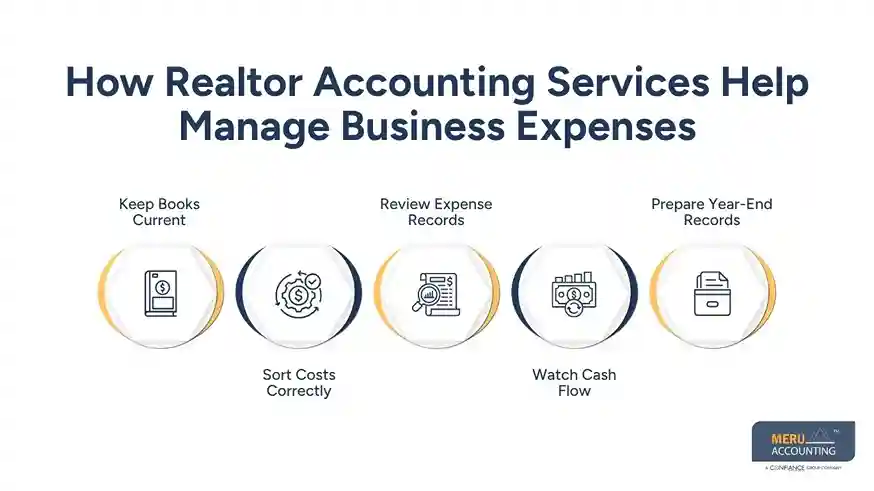
Watch Cash Flow
Commission income may change from month to month. Tracking when money comes in and when major costs need to be paid can help maintain better control.
That view can help a realtor plan for taxes, marketing, software, insurance, and other bills.
Prepare Year-End Records
Realtor accounting services can keep financial records ready for tax preparation. A year-end file may include income reports, expense details, bank records, and home office information.
That can make discussions with a tax preparer more direct and easier to manage.
optional anymore
on running the business
Common Home Office Accounting Mistakes Realtors Should Avoid
Mixing Personal Spending
Mixing personal and business payments makes accounting for realtors harder. It may also make it difficult to identify the true business amount of a shared cost.
Use separate accounts and keep personal purchases out of the business books.
Claiming Full Home Costs
A realtor should not assume that the full household bill is deductible because work takes place at home. Shared costs usually need a proper business-use calculation.
Good records should show how each amount was determined.
Using Rough Estimates
Guessing yearly costs can create weak records. A better approach is to keep actual bills and use a consistent method for shared costs.
The same approach should be used across the year unless facts change.
Ignoring Space Rules
A room called an office does not automatically qualify for a home office deduction. The way the space is used matters.
Realtors should review the use of the room before including realtor home office expenses in a tax calculation.
Waiting Until Tax Time
Waiting until tax season can lead to missing receipts and unclear bank entries. It can also make accounting for realtors much more time-consuming.
Using realtor accounting services for monthly bookkeeping gives enough time to identify and fix errors while records are still easy to find.
Best Accounting Practices For Realtors In 2026
Trust Accounting Features
Select software that separates client funds from operational accounts automatically. This ensures compliance with state bar rules and avoids fund misuse.
Automation Capabilities
Automated invoicing, payment tracking, and recurring reports reduce manual work. It also saves time and lowers the chance of human errors.
User-Friendly Interface
Solo attorneys may not be finance experts. Choose software that is easy to navigate and understand. A simple interface speeds up training and daily use for attorneys.
Compatibility
Ensure the software works with your existing practice management tools and devices. Compatibility reduces double entry and improves overall workflow efficiency.
Support and Updates
Reliable customer support and regular updates are crucial for staying compliant with changing tax laws. Prompt support ensures quick problem resolution when technical issues arise.
Reporting and Analytics
Look for features that provide clear, actionable insights into your law firm’s finances. Detailed analytics help attorneys make informed decisions and plan strategically.
Separate Business Money
Strong accounting for realtors starts with separate business banking. Use a business account for commission income and normal business payments.
Personal spending should remain outside the business books.
Review Books Monthly
Set one day each month for a basic books review. Check bank entries, credit card charges, receipts, income, and unpaid bills.
A steady routine can prevent small errors from growing into larger year-end problems.
Use Clear Categories
Create accounts that fit real estate work. Advertising, MLS fees, software, travel, office costs, client costs, and professional fees can each have a clear place.
Clear categories make financial reports more useful.
Review Home Office Costs
Review realtor home office expenses throughout the year instead of waiting for tax filing. Check office size, shared costs, receipts, and changes in the way the space is used.
Any major change should be recorded and reviewed before filing.
Get Tax Advice
Tax rules can vary based on business type, income, expenses, and home use. A qualified tax professional can review the facts before a deduction is claimed.
Accounting for realtors can keep the records ready, while a tax professional can address tax treatment.
Strengthen Your Realtor Accounting With Meru Accounting
Meru Accounting provides realtor accounting services designed for real estate professionals who need accurate books, organized records, and clear financial reports. Our team handles key tasks involved in accounting for realtors, including income recording, expense classification, account reconciliation, and routine bookkeeping.
We also organize realtor home office expenses and related records in a clear format, making it easier to review business costs throughout the year. Each transaction is recorded with the right category and supporting details to keep financial records consistent.
Our team can maintain your books on a regular schedule, so you do not have to spend valuable time sorting receipts or checking every transaction yourself. Regular bookkeeping also gives you a clearer view of income, expenses, and cash flow.
With reliable accounting for realtors, financial tasks can become part of a steady monthly process rather than a rushed year-end activity. Meru Accounting gives realtors the accounting support they need to keep their financial records organized while focusing on clients, listings, and sales.
Whether you work independently or manage a growing real estate practice, our team can adapt the bookkeeping process to your needs. The goal is simple: accurate records, timely reporting, and less administrative work for your business.
Our Expert Perspective
Our experience shows that accounting for realtors works best when home office costs are viewed alongside commission income, marketing, travel, client, and other business costs. Realtors should know which home expenses relate to their work, keep a clear basis for any business-use amount, and review spending against business activity. A clear view of these costs can make tax preparation easier while also showing where money is being spent and where future business costs may need closer attention.
Key Takeaways
- Realtors should keep business spending separate from personal spending as part of accounting for realtors.
- Home office costs should be tracked and reviewed each month.
- Realtors should save receipts, bills, and other proof for each expense.
- Office size and business-use details should be kept up to date.
- Shared home costs should be divided using a clear and consistent method for accurate accounting for realtors.
- Realtors should review the home office tax rules before filing.
- Available home office deduction methods should be compared before making a choice.
- Financial records should be kept organized and ready for tax review.
- Realtor accounting services can be useful when bookkeeping becomes difficult to manage.
- Realtor home office expenses should be reviewed carefully before the tax return is filed.
FAQs
Realtors may deduct eligible business-use portions of certain home costs when the required tax rules are met.
Realtors should record receipts, bills, office size, business-use amounts, and payment details throughout the year for consistent accounting for realtors.
Realtors may claim the eligible business portion of internet costs when the service is used for qualifying business work.
Realtors can use an approved method to calculate the business portion of eligible home costs under current tax rules.
Yes, separate business accounts make costs easier to record and review, supporting more accurate accounting for realtors.
optional anymore
on running the business