
Real estate firms deal with many money tasks every day, making accounting for realtors an important part of daily business operations, including property deals, agent commissions, client payments, taxes, and expense tracking.
When these tasks grow, internal teams often face pressure and errors in records. In such cases, many firms now rely on structured external financial support and outsourcing real estate accounting services to manage their books in a better way.
This shift is not just about saving time. It is about improving accuracy, control, and long-term stability in financial work. Many real estate firms now treat financial management as a core part of business planning rather than only a back-office task. Because of this, structured external support has become a common choice for growing firms.
What You Will Learn From This Blog
- How real estate firms manage financial records in daily operations
- Why older methods of record keeping no longer meet current needs
- Main advantages of structured external financial support
- How financial delegation can support firm growth
- Key points to check before selecting a service partner
- Common risks and mistakes to avoid in financial delegation
- How Meru Accounting supports real estate firms with financial work
Understanding Accounting for Realtors in Real Estate Businesses
Real estate firms deal with frequent financial movements linked to property deals, client payments, deposits, commissions, and closing costs.
In accounting for realtors, every transaction needs to be recorded in a clear and structured way so that there is no confusion during reconciliation or reporting.
Since multiple deals often run at the same time, accounting for realtors becomes essential because even a small recording gap can create mismatches in financial records later.
Most realtor firms operate on a commission-based income model, which makes financial tracking more complex than fixed salary systems.
Income is not received in a steady pattern and depends on deal closures. Along with this, firms also manage various expenses such as marketing costs, travel expenses, office rent, and client-related spending.
All these costs must be recorded correctly to calculate true profit and maintain financial clarity, often achieved through outsourcing real estate accounting services
Real estate firms also need to follow strict tax reporting rules, where accurate income and expense records play an important role in avoiding penalties or filing errors.
Since each client deal has its own financial flow, managing multiple transactions at the same time becomes a detailed process. Keeping every client record organized helps maintain control, improve visibility, and reduce the chance of financial errors.
Why Traditional Accounting Methods are No Longer Enough for Realtors
High Volume Of Transactions
Manual spreadsheets struggle to handle frequent transactions in real estate firms, making accounting for realtors more difficult and leading to delays and errors. Frequent deal activity increases pressure on manual recording systems and reduces consistency in records.
Time-Consuming Processes
Old methods require more time for entry, checking, and correction of financial data. Extended manual effort slows down reporting cycles and delays financial review for decision-making.
Risk Of Human Error
Manual work increases the chances of missing entries or wrong calculations in commission-based income. Even small mistakes can affect payout accuracy and create reconciliation issues during audits.
Lack Of Real-Time Visibility
Firms often do not get updated financial status quickly when using outdated systems. Delayed reporting limits the ability to track performance and manage cash flow in real time.
Difficulty In Scaling Operations
As the firm grows, old methods cannot handle increased data volume efficiently. Expanding client bases and transactions create backlog risks and reduce overall financial control.
Key Benefits of Outsourcing Real Estate Accounting for Realtor Firms
Better Accuracy In Financial Records
External financial teams use structured accounting for realtors’ systems that reduce mistakes in recording transactions. Standardized review processes reduce the chances of missing entries during busy reporting cycles.
Cost Control And Resource Savings
Firms avoid hiring full-time internal staff for complex financial tasks by choosing outsourcing real estate accounting services instead. Lower staffing requirements help reduce overhead costs and improve budget control.
Clear Commission Tracking
Each agent’s commission is recorded in a proper format, reducing confusion. Transparent tracking systems also make payout reconciliation faster and more reliable.
Timely Financial Reports
Reports are prepared on fixed schedules, helping firms review performance regularly. Consistent reporting schedules allow better planning for upcoming deals and expenses.
Reduced Internal Workload
Internal teams in firms managing accounting for realtors can focus more on clients and sales instead of bookkeeping tasks. Reduced administrative pressure improves overall productivity and client response time.
How Outsourcing Real Estate Accounting Supports Business Growth
Strong Financial Planning Support
Clear records created through outsourcing real estate accounting help firms plan budgets and investments with greater clarity. Improved financial visibility allows better forecasting of upcoming costs and expected revenue patterns.
Improved Cash Flow Tracking
Firms practicing structured accounting for realtors can monitor incoming and outgoing funds more closely. Regular tracking of cash movement reduces payment delays and improves liquidity control.
Better Decision Making
Accurate accounting for realtors gives firms clear insight into profitable and weak areas. Accurate data allows owners to adjust pricing strategies and resource allocation with confidence.
Support During Expansion
When firms grow into new regions, external support helps manage increased data flow. Structured systems make it easier to handle new clients and higher transaction volume.
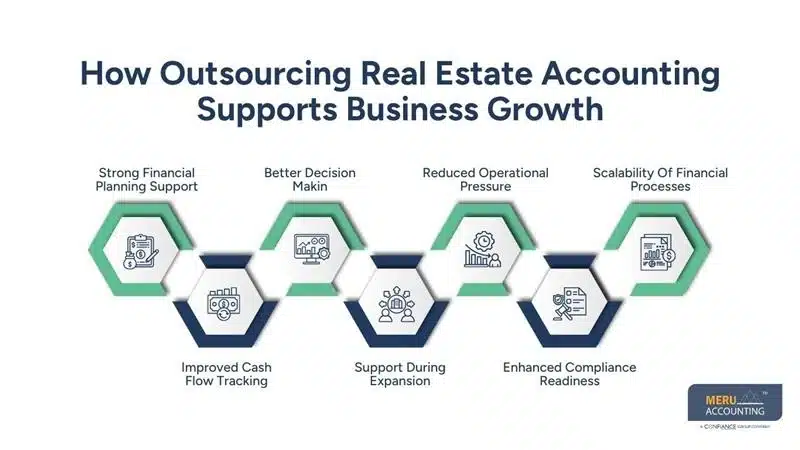
Reduced Operational Pressure
Teams experience less stress from financial backlogs and reporting delays. Workload balance improves focus on sales activity and client engagement.
Enhanced Compliance Readiness
Accurate records make tax filing and audit preparation more organized. Clean financial data reduces last-minute pressure during regulatory checks.
Scalability Of Financial Processes
Standardized systems adjust easily as transaction volume increases. Growing firms can maintain consistency in reporting without restructuring internal teams.
Choosing the Right Outsourcing Partner for Accounting For Realtors
Industry Experience In Real Estate
A service partner must understand accounting for realtors, including real estate transactions and commission systems. Practical experience with property deals reduces errors in the classification and reporting of financial entries.
Data Security And Privacy
Financial data must be protected using secure systems and access control. Strong encryption standards and restricted user access reduce the risk of data leaks or misuse.
Clear Communication System
Regular updates and simple reporting formats are important for smooth coordination. Structured communication channels reduce delays in resolving financial queries and corrections.
Use Of Modern Tools
Cloud-based systems improve tracking and reduce manual work. Automated data handling allows faster updates and better record accuracy across multiple client accounts.
Transparent Pricing Structure
Clear cost plans help firms avoid hidden charges. Defined pricing models allow better budgeting and reduce unexpected financial burdens for firms.
Risks to Avoid When Outsourcing Real Estate Accounting Services
Poor Data Handling Practices
Incorrect or unverified data entry can affect financial accuracy. Weak validation systems often lead to mismatched records during reconciliation and audit preparation.
Lack Of Regular Reporting
Without timely reports, accounting for realtors can become difficult, causing firms to lose track of their financial status. Delayed reporting reduces visibility on cash flow and can impact decision-making speed.
Weak Communication Channels
Poor communication can delay corrections and updates. Limited coordination between teams often results in repeated errors and slower resolution of financial issues.
Overdependence Without Review
Even when using outsourcing real estate accounting services, firms should still review reports instead of fully depending without checks. Regular internal review helps identify gaps and maintain control over financial outcomes.
Choosing Based On Low Cost Only
Very low pricing can lead to poor service quality and errors. Cost-focused selection often ignores experience, accuracy, and system quality.
Limited Data Security Measures
Weak security systems in outsourcing real estate accounting setups increase the risk of data exposure and financial misuse. Proper encryption, access control, and monitoring are essential for safe handling of sensitive records.
How Meru Accounting Supports Real Estate Firms
Meru Accounting provides structured financial support for real estate firms that deal with complex transactions and commission-based income models. The focus is on improving accounting for realtors by creating clear financial records and reducing manual workload for internal teams
Our team works with real estate businesses across different regions, helping them manage property-related financial entries, commission tracking, and expense reporting in a clear format. We follow organized systems that reduce errors and improve reporting speed.
We also support firms in tax preparation, monthly reporting, and financial review processes. This helps business owners understand their financial position without spending extra time on internal bookkeeping work. Our goal is to simplify accounting for realtors while giving firms more control over financial data.
Our Expert Perspective
From our experience working with real estate firms, outsourcing accounting is not just an operational choice but a strategic move toward better financial control. Effective accounting for realtors helps reduce errors in commission tracking, improves reporting consistency, and supports faster decision-making. With structured systems in place, firms gain clearer visibility into their cash flow and can focus more on growth than on manual bookkeeping tasks.
Key Takeaways
- Real estate firms handle complex financial transactions daily
- Manual methods are not enough for growing firms
- Structured external support reduces errors and saves time
- Clear financial reports help in better decision-making
- Choosing the right partner is important for safe financial handling
- Regular review of financial data is still necessary
FAQs
Real estate firms handle many transactions and commissions. External support helps keep records clear and updated.
Yes, if the provider uses secure systems and follows proper data protection rules.
Yes, even small firms benefit because accounting for realtors becomes more accurate, and workload is reduced.
Most firms review reports monthly, but some prefer weekly updates for better control.
The main benefit is better accuracy in records and more time for business growth activities.