
Industry accounting is different across sectors. Each business has its own way of handling money and records. That is why understanding the accounting procedure for each industry is important.
Every industry needs to maintain its books of accounts to know its financial position at the end of the year. Just like industries differ from one another, their accounting needs are also different and unique.
So, the accounting standards used for a start-up cannot be adopted for a tech firm or a manufacturing firm. That’s the reason that choosing an accounting firm in the accounting industry becomes very important for any industry.
What You Will Learn From This Blog
- How accounting procedures vary across different industries and why customization is necessary
- Why financial recording, reporting, and compliance differ based on unique business models
- The role of expert accountants in ensuring financial accuracy and maintaining proper records
- How professional accounting support improves business decision-making and financial planning
- Key accounting challenges faced by different industries in real-world scenarios
- Best practices for maintaining efficient, accurate, and well-organized financial systems
- How strong accounting processes contribute to better compliance and long-term business stability
What is an Accounting Procedure?
An accounting procedure is a step-by-step method used to record financial activities in an organized way. It includes processes such as data entry, posting transactions, making adjustments, and preparing reports.
In the accounting industry, these procedures are used to create accurate financial statements and reports for businesses. They also help in identifying errors and ensuring proper financial management. Accounting procedures are essential for audits, tax preparation, and effective financial planning.
Why is Industry Accounting Important?
- Within the accounting industry, every sector operates with different earning and spending patterns, making accounting essential for accurate financial management.
- Accounting tracks all financial activities, ensuring proper recording of income and expenses.
- Proper accounting supports accurate tax filing, smooth audits, and better business decision-making.
- Compliance with rules, regulations, and legal requirements becomes easier through structured accounting practices.
- Standardized accounting procedures ensure smooth, consistent, and efficient business operations.
Key Components of Accounting Procedure
Journal Entries
Record all financial transactions in chronological order. Forms the foundation of the accounting system.
Ledger Posting
Transfer journal entries into respective ledger accounts. Organizes transactions by account type for better clarity.
Trial Balance
Ensure that total debits equal total credits in the accounts. Helps verify the accuracy of bookkeeping records.
Adjusting Entries
Add entries for accruals, prepayments, and other adjustments. Ensures financial statements reflect the correct financial position.
Financial Statements
Prepare key reports like the income statement and balance sheet. Provides an overview of overall business performance.
Closing Entries
Close temporary accounts at the end of the accounting period. Resets accounts for the next financial cycle.
Audit Trail
Maintain a clear and traceable record of all financial transactions. Enables easy verification and review during audits.
optional anymore
on running the business
Industry Accounting Procedures for Different Industries
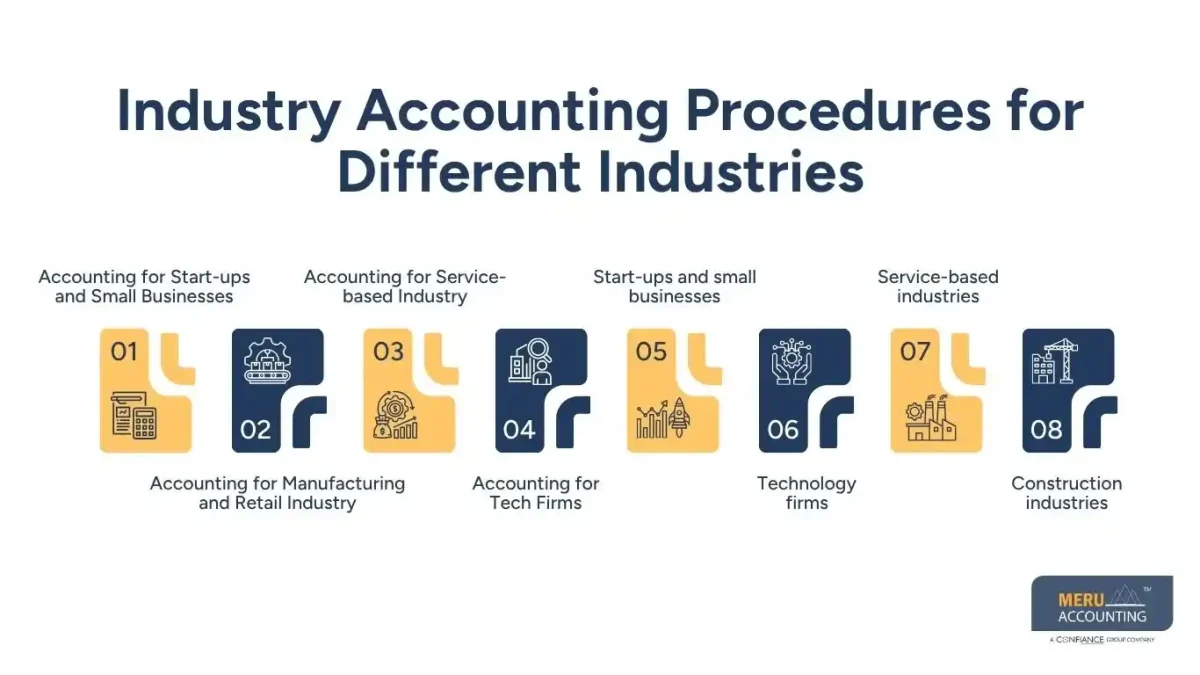
Accounting for Start-ups and Small Businesses
The major requirement for a start-up or a small business is the capital requirement. As it’s in a prior stage and a new business, sales, revenues, and expenses need to be tracked regularly. In short, maintaining capital flow in the business is a must for them, as that’s the way to their growth.
Accounting for Manufacturing and Retail Industry
For manufacturing and retail businesses, inventory management and control are the core requirements, as the whole business depends on those sources. As an accounting firm, we take care of this special need and deliver the best of our services.
Accounting for Service-based Industry
For a service-based business, accounts receivable and accounts payable, along with asset management, are important requirements. A proper accounting procedure ensures these elements are tracked and managed for smooth business flow.
Accounting for Tech Firms
Within the accounting industry, accounting for Tech Firms mainly focuses on payroll and operational costs as they often deal with intellectual property-driven businesses.
Accounting standards vary across industries based on business nature, but maintaining strong cash flow is essential everywhere. Each accounting procedure must be adapted to meet specific industry requirements while following core accounting principles.
Start-ups and small businesses
Start-ups, for instance, might require keeping a watch over the equity of the business owner. But a small business that began with the savings of a business owner would not at first have any investors. In the case of both cases, capital is critical for growth.
Technology firms
Technology firms may have fewer fixed assets to monitor because they conduct most of their work in the cloud or on computers. This implies that bookkeepers and accountants should concentrate more on overseeing working costs and the salaries of the employees.
Service-based industries
Service-based enterprises, for example, law companies, would spend additional time on making a collection of invoices that are not paid, and this would impact the processes of accounting and bookkeeping.
Construction industries
The construction industry is considered a sector that needs to account for a huge amount of money and various raw materials on the books. This implies that bookkeepers and accountants need to spend additional time handling inventory when compared to other industries. Another industry that invests additional time in the inventory could be wholesalers.
Apart from all the requirements stated, one thing that holds true for all industries is the need for steady cash flow. Without good cash flow, no industry can survive in the market. Thus, maintaining cash flow is a significant factor for any business in any industry.
Role of Expert Accountants In Financial Control
Transaction Recording Accuracy
Expert accountants ensure financial entries follow correct standards for recording. Accurate records reduce mismatches and keep financial information clear.
Compliance With Regulations
Tax rules guide how financial records are maintained in every business. Expert accountants ensure all processes follow updated legal requirements.
Financial Statement Preparation
Financial statements are prepared using structured reporting methods. These reports show true business performance for better decision-making.
Error Detection And Correction
Accountants regularly review records to find and fix mistakes. Early correction reduces risk and keeps data reliable.
System Integration Support
Modern tools in the accounting industry are used to automate financial recording and reporting. Digital systems reduce manual work and improve overall accuracy.
Best Practices in Industry Accounting
Use the Right Software
Select tools designed for your industry to track costs accurately and improve workflow efficiency. These systems also support faster reporting and reduce manual errors.
Train Your Team
Ensure staff understand accounting procedures properly, as proper training reduces errors and improves accuracy. Continuous learning also helps teams stay updated with changing standards.
Follow Tax Rules
Professionals in the accounting industry stay updated with the latest tax laws and regulations to avoid penalties and compliance issues. Regular monitoring of policy changes ensures smooth financial operations.
Keep Records Clear
Within the accounting industry, maintaining accurate and timely records of all transactions supports audits and financial reporting. Well-organized records also make data retrieval quick and simple.
Review Often
Check financial records on a regular basis, such as monthly reviews, to detect and resolve issues early. Frequent reviews also help improve financial planning and control.
Protect Your Data
Secure financial information through backups, cloud storage, and protected systems to prevent data loss or breaches. Strong cybersecurity measures help maintain business trust and continuity.
Common Accounting Challenges Across Industries
Rules Are Not the Same
Each field follows its own accounting procedure, rules, and compliance standards. Understanding industry-specific regulations helps maintain accuracy and avoid reporting issues.
Entry Errors
In the accounting industry, small mistakes in data entry can lead to major financial discrepancies and audit problems. Regular checks and proper verification reduce the risk of such errors.
Cash Flow Gaps
Late payments and delayed receivables often create cash flow shortages. Proper planning and forecasting help maintain financial stability during slow periods.
Inventory Tracking
Real-time inventory tracking remains difficult in many industries due to large volumes and frequent movement of goods within the accounting procedure. Using modern tracking systems improves accuracy and control.
Revenue Rules Vary
Different industries follow different accounting procedures for recognizing revenue. A proper understanding of revenue rules ensures compliance and correct financial reporting.
Time Pressures
Strict deadlines in accounting processes increase the chances of mistakes. Effective time management and planning help improve accuracy and efficiency.
Tips for Effective Industry Accounting
Use Automation
Within the accounting industry, automating repetitive accounting tasks helps save time and improve efficiency. Automation also reduces human errors and increases accuracy in financial reporting.
Hire the Right Help
Work with professionals who understand your industry requirements. Skilled experts help ensure compliance and improve overall financial management.
Stay Organized
Maintain well-structured financial records and properly labeled documents. Good organization makes accounting processes faster and reduces confusion during audits.
Check Each Month
Review financial reports on a monthly basis to monitor performance. Regular reviews help identify trends and support better financial planning.
Prep for Tax Early
Begin tax preparation well before deadlines to avoid last-minute stress. Early planning helps ensure accuracy and reduces the risk of penalties.
Track KPIs
Monitor key performance indicators such as profit margins, costs, and revenue growth. These metrics provide clear insights for better business decisions.
Benefits of Following the Right Accounting Procedure
Avoid Legal Trouble
Proper accounting records help ensure compliance with tax laws and regulations. Accurate documentation reduces the risk of penalties and audit-related stress.
Know Real Profit
In the accounting industry, clear financial tracking shows actual income and expenses. Better visibility into profits supports smarter financial growth and control.
Guide Big Choices
Reliable financial data supports better decision-making for investments and expenses. Strong insights help plan business strategies with confidence.
Raise Business Value
Well-maintained books increase the overall value of a business. Clean and transparent records build confidence among buyers and partners.
Gain Trust
Clear and accurate financial statements improve trust with lenders and investors. Strong credibility makes it easier to secure funding and support.
Improve Cash Flow
Proper tracking of receivables and payables helps maintain steady cash flow. Better control over money movement strengthens overall financial stability.
How Meru Accounting Supports Industry-Specific Accounting
At Meru Accounting, we provide specialized accounting and bookkeeping solutions tailored to different industries such as real estate, healthcare, hospitality, IT, and manufacturing. We understand that each sector requires a different accounting procedure, and we ensure these variations are handled with accuracy, compliance, and consistency.
Our team integrates advanced accounting software and automation tools to streamline financial processes, reduce errors, and improve reporting quality. This helps our clients maintain clean books, meet regulatory requirements, and make informed financial decisions with confidence.
With our experienced professionals, we focus on delivering scalable and industry-focused accounting solutions that support long-term business growth and financial stability. We work closely with businesses to ensure our accounting support aligns with their operational needs and accounting industry standards.
Our Expert Perspective
Our expert perspective highlights that accounting never follows a one-size-fits-all approach. Each industry carries its own financial behavior, cost structure, and compliance framework, which requires a carefully tailored accounting procedure.
Our experienced accountants focus on converting raw financial data into clear, actionable insights. Alignment of accounting procedures with industry standards strengthens financial control, reduces risk, and improves overall business performance.
In today’s digital environment, combining our domain expertise with advanced automation tools remains essential. Businesses adopting this approach achieve higher accuracy, faster reporting, and stronger financial decision-making capabilities.
Key Takeaways
- Every industry requires a customized accounting procedure based on its operations
- Accurate bookkeeping ensures compliance, transparency, and financial stability
- Expert accountants help improve financial control and reduce errors
- Industry-specific accounting improves decision-making and profitability
- Cash flow management is essential across all business sectors
- Technology and automation significantly improve accounting efficiency
- Regular financial reviews help detect issues early and improve planning
- Strong accounting systems increase business trust and valuation
FAQs
It is a structured process used to record, classify, and report financial transactions systematically.
Because each industry has different financial structures, risks, revenue models, and compliance needs.
Automation reduces manual work, minimizes errors, and speeds up financial reporting and analysis.
Journal entries, ledger posting, trial balance preparation, adjustments, financial statements, and closing entries form the core components.
Expert accountants ensure accuracy, compliance, financial planning, and error-free reporting.
optional anymore
on running the business