
Trust accounting is one of the most important financial duties in the legal field. Law firms manage client money that must be fully separated from business funds, recorded with high accuracy, and reported in a clear and transparent way. Even a small mistake in this process can create serious compliance issues, financial penalties, or damage to the firm’s professional trust.
This is where professional accounting services become very important. Trust accounting is not the same as regular bookkeeping. It requires strict legal compliance, detailed tracking of client funds, and ongoing financial control at every step.
In this blog, we will explain why law firms need specialized accounting support and how it helps reduce risk while improving financial accuracy and control.
What You Will Learn From This Blog
By reading this blog, you will clearly understand:
- What trust accounting means in legal practice
- Why it is important for law firms
- Common problems law firms face in trust accounting
- Why normal accounting systems are not enough
- How professional accounting services improve accuracy and compliance
- Benefits of hiring expert accounting support
- How the right financial partner can reduce risk and improve control
What Is Trust Accounting and Why It Matters in Legal Practice
Trust accounting is the process of managing money that law firms hold on behalf of their clients. This includes advance payments, retainers, settlement funds, and court-related fees. These funds are not the property of the law firm and must be handled with strict rules.
The most important rule in trust accounting is separation. Client money must always stay in a separate trust account and never mix with the firm’s operating funds. These accounts are often called IOLTA accounts in many regions.
Why It Matters
Trust accounting is not optional for law firms. It is a legal requirement that must be followed without error. Law firms must:
- Keep detailed records for each client
- Reconcile trust accounts on a regular basis
- Use funds only for approved client purposes
- Provide clear and accurate reports when needed
If these rules are not followed, the firm can face audits, penalties, or even loss of license. This is why many law firms depend on professional accounting services to stay compliant and avoid risk.
Key Challenges Law Firms Face in Trust Accounting
Many law firms struggle with trust accounting because it is detailed, strict, and time-sensitive. Some of the most common challenges include:
Complex Compliance Rules
Different regions have different trust accou1nting rules. Keeping up with these changes is difficult for law firms that are focused on legal work. These rules are also updated frequently, which makes ongoing compliance even more challenging.
Human Errors
Even small mistakes in data entry or fund tracking can lead to serious compliance issues and reporting errors. Over time, these small errors can accumulate and create major discrepancies in trust accounts.
Limited Accounting Knowledge
Many lawyers are not trained in advanced accounting systems, which makes trust accounting harder to manage internally. This often results in reliance on staff who may not fully understand legal financial requirements.
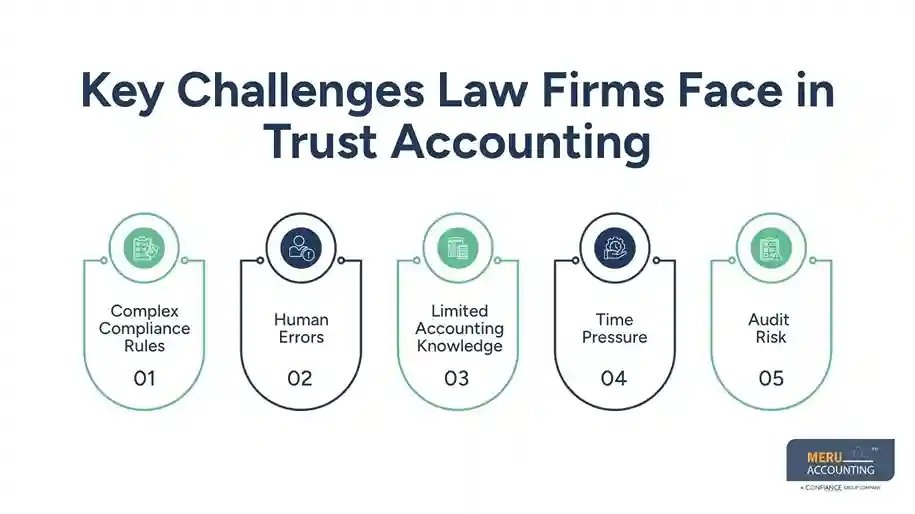
Time Pressure
Law firms spend most of their time handling cases and clients, leaving very little time for financial tracking and reconciliation. As a result, trust accounting tasks are often delayed or rushed, increasing the chance of mistakes.
Audit Risk
Incorrect trust records increase the risk of failed audits or regulatory action, which can harm the firm’s reputation. In severe cases, it may also lead to penalties or restrictions on legal practice.
These issues show why structured financial systems and expert accounting services are needed in legal practice.
Why General Accounting Systems Are Not Enough for Legal Trust Funds
Many law firms try to manage trust accounts using general accounting tools or basic bookkeeping systems. However, these systems are not designed for legal trust requirements.
No Legal-Specific Features
General systems do not support legal trust rules like three-way reconciliation or client-level fund tracking. This makes it difficult for law firms to maintain the level of precision required for compliance.
Weak Fund Separation
Proper trust accounting requires strict separation of client and business funds, which many basic systems do not enforce correctly. This increases the risk of accidental mixing of funds during day-to-day transactions.
Limited Reporting Options
Legal trust accounting requires detailed reports that standard systems often cannot generate in a proper format. As a result, firms may struggle during audits or regulatory reviews when detailed documentation is needed.
Higher Risk of Non-Compliance
Without proper controls, law firms are more likely to make mistakes that lead to compliance violations. These issues can escalate quickly and result in penalties or disciplinary action.
Because of these limitations, many firms rely on professional accounting services that are designed for legal trust management.
Benefits of Hiring a Specialized Accounting Firm for Legal Practices
Hiring experts in trust accounting brings strong financial control and peace of mind for law firms.
Better Compliance Control
Specialized accountants ensure that all trust transactions follow legal rules and industry standards. This helps law firms avoid penalties caused by accidental non-compliance.
Accurate Client Tracking
Every transaction is recorded properly for each client, reducing confusion and errors. This also makes it easier to trace funds quickly when client inquiries arise.
Lower Risk of Mistakes
Professional review and monitoring reduce the chance of accounting errors. Continuous oversight also helps detect issues early before they become serious problems.
Clear Financial Reporting
Law firms get accurate and easy-to-understand reports about trust activity. These reports also support better financial decision-making and planning.
More Time for Legal Work
Lawyers can focus on cases instead of spending time on financial records. This improves overall productivity and client service quality within the firm.
Audit Preparedness
With proper records in place, firms are always ready for audits or reviews. This readiness also builds confidence with regulators and clients alike.
Overall, expert accounting services help law firms stay safe, organized, and compliant.
How Specialized Accounting Services Improve Trust Accounting
Specialized financial support plays a key role in improving trust accounting accuracy and control. These services go beyond basic bookkeeping and focus on legal compliance.
They usually include:
- Regular reconciliation of trust accounts
- Client-level tracking of funds
- Monitoring of compliance rules
- Preparation of audit-ready reports
- Detailed financial documentation
This structured system helps law firms ensure that every client dollar is properly tracked and protected.
Why Working with an Accounting Firm for Small Business Can Still Help
Even smaller law firms must manage trust accounts carefully. Many assume they do not need advanced accounting support, but trust rules apply regardless of firm size.
An experienced accounting firm for small business can provide flexible and cost-effective solutions that fit smaller legal practices. These firms often offer scalable services that can grow with the business.
For small law firms, this becomes a practical way to access expert financial support without building a full internal accounting team.
Meru Accounting’s Accounting Services for Legal Practices and Small Business
At Meru Accounting, we provide specialized support designed for law firms that need reliable trust accounting solutions. Our professional accounting services focus on accuracy, compliance, and financial clarity.
We help law firms with:
- Complete trust account management
- Accurate reconciliation of client funds
- Compliance with legal accounting standards
- Customized reporting systems for legal firms
- Scalable solutions for small and growing practices
Our goal is to reduce financial risk and improve control so law firms can focus fully on their legal work. With Meru Accounting, you get structured financial systems that support long-term stability and compliance.
Our Expert Perspective
In working with law firms, we see that trust accounting gets hard as client volume grows and daily legal work takes priority. Most attorneys focus on case work, court tasks, and client needs, which leaves little time for close financial review. As transactions grow across many trust accounts, even small gaps in tracking can turn into larger issues in reconciliation and compliance if not handled on time. This risk often increases when firms scale without a clear system for financial control and record keeping in place.
From our view, law firms keep stronger financial control when trust accounts are reviewed on a steady and planned schedule rather than only during audits or report deadlines. Regular checks help improve accuracy, build transparency, and reduce the risk of compliance errors over time. Strong accounting services help bring structure to this process by keeping records clear and current, while many smaller practices also benefit from working with an accounting firm for small business to get simple support, clear reporting, and steady help without adding extra internal workload or cost.
Key Takeaways
- Trust accounting is a legal requirement for all law firms
- Errors in trust management can lead to serious penalties
- General accounting systems are not enough for legal trust funds
- Professional accounting services improve accuracy and compliance
- Specialized support reduces risk and saves time
- Even small law firms benefit from expert financial systems
- The right accounting partner improves transparency and control
FAQs
Trust accounting is the process of managing client funds separately from the law firm’s own money while maintaining full accuracy and compliance.
It ensures client funds are protected, properly tracked, and used only for approved legal purposes, which is required by law.
They can, but general software often lacks legal-specific features, which increases the risk of errors and compliance issues.
Professional accounting services help with reconciliation, compliance tracking, reporting, and accurate management of client funds.
Yes, even small firms handle client funds and must follow strict trust accounting rules, making expert support very important.