
Retail businesses often rely on small business accounting firms to manage the constant buying and selling of stock more efficiently. When products move fast, it becomes hard to track what is available, what is sold, and what needs to be reordered.
This is where support from professional accounting services becomes useful. Many retail owners now depend on structured financial systems to manage inventory with more clarity.
Small business accounting firms help retail stores connect their stock records with financial data. This means every product movement is also recorded in accounts, giving a clear picture of profit and loss. It reduces errors, saves time, and supports better decisions in daily operations.
What You Will Learn From This Blog
- A clear understanding of how retail businesses manage inventory using support from small business accounting firms and structured methods that improve day-to-day control and tracking.
- The importance of accounting support in maintaining accurate stock records and reducing errors in inventory reporting.
- The most common inventory-related challenges faced by small retail businesses include stock mismatch, loss, and poor planning.
- How financial systems and accounting tools help improve inventory accuracy and ensure reliable business data.
- The key benefits of integrating inventory management with accounting records are better financial visibility and control.
- Retail business owners should consider professional accounting support to improve efficiency and support business growth.
Understanding The Role Of Small Business Accounting Firms In Retail Operations
Inventory And Financial Link
Retail stores sell products daily, and each sale affects both stock and money records. Accounting firms help connect these two areas so data stays accurate.
This reduces confusion between physical stock and financial books, especially when businesses hire an accountant for a small business to manage records professionally.
Stock Recording Systems
Small business accounting firms set up proper systems to record every purchase and sale. This ensures that inventory levels are always updated and easy to review when managed through small business accounting companies.
Financial Clarity For Retailers
When inventory is linked with accounts through small business accounting firms, business owners can clearly see profit margins. It becomes easier to understand which products perform well with support from small business accounting companies handling structured reporting.
Cost Control Support
Accounting professionals help identify high-cost items and slow-moving stock. This helps reduce unnecessary spending and improves cash flow.
Reporting And Monitoring
Regular reports from accounting systems help retailers track inventory trends. This supports better planning for future stock purchases.
How Retailers Track Inventory Using Professional Accounting Support
Digital Stock Records
Retailers use accounting systems to record inventory digitally in real time. This reduces manual errors and keeps data updated in real time with better accuracy.
Purchase And Sales Tracking
Every purchase and sale is recorded in the system on a daily basis. This allows retailers to know exact stock levels at any point without confusion.
Barcode Integration
Many retail businesses that hire an accountant for a small business use barcode systems linked with accounting tools for better control. This makes stock tracking faster, simpler, and more accurate overall.
Stock Reconciliation
Accounting firms help match physical stock with digital records on a regular basis. This process ensures there are no mismatches or missing items in stock.
Automated Alerts
Some systems provide automatic alerts when stock is low or near reorder levels. This helps retailers reorder products on time without delays or shortages.
Key Inventory Management Challenges Faced By Small Retail Businesses
Manual Errors In Records
Small retailers often rely on manual entries, which is why many choose small business accounting firms to reduce mistakes in stock data and reporting. These errors create confusion in daily inventory tracking and reduce overall accuracy.
Stock Loss Issues
Many retailers choose to hire an accountant for a small business to minimize stock loss and improve control. This leads to direct financial loss and affects business profitability over time.
Overstocking Problems
Many businesses purchase excess stock, which blocks cash flow and storage space unnecessarily. This also increases the risk of unsold items becoming outdated, which can be reduced when businesses hire an accountant for a small business for better planning.
Poor Demand Planning
Without proper data, retailers may not predict customer demand correctly in advance. This results in either a stock shortage or unnecessary over-purchasing of products.
Lack Of Financial Connection
Inventory is often not linked with accounting, making profit tracking difficult and unclear. This disconnect affects decision-making and reduces financial visibility for owners.
How Small Business Accounting Firms Help Improve Stock Accuracy
Accurate Data Entry Systems
Small business accounting firms ensure every transaction is recorded correctly in the system with proper checks. This helps maintain clean records and reduces mistakes in inventory tracking.
Regular Stock Reviews
Frequent checks help identify differences between actual physical stock and recorded data. This ensures any mismatch is corrected quickly and improves overall accuracy.
Error Reduction Methods
Professional systems reduce human errors through automation and structured accounting processes. This creates more reliable inventory records and improves daily business control.
Better Purchase Planning
With accurate data, retailers can plan purchases based on real demand and sales trends. This prevents overstocking and helps maintain balanced inventory levels.
Improved Financial Reporting
Correct stock data leads to better profit and loss reports with clear financial insights. This helps business owners understand true performance when supported by small business accounting firms providing structured financial insights.
Real-Time Inventory Tracking And Financial Integration Systems
Live Stock Updates
Modern accounting systems update inventory instantly after each sale or purchase in real time. This helps retailers always know the exact stock position without delay or confusion.
Cloud-Based Access
Retailers using systems supported by small business accounting firms can check stock levels from anywhere using cloud access. This improves flexibility and allows better control even when they are not in the store.
Integrated Accounting Tools
Inventory and accounting software work together to maintain consistent and accurate data. This ensures financial records and stock records always stay properly aligned.
Faster Decision Making
Real-time data helps owners make quick business decisions with clear and updated information. This reduces waiting time and improves response to market demand changes.
Improved Transparency
Clear records reduce confusion and improve trust in financial data across all operations. This also helps in audits and financial reviews with better clarity and confidence.
Benefits Of Working With Small Business Accounting Firms For Retail Growth
- Retailers get better financial control when they work with small business accounting firms, tracking income, expenses, and stock in one system, which helps maintain clear and organized records.
- Accounting support reduces operational stress for store owners by handling manual work like bookkeeping, stock updates, and financial record management.
- Clear financial data helps improve profit tracking by showing which products perform well and which do not perform well.
- Strong compliance support ensures that accounting firms help maintain proper records for tax filing and legal requirements.
- Business growth planning becomes easier with accurate reports, helping owners plan expansion and new product lines.
When And Why You Should Hire An Accountant For A Small Business In Retail
Growing Inventory Size
When stock levels increase, it becomes important to hire an accountant for a small business for better tracking and control. This ensures inventory remains organized even as the business expands.
Frequent Stock Errors
If mistakes happen often, accounting support can improve accuracy in records. It also helps reduce repeated issues in stock reporting and management.
Lack Of Time
Retail owners with busy schedules benefit from expert handling of accounts and records. This allows them to focus more on sales and customer service.
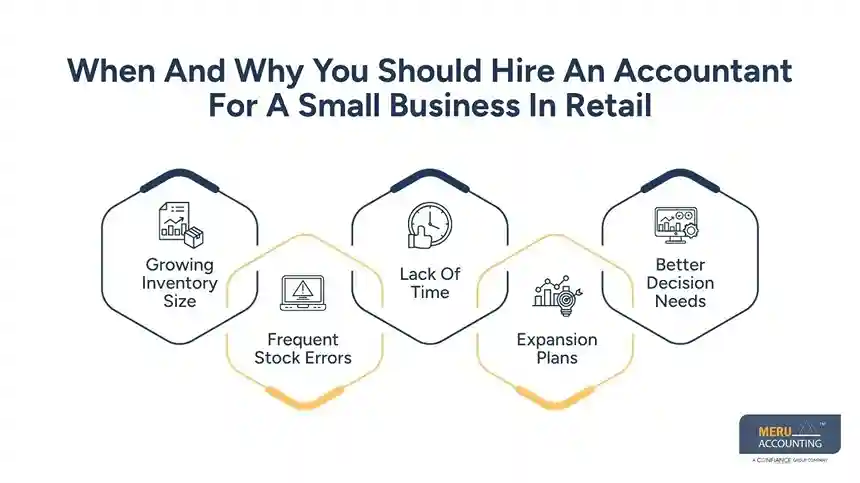
Expansion Plans
New store locations require structured financial systems designed with support from small business accounting firms for smooth operations. Proper accounting support ensures consistent tracking across all branches.
Better Decision Needs
Professional insights help in making smarter business choices based on accurate data. This improves planning and reduces risks in daily retail operations.
How Meru Accounting Supports Retail Businesses
Meru Accounting provides structured financial services for retail businesses that want better control over inventory and accounts. The focus is on simple systems that connect stock and financial records clearly.
Our team of certified experts helps retail stores set up accounting software, manage inventory tracking, and maintain accurate books. This reduces confusion between sales data and stock levels.
Meru Accounting also supports businesses in reviewing financial reports, identifying stock issues, and improving cost control. This helps store owners make better decisions based on real data.
With experience in working with small and growing retail businesses, Meru Accounting focuses on clear reporting and steady financial management. This helps businesses reduce errors and improve day-to-day operations.
Our Expert Perspective
From our expert perspective, we often see that many retail businesses struggle with a gap between inventory records and financial books, especially when stock is managed manually, leading to confusion in sales tracking and purchase planning.
When inventory systems are properly linked with accounting support, businesses gain clearer control over stock movement, a better understanding of product performance, and reduced daily pressure on operations, which supports more accurate and steady business decisions.
Key Takeaways
- Retail inventory management becomes easier with accounting support
- Linking stock and accounts improves accuracy and reduces errors
- Real-time systems help track inventory instantly
- Small retail businesses face challenges like overstocking and manual errors.
- Working with small business accounting firms or choosing to hire an accountant for a small business improves financial clarity and control.
- Structured systems created with the help of small business accounting firms help retail businesses grow with better planning.
FAQs
Inventory management helps track stock levels and avoid shortages or overstocking, especially when supported by small business accounting firms. It supports better sales planning and cost control.
They connect stock records with financial systems to ensure accuracy. This helps retailers know real-time stock and profit data.
They often face errors, stock loss, and poor planning. It also becomes hard to track profits correctly.
Yes, many simple tools used by small business accounting firms are available that connect inventory and accounting.
When the stock becomes large or errors increase, professional support is useful. It helps improve accuracy and saves time.