
Running a successful dance studio involves more than teaching classes and organizing performances. Studio owners must also manage tuition payments, instructor payroll, operating expenses, tax records, and financial reports. Handling these tasks manually often leads to errors, missed payments, and time-consuming administrative work. Using accounting software for dance studios helps organize financial data, automate routine bookkeeping, and maintain accurate records from a single platform.
Effective dance studio accounting gives owners better visibility into cash flow, income, expenses, and business performance. Whether managing one studio or multiple locations, the right accounting software for dance studios simplifies financial management, supports informed decision-making, and reduces the time spent on manual accounting tasks, allowing owners to focus on growing their business and serving their students.
What You Will Learn From This Blog
- Why accounting software for dance studios is valuable for studio owners.
- Common financial challenges faced by dance studios.
- Features every accounting solution should include.
- Ways automation simplifies daily bookkeeping.
- How software manages tuition, payroll, and operating expenses.
- Benefits of accurate dance studio accounting.
- Tips for selecting the right accounting solution.
Why Dance Studio Accounting Requires Specialized Software
General bookkeeping software often falls short because dance studios manage recurring tuition, instructor payments, and event-related expenses. Specialized software keeps financial records organized and makes these everyday accounting tasks easier to manage.
Multiple Revenue Sources
Dance studios receive payments from group classes, private lessons, workshops, recital tickets, merchandise, and costume sales. Tracking each income source separately provides better financial visibility.
Recurring Tuition Payments
Many students pay monthly or quarterly tuition. Accounting software for dance studios automatically records recurring payments and reminds owners about overdue balances.
Instructor Payroll Management
Dance instructors may work full-time, part-time, or on contract. Payroll calculations become easier when work hours and payment schedules are managed within one accounting system.
Seasonal Business Activities
Dance studios often experience higher expenses before competitions, performances, and annual recitals. Organized financial tracking allows owners to prepare for these seasonal costs.
Better Financial Planning
Reliable financial records provide accurate reports that make budgeting, forecasting, and business planning more practical throughout the year.
Reduced Manual Work
Instead of entering every transaction manually, accounting software for dance studios records bank transactions, categorizes expenses, and generates reports automatically, reducing repetitive administrative work.
Common Financial Challenges Dance Studios Face
Without a structured accounting system, many dance studios spend unnecessary time correcting financial records. These common issues affect both small and growing studios.
Tracking Student Payments
Late tuition payments, installment plans, and multiple payment methods make payment tracking difficult. Missing records often create confusion for both staff and parents.
Managing Payroll
Instructor wages, overtime, guest teacher payments, and tax deductions require careful calculations. Manual payroll processing increases the chance of errors.
Recording Operating Expenses
Daily business expenses such as rent, insurance, music licenses, utilities, maintenance, and costumes quickly add up. Proper categorization is essential for accurate dance studio accounting.
Cash Flow Monitoring
Even profitable studios may experience temporary cash shortages if incoming payments do not match outgoing expenses. Regular cash flow reports provide early visibility into financial gaps.
Tax Compliance
Maintaining organized records throughout the year makes tax preparation easier. Financial reports generated by accounting software for dance studios also simplify discussions with accountants and tax professionals.
Financial Reporting
Owners often need monthly profit reports, expense summaries, and income statements when making business decisions. Manual reporting consumes significant time compared to automated accounting systems.
Key Features To Look For In Accounting Software For Dance Studios
Selecting the right accounting software for dance studios requires more than comparing prices. The software should match your daily financial tasks, reduce manual work, and provide reliable reports that support business decisions. A good solution also keeps dance studio accounting organized as your studio grows.
Automated Bookkeeping
Recording every transaction manually takes time and increases the chance of errors. Modern software imports bank transactions, categorizes income and expenses, and keeps financial records updated automatically. This reduces routine work while maintaining accurate books.
Tuition Payment Management
Dance studios often collect recurring monthly fees, annual registration charges, workshop fees, and recital payments. The software should create invoices, record payments, send reminders for overdue balances, and provide a clear payment history for every student.
Payroll Processing
Instructor payroll is one of the largest operating expenses for most studios. Accounting software for dance studios should calculate wages, overtime, reimbursements, and deductions while maintaining complete payroll records for future reference.
Expense Tracking
Daily business expenses include rent, utilities, costumes, equipment, cleaning supplies, advertising, and maintenance. Proper expense categorization gives studio owners a better understanding of spending patterns and keeps dance studio accounting accurate throughout the year.
Financial Reporting
Good financial decisions depend on reliable reports. Look for software that generates Profit and Loss Statements, Balance Sheets, Cash Flow Reports, and Expense Summaries with only a few clicks.
Bank Reconciliation
Matching accounting records with bank statements is an important financial control. Automated reconciliation quickly identifies missing transactions, duplicate entries, or recording mistakes before they become larger problems.
optional anymore
on running the business
How Accounting Software For Dance Studios Simplifies Daily Financial Management
Daily financial tasks can quickly consume valuable business hours. Using accounting software for dance studios allows studio owners to organize routine accounting work without spending hours updating spreadsheets or searching through paper records.
Records Daily Transactions Automatically
Every payment received and every expense recorded becomes part of one organized financial system. This creates consistent records and reduces duplicate data entry.
Centralizes Financial Information
Instead of storing invoices, receipts, payroll records, and reports across multiple files, everything remains available within one system. Owners can quickly locate financial information whenever required.
Creates Professional Invoices
Invoice generation becomes simple for monthly tuition, workshops, private lessons, and recital fees. Automatic invoice creation also reduces administrative work for office staff.
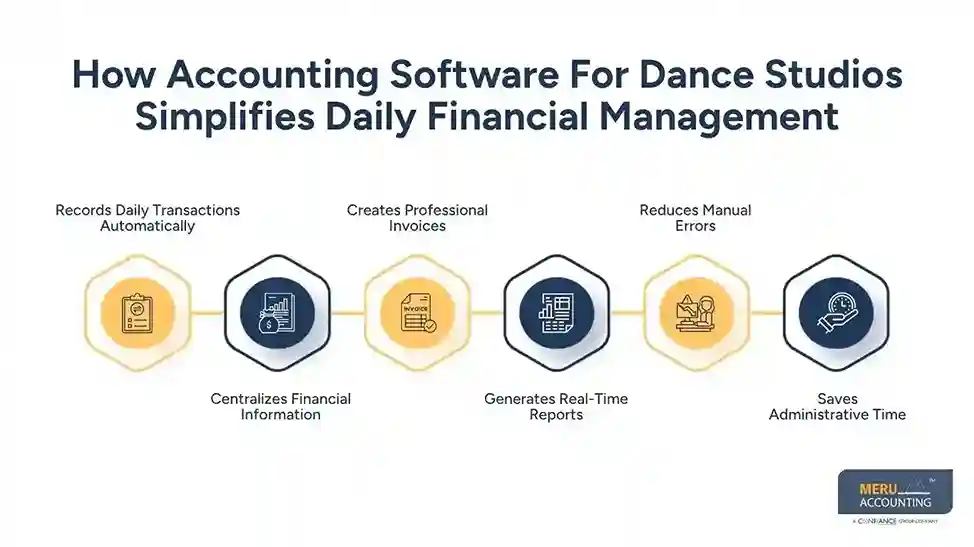
Generates Real-Time Reports
Instead of waiting until month-end, owners can review current income, expenses, outstanding payments, and available cash at any time. Reliable reporting allows quicker business decisions.
Reduces Manual Errors
Typing numbers repeatedly often creates mistakes. Automated calculations reduce common bookkeeping errors while keeping dance studio accounting consistent across all financial records.
Saves Administrative Time
Many studio owners spend several hours each week updating accounting records. Accounting software for dance studios reduces repetitive accounting tasks, allowing more time for student programs and business growth.
Benefits of Using Accounting Software For Dance Studio Owners
A well-managed accounting system benefits both small studios and growing businesses. Beyond organizing financial records, it provides valuable insights that assist with planning and long-term financial stability.
Better Cash Flow Visibility
Knowing how much money is coming in and going out allows owners to prepare for payroll, rent, competitions, and seasonal events. Regular cash flow monitoring also reduces unexpected financial pressure.
Faster Financial Decisions
Accurate reports provide a clear picture of business performance. Owners can evaluate class profitability, monitor operating costs, and identify areas where spending can be controlled.
Easier Budget Planning
Historical financial data makes future budgeting more reliable. Studio owners can estimate annual expenses, marketing budgets, equipment purchases, and event costs with greater confidence.
Stronger Financial Organization
Well-organized financial records simplify communication with accountants, lenders, and tax professionals. Maintaining complete documentation also makes year-end reporting much less stressful.
Higher Accuracy
Automation records transactions consistently, reducing missing entries and duplicate records. Reliable dance studio accounting gives owners greater confidence in their financial reports.
More Time For Business Growth
Administrative work often limits the time available for student engagement, instructor development, and marketing. By reducing routine bookkeeping tasks, accounting software for dance studios allows owners to focus on expanding their studio rather than maintaining spreadsheets.
How Automation Improves Dance Studio Accounting Accuracy
Automation reduces manual bookkeeping errors by recording transactions accurately and keeping financial records organized. Accounting software for dance studios simplifies routine financial tasks, helping businesses maintain greater accuracy and efficiency in dance studio accounting.
Reduces Manual Data Entry
Entering every payment and expense by hand increases the chance of typing mistakes. Automated bank feeds and transaction imports record financial activity directly from connected accounts, reducing duplicate work and improving record accuracy.
Maintains Consistent Financial Records
Every transaction follows the same accounting process, making reports more reliable. Consistent recordkeeping also makes it easier to review financial performance from one month to the next.
Detects Missing Transactions
Modern accounting systems compare financial records with bank activity and quickly identify missing or unmatched transactions. Finding these issues early prevents reporting errors later.
Creates Accurate Financial Reports
Profit and Loss Statements, Cash Flow Reports, and Balance Sheets rely on complete financial records. Since accounting software for dance studios updates information automatically, reports reflect current business activity without waiting for manual calculations.
Simplifies Tax Preparation
Organized records throughout the year reduce stress during tax season. Accountants can access complete income and expense reports without sorting through paper receipts or incomplete spreadsheets.
Keeps Audit Trails
Every financial change is recorded with a timestamp and user history. This creates greater transparency and strengthens dance studio accounting, especially when multiple staff members access financial records.
Managing Tuition Fees, Payroll, And Expenses With Accounting Software
Financial management in a dance studio extends beyond recording income. Tuition collection, instructor payroll, operating expenses, and event costs all require careful organization. Accounting software for dance studios brings these activities together into one centralized system, allowing owners to monitor finances more efficiently.
Tuition Fee Collection
Monthly tuition is the primary income source for most dance studios. The software automatically generates invoices, records payments, tracks overdue balances, and maintains payment histories for every student. Parents also receive timely reminders, reducing follow-up work for office staff.
Instructor Payroll
Dance instructors may have different payment structures based on hourly rates, fixed salaries, or contract agreements. Payroll automation calculates wages, deductions, reimbursements, and payment schedules accurately while reducing manual calculations.
Business Expense Management
Every studio incurs regular expenses such as rent, utilities, costumes, cleaning supplies, equipment, insurance, marketing, and recital preparation. Organized expense tracking provides a clearer picture of operating costs and strengthens dance studio accounting throughout the year.
Budget Monitoring
Budget reports compare planned spending with actual expenses. Owners can quickly identify areas where costs are increasing and adjust spending before financial problems develop.
Cash Flow Management
Reliable cash flow monitoring allows studio owners to prepare for seasonal expenses, instructor payments, and major events. Regular reporting reduces the likelihood of unexpected cash shortages.
Financial Reporting For Better Decisions
With accounting software for dance studios, financial reports are available whenever needed. Owners can review revenue trends, expense categories, student payment status, and overall profitability without waiting for month-end bookkeeping.
Tips For Choosing The Best Accounting Software For Dance Studios
Not every accounting solution fits the needs of a dance studio. Before selecting software, owners should evaluate both current requirements and future business growth. The right choice should simplify financial management without adding unnecessary complexity.
Understand Your Studio’s Needs
Every studio operates differently. Consider the number of students, instructors, locations, and payment methods before selecting a solution. The software should support your daily accounting activities without requiring extensive manual adjustments.
Look For Automation Features
Automation saves valuable administrative time. Features such as recurring invoices, bank synchronization, payroll processing, and automatic expense categorization reduce routine bookkeeping tasks.
Review Reporting Capabilities
Good financial reporting provides valuable business insight. Choose software that generates detailed Profit and Loss Statements, Cash Flow Reports, Balance Sheets, and expense summaries that are easy to understand.
Consider Ease Of Use
A simple interface allows owners and staff to learn the software quickly. Easy navigation also reduces training time and minimizes operational disruptions during implementation.
Check Integration Options
Many studios use separate systems for class scheduling, payment processing, and customer management. Selecting software that integrates with these tools creates a more organized financial workflow.
Think About Future Growth
As student enrollment increases, accounting requirements also become more complex. Choosing scalable accounting software for dance studios reduces the need to replace systems as the business expands.
Simplify Dance Studio Accounting with Meru Accounting
Managing studio finances should not take hours every week. Meru Accounting simplifies dance studio accounting by providing professional bookkeeping and accounting services that keep tuition payments, invoices, expenses, payroll records, and financial reports accurate and well organized. Our streamlined processes reduce routine bookkeeping work, allowing studio owners to spend more time teaching and growing their business.
Our experienced accounting professionals deliver timely financial reports that provide a clear view of cash flow, income, and expenses. We work with secure cloud-based accounting systems to ensure your financial records remain accessible, organized, and up to date. With Meru Accounting managing your finances, you can make informed business decisions and confidently support your studio’s long-term growth.
Our Expert Perspective
From our experience, many dance studio owners struggle with time-consuming bookkeeping and financial tracking. Using accounting software for dance studios simplifies dance studio accounting by improving record accuracy, automating routine tasks, and making financial reporting and tax preparation much easier. Combined with professional accounting support, it helps studios build a stronger financial foundation for long-term growth.
Key Takeaways
- Accounting software for dance studios keeps financial records organized in one place.
- Automated bookkeeping reduces manual work and common accounting errors.
- Recurring tuition payments become easier to manage with automated invoicing and payment tracking.
- Payroll automation records instructor payments accurately and on time.
- Expense tracking provides better visibility into daily operating costs.
- Financial reports give studio owners a clear picture of revenue, expenses, and cash flow.
- Better dance studio accounting allows owners to prepare for tax filing with organized records.
- Choosing software with automation, reporting, and integration features creates long-term value.
- Combining reliable software with professional accounting guidance strengthens financial management.
FAQs
Yes, accounting software for dance studios can calculate instructor payments and maintain payroll records accurately. It also keeps payment history organized for future reference.
Dance studio accounting handles recurring tuition, instructor payroll, recital costs, and other studio-specific financial activities.
Yes, it automates invoicing, records payments, tracks outstanding balances, and maintains payment histories.
It automates routine accounting tasks, reducing manual data entry and improving financial accuracy.
Yes, an accountant provides expert financial guidance, tax support, and compliance beyond what software can do.
optional anymore
on running the business