A travel agency’s busiest month isn’t always its most profitable. A spike in bookings can bring higher sales, but supplier costs, booking fees, agent commissions, and last-minute cancellations can eat into the margin. Without a clear picture of these numbers, it’s easy to mistake high sales for healthy profits. That’s where accounting software for travel agencies comes in.
But choosing the right software isn’t as simple as picking a popular accounting tool. An independent travel agent may need little more than invoicing and expense tracking, while an agency with multiple agents, global clients, and vendor deals may need better reporting and multi-currency support. In this blog, we’ll compare seven leading tools, look at their features and pricing, and see whether QuickBooks for travel agency accounting is the right fit for your business.
What You Will Learn From This Blog
- What features to look for in travel agency accounting tools.
- Seven tools worth a look, along with their key uses.
- How pricing and plan limits can affect your choice.
- Whether QuickBooks is a good fit for a travel agency.
- How better books can help track cash flow, costs, and profit.
What to Look for in Accounting Software for Travel Agencies
Travel firms have some unique money flows. A client may pay the agency today, while the agency pays an airline, hotel, or tour firm later. The full amount paid by the client may not be the agency’s income. The agency may earn only a fee or commission.
So, accounting software for travel agencies should do more than send bills and log costs. Look for these key features before you buy.
1. Income and Payment Tracking
The tool should help you track client payments, booking fees, service fees, and other income. It should also help match each payment with the right invoice or booking record.
2. Vendor Bills and Payments
Travel agencies work with hotels, airlines, tour firms, and other vendors. A good tool should help you log bills, track due dates, and check what you owe each vendor.
3. Commission Tracking
Many agencies earn money through sales fees or vendor commissions. Look for a way to record the amount earned, the amount due, and the date it was paid.
4. Refunds and Cancellations
Trips can be changed or called off. Your books should show the refund, any fee kept by the agency, and any amount still due to a vendor or client.
5. Multi-Currency Support
Agencies that work with global clients may deal in more than one currency. Check if the tool can record foreign currency sales, bills, and gains or losses from rate changes.
6. Reports and Bank Reconciliation
Profit and loss reports, balance sheets, cash flow reports, and bank feeds can help owners make sound choices. Bank reconciliation is also key to finding missing or duplicate entries.
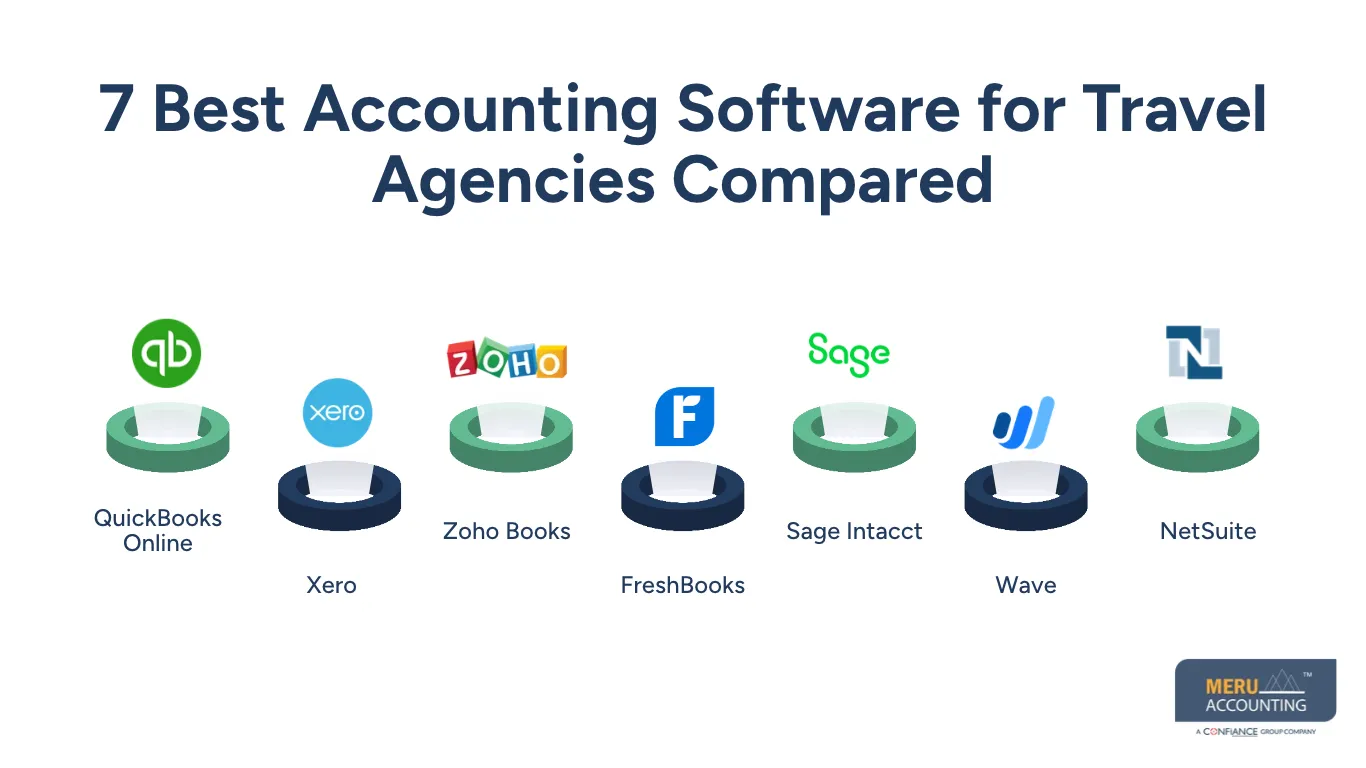
7 Best Accounting Software for Travel Agencies Compared
The best choice will depend on your agency’s size, sales model, and need for reports. Here are seven tools to review.
1. QuickBooks Online
QuickBooks Online is a well-known choice for small and mid-sized firms. It can help travel agencies track sales, bills, costs, bank records, and cash flow.
Key features:
- Create and send client invoices.
- Track bills and vendor payments.
- Link bank and card accounts.
- Run profit and loss and cash flow reports.
- Track income and costs by class or project on plans that support these tools.
- Support multi-currency use on eligible plans.
Pricing: US plans start at $38 per month for Simple Start at the listed standard rate. Higher plans cost more and offer added tools and user access. Intro offers may change the first few months of cost.
Best for: Small and growing agencies that need a common accounting tool with broad app support.
QuickBooks can manage the books, but it does not act as a full travel booking system. You may need a link to your booking tool or a clear process to move sales data into the books.
2. Xero
Xero is a cloud-based tool with a clean layout and strong bank feed tools. It can suit agencies that want to share books with an owner, bookkeeper, or CPA.
Key features:
- Send quotes and invoices.
- Track bills and costs.
- Reconcile bank records.
- View live reports.
- Use multi-currency tools on the top plan.
- Add apps from its wider app network.
Pricing: US plans start at $27 per month for Early, $59 for Growing, and $97 for Established at the listed regular rates. Intro offers may apply to new users.
Best for: Agencies that want cloud access, bank feeds, and room to grow.
Xero can help track the money side of travel sales. Still, booking data and agent fees may need an app or set process to flow into the books.
3. Zoho Books
Zoho Books is a good option for firms that want core accounting tools at a lower price. It also works well for firms that use other Zoho apps.
Key features:
- Create invoices and track client payments.
- Log vendor bills and costs.
- Set up bank feeds and bank checks.
- Record multi-currency sales and costs on paid plans.
- Run tax and cash flow reports.
- Set user roles and work rules on eligible plans.
Pricing: A free plan is offered for small firms. Paid US plans start at $20 per month, or $15 per month when billed each year. Higher plans add more users and tools.
Best for: Small agencies that want low-cost books and a wide set of features.
Zoho Books can handle many day-to-day tasks, but you should check its links with your booking and CRM tools before you choose it.
4. FreshBooks
FreshBooks puts a strong focus on billing, costs, and ease of use. It can work for solo travel agents or small firms with a simple sales model.
Key features:
- Create and send invoices.
- Track costs and receipts.
- Make estimates and client deals.
- View basic finance reports.
- Give an accountant access.
- Check project profit on eligible plans.
Pricing: US plans have standard rates of $23 per month for Lite, $43 for Plus, and $70 for Premium. Rates may vary with sales offers.
Best for: Solo agents and small firms that need easy billing and cost tracking.
FreshBooks may not suit a large agency with complex vendor flows or a high number of monthly bookings. Check user limits and add-on costs as well.
5. Sage Intacct
Sage Intacct is built for firms with more complex finance needs. It offers deeper control over reports, entities, and finance tasks than many basic tools.
Key features:
- Manage accounts payable and receivable.
- Build detailed finance reports.
- Track results by team or business unit.
- Set up approval steps.
- Support multi-entity accounting.
- Link with other business apps.
Pricing: Sage does not show one set of public prices for all users. Costs depend on the setup, users, features, and service needs.
Best for: Large travel firms or groups with more than one business unit.
This tool may be too much for a small agency. But firms with many branches or complex books may gain from its deeper finance controls.
6. Wave
Wave offers basic tools for firms that want to keep costs low. It can be a starting point for a solo agent or a small agency with simple needs.
Key features:
- Create invoices.
- Track income and costs.
- Manage bills.
- View cash flow.
- Accept online payments.
- Import bank data on paid plans.
Pricing: Wave has a free Starter plan. Its Pro plan is listed at $19 per month in the US.
Best for: Solo agents and small firms with basic billing and book needs.
Wave may not offer the depth needed for complex travel sales, multi-currency work, or detailed commission reports. Check its limits before you move your full books.
7. NetSuite
NetSuite is an ERP tool with finance, sales, and business tools in one system. It may suit large travel firms that need a single view of many teams or business units.
Key features:
- Manage accounts and finance records.
- Track income and costs by unit.
- Support multi-currency work.
- Build custom finance reports.
- Manage approval flows.
- Link finance data with wider business tasks.
Pricing: NetSuite uses custom quotes. The cost can vary based on users, modules, setup, and support.
Best for: Large travel firms with complex finance and business needs.
NetSuite can be a major step up in cost and setup time. A small agency may not need its full set of tools.

Accounting Software Comparison: Features, Pricing, and Best Use Cases
Software | Starting US Price* | Key Strength | Best For |
QuickBooks Online | $38/month | Reports and app links | Small to mid-sized agencies |
Xero | $27/month | Bank feeds and cloud access | Growing agencies |
Zoho Books | Free; paid from $20/month | Low-cost accounting | Small agencies |
FreshBooks | $23/month | Simple billing | Solo travel agents |
Sage Intacct | Custom quote | Deep finance controls | Large travel firms |
Wave | Free; Pro at $19/month | Basic billing and books | Solo agents |
NetSuite | Custom quote | ERP and multi-unit finance | Large travel groups |
Prices are based on listed US rates and may change. Paid plans, user limits, add-ons, taxes, and special offers can affect the final cost.
When you compare accounting software for travel agencies, do not look at price alone. A low-cost plan may lack key tools for bank feeds, foreign currency, or reports. A higher plan may save time if it cuts down on manual work.
QuickBooks for Travel Agency Accounting: Features, Benefits, and Limitations
Many owners look at QuickBooks for travel agency books because it can track sales, costs, bills, and bank records in one place. It can also help an owner review income and costs each month.
Benefits of QuickBooks
- Easy income tracking: Record client fees, booking charges, and other sales.
- Vendor bill control: Track what you owe hotels, airlines, and tour firms.
- Bank feeds: Match bank records with entries in your books.
- Finance reports: Review profit, costs, and cash flow.
- App links: Connect with other tools to cut down on manual data entry.
Limitations to Keep in Mind
QuickBooks is not built to run every part of a travel agency. It does not replace a booking engine, a global distribution system, or a travel CRM. It may also need extra setup to track agent commissions, booking-level profit, and supplier payments.
For a small agency, QuickBooks may be enough for core books. A larger firm may need a booking app, custom reports, or expert help to keep all records in sync.
optional anymore
on running the business
Common Accounting Challenges Travel Agencies Face and How Software Helps
1. Mixing Sales With Earned Income
A client may pay $3,000 for a trip, but the agency may earn only $300 in fees and commission. The rest may be due to vendors. Good books should split these amounts so that sales and income are not mixed up.
2. Tracking Vendor Payments
A hotel or tour firm may ask for a deposit before the trip. The agency must track what was paid, what is due, and which client or trip it relates to.
3. Managing Refunds
A canceled trip can lead to a client refund, a vendor credit, or a fee kept by the agency. Each part must be logged in the right account.
4. Tracking Agent Commissions
If agents earn a share of each sale, the agency must track the rate, amount due, and amount paid. This helps avoid errors in agent pay.
5. Keeping Cash Flow Clear
Travel firms may pay vendors before they get the full amount from clients. Cash flow reports can help owners plan for these gaps and avoid late payments.
QuickBooks Accounting Services for Travel Agencies by Meru Accounting
A $5,000 group tour, a hotel deposit, an airline commission, and a canceled booking can all affect your books in different ways. If these entries aren’t recorded and matched correctly, your reports may not show what your agency has actually earned. Meru Accounting helps travel agencies manage these financial details with dedicated QuickBooks accounting and bookkeeping support.
Our services cover the day-to-day financial work behind travel operations:
- QuickBooks Setup: Set up accounts to track booking fees, commissions, vendor costs, and other income.
- Booking Income and Expense Tracking: Record client payments, trip costs, service fees, and operating expenses.
- Vendor and Supplier Reconciliation: Match hotel, airline, and tour operator bills with payments and outstanding balances.
- Commission Accounting: Track commissions earned, received, and paid to travel agents.
- Accounts Payable and Receivable: Manage supplier dues, client balances, invoices, and payment records.
- Bank and Credit Card Reconciliation: Match transactions and resolve missing or duplicate entries.
- Financial Reporting: Prepare monthly profit and loss statements, balance sheets, and cash flow reports.
- Cleanup and Catch-Up Bookkeeping: Organize past records and bring overdue books up to date.
Whether you manage a small travel agency or handle a growing volume of bookings, we can help you get a clearer view of your income, costs, outstanding payments, and business performance.
Our Expert Insight
A travel agency may get most of its bookings through online platforms, but higher booking volume doesn’t always mean higher profit. Third-party platform fees, discounts, marketing costs, and agent commissions can all affect the margin. Owners should look beyond total sales and review how much each booking channel contributes to the bottom line.
We recommend tracking sales and related costs by channel, such as direct bookings, referral partners, corporate clients, and online travel platforms. This gives owners a better way to compare margins, spot costly sales channels, and decide where to focus their marketing budget. Accounting reports are far more useful when they help answer not just how much the agency sold, but which parts of the business are actually making money.
Key Takeaways
- The best tool depends on your agency’s size, sales flow, and finance needs.
- QuickBooks and Xero suit many small and growing firms.
- Zoho Books and Wave offer lower-cost ways to manage basic books.
- Sage Intacct and NetSuite suit firms with more complex needs.
- Check bank feeds, multi-currency tools, reports, and app links before you buy.
- Track client funds, vendor costs, fees, and commissions with care.
- Regular bank checks can help you spot errors and make better choices.
FAQs
QuickBooks Online, Xero, and Zoho Books are good options. QuickBooks suits agencies that need detailed reports, while Zoho Books can be a good fit for those on a tighter budget.
QuickBooks can record booking-related invoices, payments, fees, and expenses. However, it does not manage flight reservations, hotel availability, or travel itineraries. You’ll need a separate booking system for those tasks.
Travel agencies can record commissions as income when they are earned under the terms of their agreements. They can use separate income accounts to track commissions by source or vendor. More detailed tracking may need classes or other reporting tools.
Yes. Tools such as QuickBooks Online, Xero, and Zoho Books offer multi-currency features on eligible plans. These help agencies record foreign currency transactions and account for exchange rate changes.
Agencies can link booking records with related sales, vendor costs, service fees, and commissions. They can then review the total cost and income for each trip. Project tracking, classes, or a connected booking system may help make this process easier.
optional anymore
on running the business