
A customer who pays every invoice 10 days late may seem like a minor concern. But when dozens of customers follow the same pattern, it can change how a business manages credit, plans expenses, and handles day-to-day operations. The accounts receivable turnover ratio helps put this pattern into numbers by showing how often a business collects its average outstanding receivables.
What makes this metric useful is the story behind the numbers. A change in the ratio may reflect new customer payment habits, different credit terms, or a shift in the types of customers a business serves. When read alongside invoice records and aging reports, it gives business owners a better sense of who pays on time and where collections need attention.
What You Will Learn From This Blog
- What the accounts receivable turnover ratio measures and why it matters.
- How customer payment habits affect cash flow and working capital.
- How the ratio can reveal changes in payment patterns.
- How to calculate the ratio with a simple business example.
- What high and low results may say about customer payments.
- How to spot late-paying customers and improve collection work.
- Which factors can affect the ratio and how to read it with care.
What Is the Accounts Receivable Turnover Ratio?
The accounts receivable turnover ratio is a financial metric that shows how often a business collects its average accounts receivable balance over a set period. It helps owners and finance teams see how well they turn credit sales into cash.
When a business sells goods or services on credit, it records the amount due as accounts receivable. That balance stays on the books until the customer pays. The ratio tracks how fast those open balances are collected over time.
For example, if a business has an accounts receivable turnover ratio of 8, it means the business collected its average receivables balance about eight times during the period. This does not mean every customer paid eight times. It is a view of the full customer base.
A business can use this metric to:
- Check how well its collection process works.
- Review whether customers pay within the agreed terms.
- Spot changes in payment trends.
- Compare collection results across time periods.
- See if more cash is getting tied up in unpaid bills.
The ratio is most useful when viewed as part of a wider review of credit sales, open invoices, and cash flow.
Why Customer Payment Behavior Matters for Business Cash Flow
Customer payment behavior has a direct effect on how much cash a business has on hand. When customers pay on time, the business can use that cash to cover payroll, rent, vendor bills, and other costs. When payments are late, the business may have to use its own cash reserves or rely on short-term credit.
This can create problems even when sales are strong. A business may record revenue today but wait 30, 60, or 90 days to receive the cash. If many customers pay late at the same time, the unpaid balance can grow and put pressure on daily operations.
Reviewing the accounts receivable turnover ratio helps a business see whether its collection pace is keeping up with sales. A steady decline may point to slower payments, weak follow-up, or credit terms that no longer fit the business.
It also helps finance teams make better plans. They can use past collection trends to estimate when cash may come in, set credit limits, and decide which accounts need closer review.
optional anymore
on running the business
How Accounts Receivable Turnover Ratio Reveals Customer Payment Patterns
The accounts receivable turnover ratio can help businesses spot changes in how customers pay their bills. By comparing results across months, quarters, or years, finance teams can see whether collections are getting faster or slower.
Here are a few ways to use it to review customer payment patterns.
- Spot changes in payment speed
If the ratio drops from one quarter to the next, customers may be taking longer to pay. This can happen when customers face cash flow issues, dispute invoices, or delay payments beyond the agreed terms. A steady rise may show that collections are getting faster.
- Review the effect of credit terms
A business that offers 30-day payment terms can compare its collection results with those that offer 45 or 60 days. If the ratio falls after a change in credit terms, the business should check whether customers are using the extra time to delay payment.
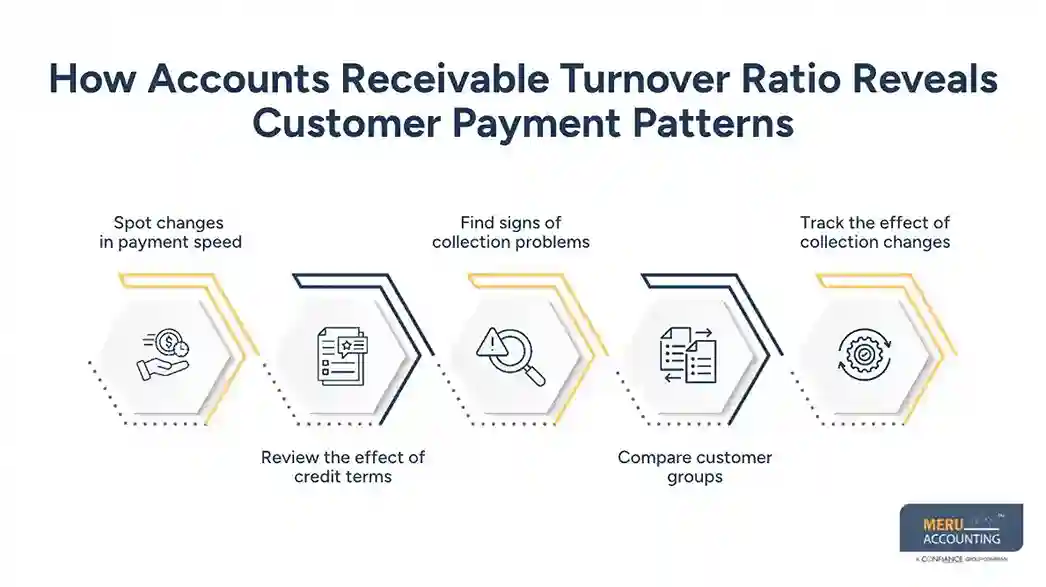
- Find signs of collection problems
A drop in the ratio can point to gaps in invoice follow-up. For example, a business may send invoices on time but fail to send payment reminders before the due date. Reviewing the ratio with open invoice records can help teams find these gaps.
- Compare customer groups
Businesses can also review payment trends by customer type, sales channel, or market. A single overall ratio may look healthy even when one group of customers pays late. A closer review can show where the business needs to change its credit or collection process.
- Track the effect of collection changes
If a business starts sending reminders earlier or sets clear payment rules, it can compare the ratio before and after the change. This helps the team see whether the new steps are helping it collect cash faster.
How to Calculate Accounts Receivable Turnover Ratio: Formula and Example
Knowing how to calculate accounts receivable turnover ratio helps a business turn its sales and balance sheet data into a useful measure of collection speed. The calculation is simple, but the figures used must be correct.
The formula is:
ARTurnoverRatio=NetCreditSalesAverageAccountsReceivable
To find average accounts receivable, use:
AverageAR=BeginningAR+EndingAR2
Here is what each figure means:
- Net credit sales: Sales made on credit, less sales returns and allowances. Cash sales should not be included.
- Beginning accounts receivable: The amount customers owed at the start of the period.
- Ending accounts receivable: The amount customers owed at the end of the period.
- Average accounts receivable: The average of the opening and closing balances.
Example:
Suppose a business reports the following figures for one year:
Financial item | Amount |
Net credit sales | $900,000 |
Beginning accounts receivable | $90,000 |
Ending accounts receivable | $110,000 |
Average accounts receivable | $100,000 |
First, find the average receivables:
($90,000 + $110,000) ÷ 2 = $100,000
Next, divide net credit sales by average receivables:
$900,000 ÷ $100,000 = 9 times
Result: 9 times
The business collected its average accounts receivable balance nine times during the year.
To put this into a time-based view, divide 365 days by the turnover ratio:
365 days ÷ 9 = 40.6 days
This means the business took about 41 days to collect its average receivables. If its standard payment terms are 30 days, this gap may need a closer look.
The result does not mean every customer took 41 days to pay. Some may have paid early, while others may have paid well past the due date. A customer-level aging report can help explain the difference.
How to Interpret Accounts Receivable Turnover Ratio Results
The result becomes useful when a business knows what it means and compares it with the right figures. A single number should not be treated as proof that customers pay on time or that collections are working well.
What Does a High Accounts Receivable Turnover Ratio Mean?
A high ratio often means a business collects credit sales quickly. This can point to strong follow-up, clear payment terms, and customers who pay on time.
But a very high result is not always a good sign. Strict credit rules may keep slow-paying customers away, but they may also limit sales. Some businesses may lose good customers by giving them too little time to pay.
What Does a Low Accounts Receivable Turnover Ratio Mean?
A low ratio may mean customers take longer to pay. It can also point to weak follow-up, billing errors, disputes, or credit terms that do not fit the customer base.
Still, the result needs context. A business that works with large companies may have longer payment terms than one that sells to small firms. The right comparison is with past results and similar businesses that use similar credit terms.
What Is a Good Accounts Receivable Turnover Ratio?
There is no single ideal ratio for every business. The right level depends on the type of work, customer base, payment terms, and sales model.
A useful way to judge the result is to compare it with:
- The business’s own results from past periods.
- Its stated customer payment terms.
- Ratios from firms in the same line of work.
- Days sales outstanding and aging report data.
This gives a fair view of whether the business is collecting at a pace that fits its sales and credit rules.
How Accounts Receivable Turnover Ratio Helps Identify Late-Paying Customers
The overall ratio can show a change in collection speed, but it cannot name the customers who pay late. To find them, businesses need to review it with invoice-level data.
An accounts receivable aging report is a useful tool for this task. It groups unpaid invoices by how long they have been open, such as current, 1–30 days past due, 31–60 days past due, and more than 90 days past due.
For example, a business may have a falling turnover ratio and find that most of its overdue balance comes from three large customers. The finance team can then check their payment records, open disputes, and review credit terms.
Businesses can use these findings to:
- Send reminders before and after invoice due dates.
- Contact customers with old or high-value unpaid bills.
- Review credit limits for repeat late payers.
- Fix billing errors that hold up payment.
- Set clear rules for overdue balances and new orders.
The accounts receivable turnover ratio helps show when a wider collection issue may be forming. Aging reports and customer payment records help show where the issue sits.
Factors That Influence Accounts Receivable Turnover Ratio
Several factors can affect the result, even when customer payment behavior has not changed. Finance teams should review these points before making decisions based on the ratio.
Credit terms: Longer payment terms can lower turnover because customers have more time to pay.
Customer mix: Large clients may have longer payment cycles than small customers. A change in the customer base can shift the ratio.
Seasonal sales: Sales may rise at certain times of the year, which can raise receivables and affect the result.
Invoice accuracy: Wrong amounts, missing details, or late invoices can delay payment.
Collection follow-up: Slow or uneven follow-up can leave overdue bills open for longer.
Use of credit sales: Including cash sales in the calculation can make the result look better than it is. Use net credit sales for a fair measure.
Write-offs and returns: Bad debt, sales returns, and allowances can affect the figures used in the calculation. Keep these items in line with the business’s accounting records.
For a more useful view, businesses can calculate the ratio each month or quarter and use average receivables from more than two dates when sales change a lot during the year.
How Meru Accounting's Accounts Receivable Services Help Improve Collection Efficiency
A turnover ratio can highlight a change in collection performance, but understanding the reason behind that change takes a closer look at customer accounts. For example, a business may see its ratio decline without knowing whether the cause is delayed payments from a few major clients, unresolved invoice disputes, or a wider change in payment habits. Meru Accounting helps businesses investigate these patterns through accurate receivable records and regular account reviews.
Our accounts receivable management services cover the day-to-day work and financial reviews needed to keep customer balances clear and collections on track.
- Customer Account Reconciliation: Match invoices, credit notes, and payments to find incorrect or outstanding balances.
- Accounts Receivable Aging Analysis: Review overdue invoices by customer and age to identify repeat late payers and high-risk balances.
- Payment History Tracking: Maintain customer-level payment records to help businesses spot delays and changes in payment patterns.
- Invoice and Dispute Management: Review billing issues, track disputed invoices, and help resolve errors that hold up payment.
- Collection Follow-Up: Manage payment reminders and follow-ups based on invoice due dates and agreed credit terms.
- Receivables Reporting: Prepare clear reports that help management review collection trends, outstanding balances, and customer payment performance.
By bringing these activities together, Meru Accounting helps businesses move beyond a single turnover figure and understand what’s happening across their customer accounts. Our accounting professionals use multi-industry experience and a quality review process to support accurate reporting, timely follow-ups, and better-informed credit decisions.
Our Expert Insight
In our experience, one common mistake in receivables analysis is treating all overdue balances as equally risky. A $20,000 invoice that’s 10 days past due from a long-term customer with a strong payment record may need a different response than a $5,000 invoice that’s 60 days overdue from a customer with a history of missed payments. The amount owed alone doesn’t tell you how much attention an account needs.
We recommend looking at customer payment history, invoice size, dispute status, and past collection patterns before changing credit limits or putting accounts on hold. This helps businesses focus their collection efforts where they matter most, rather than relying on the accounts receivable turnover ratio as the sole measure of customer reliability.
Key Takeaways
- The accounts receivable turnover ratio shows how often a business collects its average receivables balance during a set period.
- A high ratio often points to faster collections, while a low ratio may signal slow payments or gaps in follow-up.
- Businesses should use net credit sales and average accounts receivable for a fair calculation.
- A single ratio cannot show which customers pay late. Aging reports and payment records provide that detail.
- Credit terms, customer mix, billing errors, and seasonal sales can all affect the result.
- Regular reviews help businesses spot collection issues, manage credit risk, and plan cash flow.
FAQs
It shows how often a business collects its average receivables during a given period. It helps measure how well the business collects payments from customers.
Yes. A falling ratio may point to slower customer payments, which can reduce available cash and make it harder to cover business expenses.
Late customer payments, longer credit terms, billing disputes, and weak collection follow-ups can all cause the ratio to decline.
Not without context. Payment terms and sales cycles vary by industry, so businesses should compare their results with similar companies.
Customers who pay on time help maintain a higher ratio, while frequent late payments can lower it by increasing outstanding receivables.
optional anymore
on running the business