A 401(k) balance can look quite different once taxes enter the picture. Two people with the same $100,000 retirement savings may end up with very different amounts to spend, depending on how and when they take the money out. The tax rate on 401(k) distributions can make a real difference, especially when a withdrawal adds to your regular income or triggers an early withdrawal tax.
The tricky part is knowing which rules apply to your plan. A traditional 401(k), a Roth 401(k), and an early withdrawal don’t all get the same tax treatment. Here’s what to know about the tax rules, how to work out what you may owe, and what to check before requesting a distribution.
What You Will Learn From This Blog
- How the tax rate on 401(k) distributions works.
- How traditional and Roth 401(k) withdrawals differ.
- How to estimate taxes on a 401(k) withdrawal.
- When early withdrawal penalties and RMD rules apply.
- How income, age, and withdrawal timing affect your tax bill.
What Is the Tax Rate on 401(k) Distributions?
There is no single tax rate for every 401(k) withdrawal. The tax you owe depends on the type of account and your tax status for the year.
Money taken from a traditional 401(k) is usually taxed as ordinary income. This means the taxable amount is added to your other income, such as wages, interest, and other retirement income. Your filing status, tax brackets, and deductions help set the final amount.
For example, if you take $20,000 from a traditional 401(k), that amount is generally added to your taxable income for the year. It does not mean the full $20,000 is taxed at one fixed rate. Part of your income may fall into one tax bracket and the rest into another.
A qualified Roth 401(k) withdrawal works in a different way. If you meet the five-year rule and a qualifying event, such as reaching age 59½, both your contributions and earnings can generally come out tax-free.
The key is to check your account type before taking money out. A tax estimate based on the wrong account type can give you a poor idea of what you will owe.
How Federal Income Tax Rates Apply to 401(k) Distributions
The federal tax rate on traditional 401(k) distributions follows the same tax bracket system used for other ordinary income. The US tax system is progressive, so different parts of your taxable income can be taxed at different rates.
Your federal tax bill depends on:
- Your filing status, such as single or married filing jointly.
- Your total taxable income for the year.
- Your deductions and other tax credits.
- The size of your 401(k) withdrawal.
A large withdrawal may raise your taxable income and cause part of it to fall into a higher tax bracket. However, it does not mean all your income is taxed at that higher rate.
You should also check your state income tax rules. Some states tax 401(k) withdrawals, while others offer full or partial tax breaks for retirement income. The rules can vary by state and age.
One point that often causes confusion is the 20% federal tax withholding rule. If you receive an eligible rollover distribution from an employer plan instead of having it sent directly to another retirement account, the plan will generally withhold 20%. This is a tax payment made in advance, not your final tax rate. You may owe more or get some of it back when you file your return.
optional anymore
on running the business
Traditional vs. Roth 401(k): How Distribution Taxes Differ
The tax treatment of a withdrawal depends on whether your savings are in a traditional or Roth 401(k).
Traditional 401(k)
You usually make traditional 401(k) contributions with pre-tax income. You do not pay federal income tax on those contributions when they go into the account. Instead, you pay tax when you take the money out.
In most cases, the full distribution is taxable as ordinary income. This includes both the money you put in and the investment gains.
Roth 401(k)
Roth 401(k) contributions are made with after-tax income. You pay tax on the money before it goes into the account, so a qualified withdrawal is generally tax-free.
To qualify, the payment must meet the five-year rule and occur after age 59½, death, or disability. If the payment does not meet the qualified distribution rules, the earnings portion may be taxable. An early withdrawal tax may also apply unless an exception is available.
Feature | Traditional 401(k) | Roth 401(k) |
Contributions | Usually pre-tax | After-tax |
Qualified withdrawals | Usually taxable | Generally tax-free |
Investment earnings | Taxed when withdrawn | Tax-free if qualified |
Early withdrawal tax | May apply | May apply to taxable earnings |
Check your plan records before taking money out, as some accounts may hold both traditional and Roth funds.
How Early 401(k) Withdrawals Affect Your Taxes
Taking money out of a 401(k) before age 59½ can lead to two costs: regular income tax and an extra 10% early distribution tax.
For a traditional 401(k), the withdrawal is usually added to your taxable income. The extra 10% tax may also apply to the taxable amount if no exception fits your case.
For example, a $10,000 early withdrawal from a traditional 401(k) may lead to $1,000 in extra tax, along with regular federal and state income taxes.
Some exceptions may let you avoid the extra 10% tax. These can include:
- Leaving your job in or after the year you turn 55.
- Certain disability cases.
- Payments made to a beneficiary after the account holder’s death.
- Certain qualified medical costs.
- Payments under a qualified domestic relations order.
- Certain scheduled payments based on life expectancy.
Not all exceptions remove regular income tax. They may only remove the extra 10% tax. Check the IRS rules and your plan terms before making a withdrawal.
How Required Minimum Distributions (RMDs) Affect 401(k) Taxes
Required minimum distributions are amounts you must take from certain retirement accounts once you reach the age set by law. Under current rules, the general RMD starting age is 73. It is scheduled to rise to 75 for people born in 1960 or later.
A traditional 401(k) RMD is usually taxed as ordinary income. The amount you must take is based on your account balance at the end of the prior year and an IRS life expectancy factor.
You may not have to take an RMD from your current employer’s 401(k) while you still work there, if the plan allows this and you are not a 5% owner. This rule may not apply to a former employer’s plan.
If you fail to take the full RMD on time, an excise tax may apply to the amount you missed. The standard rate is 25%, but it may fall to 10% if you correct the shortfall within the allowed time. You may also request a waiver in certain cases.
Plan ahead for RMDs, as a large required withdrawal can raise your taxable income for the year.
What Factors Can Increase or Reduce Your 401(k) Distribution Taxes?
Several factors can change how much tax you owe when you take money out of a 401(k).
- Total income: A large withdrawal can raise your taxable income and push part of it into a higher tax bracket.
- Filing status: Your tax brackets and standard deduction depend on whether you file as single, married filing jointly, or under another status.
- Age at withdrawal: Taking money out before age 59½ may lead to the extra 10% tax.
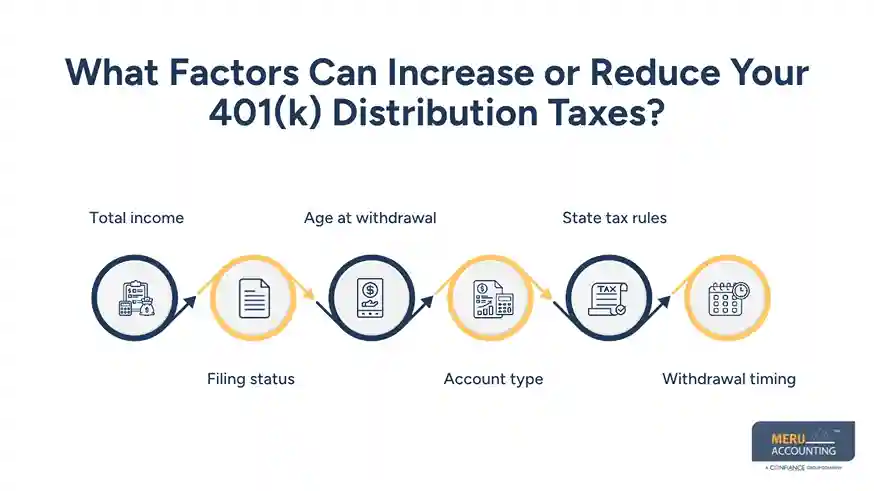
- Account type: Traditional withdrawals are usually taxable, while qualified Roth withdrawals are tax-free.
- State tax rules: Your state may tax retirement income or offer an exemption based on age or income.
- Withdrawal timing: Taking a large amount in one year may lead to a higher tax bill than spreading withdrawals across more than one year.
Before you take a large amount, look at your other income for the year. A tax estimate can help you choose a better time and avoid taking out more than you need.
401(k) Distribution Tax Examples: How Much Tax Will You Pay?
A 401(k) distribution tax calculation can help you plan for the tax cost before you request a payment. The examples below use simple figures to show how the rules work. They are not personal tax estimates.
Example 1: Traditional 401(k) Withdrawal
Suppose you are 62 and take $20,000 from a traditional 401(k). Your other taxable income is $50,000.
The $20,000 is generally added to your taxable income, bringing the total to $70,000 before any other changes. You will pay tax based on your filing status, deductions, and tax brackets. Since you are over 59½, the extra 10% early withdrawal tax does not apply.
Example 2: Early 401(k) Withdrawal
Suppose you are 45 and take $10,000 from a traditional 401(k). No early withdrawal exception applies.
- Withdrawal: $10,000
- Extra 10% tax: $1,000
- Regular income tax: Based on your taxable income and filing status.
Your total tax cost includes regular income tax plus the extra $1,000. The plan may also withhold federal tax from the payment.
Example 3: Qualified Roth 401(k) Withdrawal
Suppose you are 60 and have met the five-year rule. You take $15,000 from your Roth 401(k).
If the payment meets all qualified distribution rules, the full $15,000 is generally tax-free. You do not owe regular federal income tax or the extra 10% early withdrawal tax.
These cases show why age, account type, and total income matter when working out your tax bill.
Get Help With Retirement Tax Planning From Meru Accounting
A 401(k) distribution shouldn’t be treated as a separate line on your tax return without looking at the rest of your finances. The type of withdrawal, taxable portion, withholding, and other sources of income all matter when working out your actual tax liability. At Meru Accounting, we help clients make sense of these details through tax planning, preparation, and income review.
Our relevant tax services include:
- Retirement Income Tax Planning: Review 401(k) withdrawals alongside other income to assess their effect on your tax liability.
- 401(k) Distribution Tax Review: Help assess taxable distributions, early withdrawal taxes, and applicable tax rules.
- Individual Tax Return Preparation: Report retirement distributions and other taxable income correctly.
- Federal and State Tax Preparation: Review applicable tax rules, deductions, and state tax obligations.
- Tax Liability Assessment: Estimate potential tax payments and identify opportunities to manage taxable income.
Whether you’re planning a retirement withdrawal or preparing a return that includes 401(k) income, our team can help you review the tax details, organize the records, and make informed decisions before filing.
Our Expert Insight
A detail worth paying attention to is how a 401(k) distribution affects other tax benefits. For example, a large withdrawal can increase your adjusted gross income (AGI), which may reduce certain tax credits or deductions and affect the taxability of Social Security benefits. This is why looking at the withdrawal alone may not give you a complete picture of its tax impact.
We recommend reviewing the full-year tax estimate before taking a large distribution, especially if you plan to retire, sell investments, or receive other income in the same year. A little tax planning ahead of time can help avoid unexpected costs and make better use of your retirement savings.
Key Takeaways
- The tax rate on 401(k) distributions depends on your account type, income, age, and filing status.
- Traditional 401(k) withdrawals are usually taxed as ordinary income.
- Qualified Roth 401(k) withdrawals are generally tax-free.
- Early withdrawals may face an extra 10% tax unless an exception applies.
- The 20% withholding rule does not set your final tax rate.
- RMDs from traditional 401(k) accounts are usually taxable.
- A 401(k) distribution tax calculation can help you plan before taking money out.
FAQs
It depends on your tax bracket and filing status. Traditional 401(k) withdrawals are taxed as regular income, while qualified Roth withdrawals are tax-free.
Yes. Traditional 401(k) withdrawals generally count as taxable income. Qualified Roth withdrawals are tax-free.
Yes. Qualified Roth withdrawals and eligible direct rollovers can avoid current federal income tax.
You may owe regular income tax plus an extra 10% early withdrawal tax. Some exceptions apply.
Add the taxable withdrawal to your other income, then apply the federal tax brackets for your filing status. Also check for state taxes and early withdrawal taxes.
optional anymore
on running the business