For a small business owner, payroll involves more than knowing how much each employee should take home. A new hire, a year-end bonus, an overtime payment, or a change in an employee’s tax details can all affect payroll records and tax filings. That’s why payroll tax filing best practices need to be part of the regular payroll process, not something to think about only when a tax deadline is close.
The tricky part is keeping every detail straight while running the business. Employers must track tax withholdings, match payroll records with tax deposits, and file the right forms on time. In this guide, we’ll cover 10 practical ways to handle these tasks, including how to file payroll taxes correctly and avoid mistakes that can cost your business time and money.
What You Will Learn From This Blog
- What payroll tax filing best practices mean for small businesses.
- 10 ways to keep payroll tax records and returns accurate.
- How to file payroll taxes correctly, from wage checks to tax deposits.
- Common payroll tax errors and ways to avoid them.
- Key federal payroll tax forms and filing dates.
- When to seek help from a payroll tax service.
What Are Payroll Tax Filing Best Practices?
Payroll tax filing best practices are the steps employers use to work out, pay, report, and track payroll taxes. They help make sure that tax is held from employee pay, the right employer taxes are paid, and all tax forms are sent on time.
These steps cover more than filing a tax return. They start when a new hire joins the firm and continue with each pay run. Employers need to keep tax forms up to date, check wage data, track tax deposits, and match payroll records with filed returns.
Federal payroll taxes include income tax withheld from employee pay, Social Security and Medicare taxes, and FUTA tax. Employers may also need to pay state income tax, state unemployment tax, and local payroll taxes, based on where their staff work.
Following payroll tax filing best practices helps small firms lower the risk of late fees, wrong tax reports, and gaps in their records.
optional anymore
on running the business
10 Payroll Tax Filing Best Practices Every Small Business Should Follow
1. Classify Employees and Contractors Correctly
The first step is to know who is an employee and who is an independent contractor. This matters because the tax rules for each group are not the same.
Employers must withhold and pay certain payroll taxes for employees. In most cases, they do not withhold payroll taxes from payments to valid independent contractors. An incorrect worker status can lead to back taxes, interest, and fines.
Review each worker’s role, level of control, and work terms before you set them up in payroll. Do not rely only on a contract or job title to make this choice.
2. Collect Accurate Employee Tax Details
Good payroll tax filing starts with the right data. Ask each new hire to fill out Form W-4 so you can work out the right federal income tax to withhold from their pay.
Keep each worker’s legal name, Social Security number, home address, and tax forms on file. Check these details before the first pay run. A wrong name or Social Security number can cause issues with wage reports and Form W-2 filing.
Also, ask staff to report changes that may affect their tax setup. Keep all tax data safe and limit access to staff who need it for their work.
3. Use Current Tax Rates and Wage Limits
Payroll tax rates and wage limits can change each year. Using old rates may lead to wrong tax amounts and errors in year-end reports.
For 2026, the Social Security tax rate is 6.2% for both the employee and employer, up to the annual wage base of $184,500. The Medicare tax rate is 1.45% for both sides, with no wage cap. An extra 0.9% Medicare tax may apply to an employee’s wages above $200,000, which the employer must withhold.
Check IRS rules each year before you set tax rates in your payroll system. Also review state and local tax rates if you have staff in more than one area. This is one of the most useful payroll tax filing best practices for firms with changing pay levels.
4. Follow the Right Tax Deposit Schedule
Withholding tax from employee pay does not mean the tax has been paid to the IRS. Employers must send the funds based on their assigned deposit schedule.
The IRS sets federal tax deposit schedules based on past tax liability. Most employers follow a monthly or semiweekly schedule. Some small employers may qualify to pay with Form 944 each year, but they must meet IRS rules and receive approval to use it.
Use the Electronic Federal Tax Payment System (EFTPS) or another approved payment method to make federal tax deposits. Keep payment records and check that each deposit is made by its due date.
5. Track Every Payroll Tax Filing Deadline
Missing a tax filing date can lead to penalties, even when you have the funds to pay the tax. Create a tax calendar that lists all federal, state, and local due dates.
For federal payroll taxes, key forms include:
- Form 941: Filed each quarter by most employers.
- Form 940: Filed each year to report FUTA tax.
- Form W-2: Sent to employees and filed with the Social Security Administration.
- Form W-3: Sent with paper W-2 forms to the Social Security Administration.
- Form 944: Used by eligible small employers who have IRS approval to file once a year.
Set alerts a few days before each due date. This gives your team time to check the figures and fix any errors before filing.
6. Reconcile Payroll Records Before Filing
Payroll records should match the tax returns you file. Before sending a return, compare gross wages, tax withheld, employer tax, and tax deposits with your payroll reports.
For example, the total federal income tax withheld from employee pay should match the amount shown on the related tax return. Social Security and Medicare wages should also match the payroll data, subject to the rules for each tax.
Check for voided checks, off-cycle pay runs, bonuses, and changes made after payroll was first processed. A monthly or quarterly review can help find gaps before they grow into larger issues.
7. Use Reliable Payroll Software or Expert Support
Payroll software can help with tax math, pay records, tax reports, and due date alerts. It can also help reduce manual data entry and keep payroll data in one place.
Still, software is only as good as the data and settings it uses. Review tax rates, employee details, and filing settings on a regular basis. Do not assume that every tax return or deposit has been sent just because the system shows a completed pay run.
Small firms with few staff may be able to manage payroll in-house. But firms with complex pay, multi-state staff, or frequent tax changes may need expert support.
8. Keep Complete Payroll Tax Records
Good records make it easier to check tax returns, answer IRS notices, and fix past errors. Keep payroll reports, tax forms, payment receipts, employee tax details, and wage records in a safe place.
The IRS says employers should keep employment tax records for at least four years after the tax is due or paid, whichever is later. Some state rules may call for longer record periods.
Use a clear folder system, with records sorted by tax year and pay period. Keep digital copies with secure access and a backup plan. These payroll tax filing best practices can save time if your firm faces a tax review.
9. Review Tax Returns Before You Submit Them
Never file a payroll tax return without a final check. Review each form for wrong figures, missing data, and gaps between the return and your payroll reports.
Check the business name, EIN, tax period, wage totals, tax amounts, and deposit credits. Make sure all required fields are complete. If you find an error, fix it before you send the form.
If a return has already been filed with incorrect data, check the IRS rules for making a correction. For example, Form 941-X is used to correct errors on a past Form 941. Do not file a new Form 941 just to fix an old return.
10. Stay Up to Date With Tax Rule Changes
Tax rules can change each year. New wage limits, tax rates, state rules, and filing needs may affect how much you owe and when you need to pay it.
Check IRS updates and state tax agency notices on a regular basis. Review payroll settings at the start of each tax year and when a staff member moves or starts work in a new state.
If you are unsure how a rule applies to your firm, ask a payroll tax expert or tax pro before you file. A quick review can help prevent a costly mistake.
How to File Payroll Taxes Correctly: A Step-by-Step Process
Knowing how to file payroll taxes correctly can help you keep each pay period on track. Follow these steps to manage the process from wage checks to tax reports.
Step 1: Review employee wages. Add regular pay, overtime, bonuses, tips, and other taxable pay. Check that all hours and pay rates are right before you work out taxes.
Step 2: Calculate tax withholding. Use each employee’s Form W-4 and current IRS rules to work out federal income tax withholding. Then work out Social Security and Medicare taxes for both the employee and employer.
Step 3: Record employer tax costs. Add the employer share of Social Security and Medicare taxes, along with any FUTA and state unemployment tax due. Keep these costs apart from employee tax deductions.
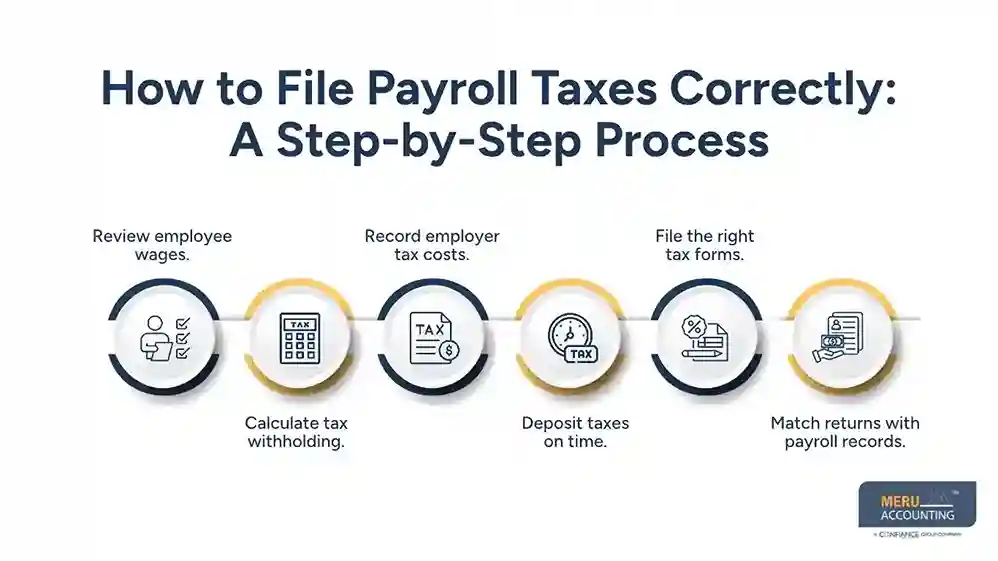
Step 4: Deposit taxes on time. Check your IRS deposit schedule and send the tax funds by the due date. Federal tax deposits must generally be made by electronic funds transfer.
Step 5: File the right tax forms. Submit Form 941 each quarter if your business is required to use it. File Form 940 for FUTA tax and prepare Forms W-2 and W-3 for annual wage reporting. Eligible employers may use Form 944 if the IRS has assigned them to that filing method.
Step 6: Match returns with payroll records. Check each return against payroll reports and tax deposit records. Save the filing receipt and payment details for your files.
This process gives small firms a clear way to handle payroll taxes and helps them follow payroll tax filing best practices throughout the year.
Common Payroll Tax Filing Mistakes Small Businesses Should Avoid
Even firms with a small team can face payroll tax issues. Many errors start with poor data, missed dates, or a lack of review. Here are some common issues to watch for:
- Wrong worker status: Treating an employee as a contractor can lead to unpaid payroll taxes and other costs.
- Old tax rates: Using past tax rates or wage limits can cause wrong tax amounts.
- Late tax deposits: Filing a return does not replace the need to make tax deposits on time.
- Wrong employee data: Errors in names, Social Security numbers, or Form W-4 details can affect wage reports.
- Poor payroll records: Missing pay slips, tax receipts, or filed forms can make it hard to check past returns.
- No final review: Sending a return without checking the figures can lead to errors that need to be fixed later.
A set review process can help spot these issues before they affect your tax filings. Make one staff member responsible for each key task, and have another person check the final figures when possible.
Federal Payroll Tax Forms and Filing Deadlines Small Businesses Should Know
Small businesses must use the right forms to report wages, tax withheld, and employer tax costs. The main federal forms include:
IRS Form | Purpose | Usual filing date |
Form 941 | Reports wages, federal income tax withheld, and Social Security and Medicare taxes | Last day of the month after each quarter |
Form 940 | Reports annual federal unemployment tax (FUTA) | January 31 |
Form W-2 | Reports annual wages and taxes withheld for each employee | January 31 |
Form W-3 | Sends the W-2 summary to the Social Security Administration when paper filing | January 31 |
Form 944 | Annual employment tax return for employers assigned to this filing method | January 31 |
For Form 941, the usual due dates are April 30, July 31, October 31, and January 31. If a due date falls on a weekend or legal holiday, the next business day may apply. Employers who make all required tax deposits on time may get extra time to file some returns.
Form 940 is also due on January 31. If all FUTA tax deposits are made on time and in full, the filing date may move to February 10.
These are federal dates. State and local payroll tax returns may have other due dates. Check the IRS tax calendar and the tax agency for each state where your staff works before you file.
Payroll Tax Services by Meru Accounting
A payroll report can show the right wage totals, yet the tax figures may still be off if deposits, adjustments, or employee withholdings haven’t been recorded correctly. These gaps often show up during quarterly filing or year-end reporting. Meru Accounting helps businesses address these details through hands-on payroll tax support and accounting reviews.
Our payroll tax services include:
- Payroll Tax Calculation and Review: Checking employee withholdings, employer tax liabilities, taxable wages, and applicable tax rates.
- Quarterly Payroll Tax Reporting: Preparing and reviewing payroll tax data for Form 941 and related filings.
- Tax Deposit Reconciliation: Matching IRS tax deposits with payroll records and reported tax liabilities.
- Federal and State Payroll Tax Support: Assisting with payroll tax reporting and filing requirements across applicable jurisdictions.
- Year-End Payroll Tax Reporting: Reviewing wage and withholding records for W-2 and W-3 preparation.
- Payroll Record Cleanup: Finding and correcting gaps in payroll records, tax entries, and past-period reconciliations.
Our team focuses on more than processing payroll figures. We review how wages, withholdings, employer tax costs, and tax payments connect across each reporting period. This gives business owners a clearer picture of their payroll tax obligations and helps them maintain accurate records throughout the year.
Our Expert Insight
A common source of confusion in payroll accounting is the difference between payroll tax expense and payroll tax liability. They aren’t the same. For example, an employer’s share of Social Security and Medicare taxes adds to payroll tax expense, while employee withholdings create a liability that the business must remit to the IRS. Mixing these amounts can distort payroll expenses and make financial reports less reliable.
We advise small businesses to keep employee withholdings, employer payroll taxes, and tax payments clearly separated in their books. This gives owners a more accurate view of labor costs and helps them understand what the business still owes. It also makes it easier to spot unusual changes in payroll costs from one month to the next.
Key Takeaways
- Follow payroll tax filing best practices to keep tax reports accurate and meet IRS deadlines.
- Classify employees and contractors based on their actual work terms.
- Use current tax rates and wage limits for each tax year.
- Follow the right federal tax deposit schedule.
- Review payroll reports before filing Form 941 or other tax returns.
- Keep employment tax records for at least four years.
- Track state and local payroll tax rules as well as federal rules.
- Seek expert help if payroll tax tasks become hard to manage in-house.
FAQs
Payroll software or an outsourced payroll service can help manage tax calculations, deposits, returns, and employee records.
Yes. Employers with even one employee may need to withhold and pay payroll taxes and file the required tax forms.
Yes. Employers can use Form 941-X to correct certain errors on a previously filed Form 941.
Costs vary based on the number of employees, pay frequency, filing needs, and level of service.
It should calculate the outstanding amount, review the affected tax periods, and contact the IRS or a tax professional to discuss payment options.
optional anymore
on running the business