A freelancer can earn $8,000 one month and half that the next. A contractor may work with several clients, while a consultant may have income from projects, retainers, and one-time fees. Each income source can bring its own tax records and reporting needs. This is where personal tax outsourcing becomes relevant for people whose tax situation doesn’t fit a simple W-2 return.
The real challenge isn’t just filing a return. It’s knowing how different income sources fit together, which expenses qualify as deductions, and how much tax to set aside. This guide looks at how professional tax preparation works for freelancers, contractors, and self-employed individuals, including the records, deductions, and tax rules they need to consider.
What You Will Learn From This Blog
- Why self-employed people often face more tax work than regular employees.
- What personal tax outsourcing services can cover.
- How outsourced tax preparation for individuals works.
- Which tax breaks may apply to freelancers and contractors.
- How to choose a tax prep provider and avoid common filing errors.
Introduction to Personal Tax Outsourcing for Self-Employed Taxpayers
Personal tax outsourcing means hiring an outside tax expert or firm to help prepare and file your personal tax return. It can be a good fit for freelancers, gig workers, consultants, and contractors who report income from self-employment.
If you work for yourself, your tax return may include more than a W-2. You may get 1099-NEC forms from clients, 1099-K forms from payment apps, bank records, and other income reports. You also need to track costs tied to your work and check which tax rules apply to your income.
A tax expert can help bring these records into one clear view. They can check your income, review your costs, and help report the right figures on your federal and state tax returns. They can also help you plan for tax payments during the year, not just at filing time.
This does not mean you hand over all control of your taxes. You still need to share true records, review your return, and approve it before filing. The goal is to get expert help while keeping a clear view of your tax duties.
optional anymore
on running the business
Why Freelancers and Independent Contractors Face More Complex Tax Filing Requirements
Self-employed people have tax duties that many W-2 workers do not. Their income may change each month, and they often need to keep their own books and tax records. Here are some key areas that can make tax filing harder.
1. Reporting Income From Many Clients
A freelancer may work with five or more clients in one year. Each client may pay in a different way or send a tax form at a different time. You must report all taxable income, even if a client does not send a 1099 form.
Payment apps and online work sites can add to the task. A 1099-K may show gross payments, which may not match your net business income. You need to check these forms against your own records to avoid missed or double-counted income.
2. Tracking Business Costs
You may pay for software, tools, ads, office items, travel, and other work costs. These costs can lower your taxable business income when they meet IRS rules. But you need clear records to show what you paid for and why it was tied to your work.
Mixing personal and work costs can make this task harder. A tax expert can help sort these costs and flag items that need more proof.
3. Paying Self-Employment Tax
Self-employed people may need to pay self-employment tax on their net earnings. This tax helps fund Social Security and Medicare. It is separate from regular federal income tax, so it must be part of your tax plan.
Many new freelancers miss this cost when they set their rates or plan their cash flow. A tax preparer can help work out the amount due and check if any part can be claimed as a tax break.
4. Making Quarterly Estimated Tax Payments
Many self-employed people must pay tax during the year because no employer holds tax from their pay. These payments are often due four times a year. The amount depends on your income, tax credits, and other factors.
If your income goes up or down, your tax payments may need to change too. A tax expert can help review your income and plan payments to lower the risk of a large tax bill or an underpayment penalty.
What Does Personal Tax Outsourcing Include?
The exact work depends on your needs and the provider you hire. Still, most personal tax outsourcing services for self-employed people may cover the following tasks.
1. Individual Tax Return Preparation
A tax preparer reviews your income records and helps prepare your federal tax return, often Form 1040 with Schedule C and Schedule SE when these forms apply. They may also help with state tax returns based on where you live and work.
2. Self-Employment Income and Expense Review
Your tax expert can review client payments, 1099 forms, bank records, and other income data. They can also sort your work costs and check which ones may qualify as business deductions.
3. Tax Deductions and Credit Review
A preparer can check whether you may claim a home office deduction, health insurance deduction, or other tax breaks. They can also review credits that may apply to your case. Each claim must meet the rules for that tax year.
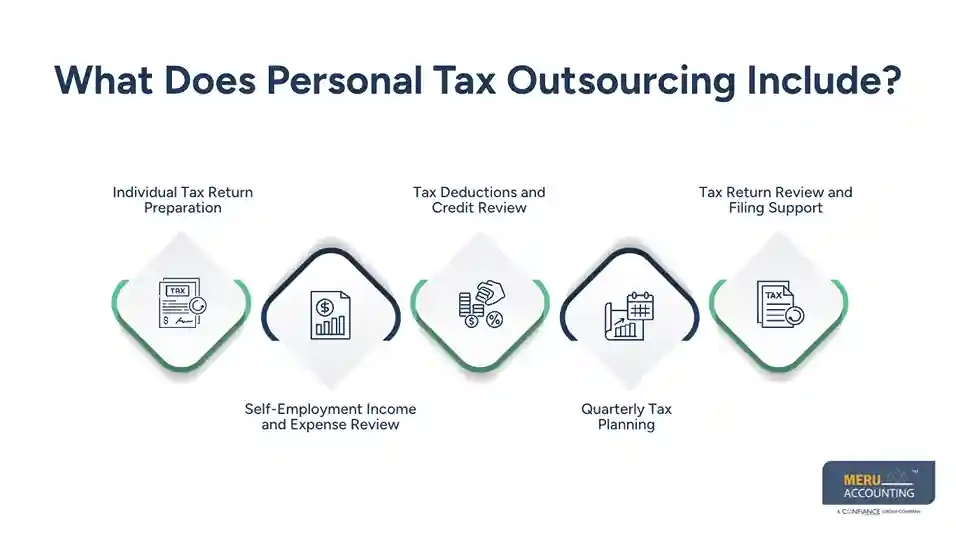
4. Quarterly Tax Planning
Tax support does not have to end after one return is filed. Some firms can help you work out estimated tax payments for the next year. This can help you set aside enough money as you earn it.
5. Tax Return Review and Filing Support
A provider can review the return for missing forms, wrong figures, and other errors before filing. They may also help you respond to basic IRS or state tax notices, if this work is part of your service plan.
How Outsourced Tax Preparation for Individuals Works
Professional tax preparation follows a set process. Knowing what to expect can help you keep your records ready and avoid delays.
Step 1: Gather Your Tax Records
Start by sharing the records your tax preparer needs. These may include:
- Forms 1099-NEC and 1099-K, if received.
- Bank statements and payment records.
- Receipts for business costs.
- Records of estimated tax payments.
- Health insurance and retirement plan records.
- Prior-year tax returns.
The exact list depends on your income sources and tax needs.
Step 2: Review Income and Business Costs
Your tax preparer checks your income records against the payments you received. They also review your business costs to see which expenses may qualify for a tax deduction.
For example, if you earn $75,000 from freelance work and have $15,000 in valid business costs, your net business income is $60,000 before other tax adjustments. This figure helps form the basis for your self-employment tax and income tax review.
Step 3: Check Deductions and Tax Credits
The next step is to review tax breaks that may apply to your work and personal tax status. Your preparer checks the IRS rules, reviews the proof you have, and avoids claims that do not meet the rules.
Step 4: Prepare and Review Your Tax Return
Once the records are checked, the tax expert prepares your return. They review key figures, check for missing details, and share the draft with you for review.
You should read the return before you approve it. Check your income, bank details, filing status, and tax payments to make sure the data is right.
Step 5: File the Return and Plan Ahead
After your approval, the provider can e-file your return when eligible. You should also get a copy of the filed return and any payment details.
If you owe tax, your preparer can help you understand the amount due and the payment date. They may also help set up a plan for the next tax year.
Key Tax Deductions Freelancers and Self-Employed Individuals Should Know
Tax deductions can lower your taxable income, but each expense must meet IRS rules. Keep clear records and ask a tax expert to review any cost you are unsure about.
1. Home Office Deduction
If you use part of your home on a regular and exclusive basis for business, you may qualify for a home office deduction. The space must meet IRS rules. You may use the simplified method or the regular method to work out the deduction.
2. Business Travel and Vehicle Costs
You may be able to deduct some costs for business travel, such as airfare, lodging, and local travel. If you use your car for work, you may also claim eligible vehicle costs under the IRS rules. Keep a record of business miles, dates, and the reason for each trip.
3. Software, Equipment, and Office Supplies
Tools used to run your work may qualify as business costs. These can include design tools, cloud apps, work software, office supplies, and some equipment. The tax rules for larger items may differ from those for small daily supplies.
4. Health Insurance Premiums
Some self-employed people may qualify to deduct health insurance premiums paid for themselves, their spouse, and their dependents. This deduction has limits and depends on your income and other factors. It is not the same as a business expense claimed on Schedule C.
5. Retirement Plan Contributions
If you work for yourself, you may be able to save for retirement through plans such as a SEP IRA or a solo 401(k). Eligible contributions may offer tax benefits, subject to plan rules and limits. A tax expert can help check which plan fits your income and goals.
Not every expense is deductible just because it helps you earn money. Personal costs, fines, and some mixed-use costs need special care. Good records help support each claim if the IRS asks for proof.
Meru Accounting’s Outsourced Tax Preparation for Individuals
A freelance designer may have client payments, software subscriptions, and equipment costs to report. An independent contractor may need to reconcile several 1099 forms with actual payments received. These returns need more than basic data entry. They require a careful review of income, expenses, and the tax rules that apply to each taxpayer.
At Meru Accounting, we support these needs through outsourced tax preparation for individuals, with services tailored to different types of self-employment income.
Our individual tax preparation services include:
- 1099 Income Review: Reviewing income from clients, contract work, and payment platforms to help ensure all taxable income is reported.
- Self-Employment Tax Preparation: Preparing the relevant tax schedules and calculating self-employment tax.
- Business Expense Review: Reviewing expenses such as software, supplies, equipment, travel, and other eligible costs.
- Tax Deduction and Credit Review: Checking applicable deductions and credits based on the taxpayer’s records and filing details.
- Quarterly Estimated Tax Support: Helping calculate estimated payments based on income and tax obligations.
- Individual Tax Return Preparation: Preparing federal and applicable state income tax returns, along with the required supporting schedules.
We also pay attention to details that can affect the final return, such as payment platform fees, duplicate income entries, mixed personal and business expenses, and differences between 1099 forms and actual receipts. Our review process helps identify these issues before the return is finalized.
Whether you need help reporting freelance income, preparing self-employment tax schedules, or organizing records for annual filing, Meru Accounting provides tax preparation support that fits the nature of your work.
Our Expert Insight
A common mistake among self-employed taxpayers is choosing a business structure without considering its tax impact. Many freelancers start as sole proprietors because it’s simple, but as income grows, they may benefit from reviewing whether an S corporation election makes sense. However, the potential tax savings must be weighed against payroll costs, added filings, and compliance work. Higher income alone doesn’t automatically make an S corporation the better choice.
We recommend reviewing this decision based on net profit, business expenses, state rules, and the cost of ongoing compliance. A tax strategy that works well for a consultant earning $60,000 may not make sense for a contractor earning $150,000. The goal isn’t simply to find the lowest tax bill; it’s to choose a tax approach that makes financial sense for the way you work and earn.
Key Takeaways
- Freelancers and contractors may have more tax duties than regular W-2 employees.
- Personal tax outsourcing can help with income reports, deductions, tax forms, and filing.
- Keep records of all income, even when a client does not send a 1099 form.
- Track business costs and keep proof for each deduction you claim.
- Review self-employment tax and estimated payments during the year.
- Choose a tax provider with the right skills, clear fees, and sound data safety practices.
- Read your tax return before you approve it for filing.
FAQs
Freelancers, contractors, gig workers, and self-employed professionals who need help with income reporting, deductions, and tax filing can benefit from personal tax outsourcing.
Yes. Freelancers must report taxable income even if they don’t receive a 1099. They may also owe self-employment tax on their net earnings.
Yes. Eligible costs such as software, office supplies, business travel, and home office expenses may qualify for tax deductions under IRS rules.
They may owe an underpayment penalty, depending on their tax liability and payment history. Estimated tax payments help avoid a large tax bill at filing time.
Yes. Tax preparation services can cover federal and applicable state returns, including Schedule C and Schedule SE when required.
optional anymore
on running the business