
AI bookkeeping for small businesses is changing how service-based companies manage money, records, and financial decisions. Many small firms now handle clients, billing, and expenses at the same time, which creates pressure on manual accounting systems. In this situation, manual processes often struggle with accuracy and speed, especially when transaction volume increases.
Service-based businesses such as agencies, consultants, IT firms, and marketing teams often deal with many transactions in a short time. These businesses need clear tracking of income and expenses to maintain stability and avoid confusion in financial records.
Real-time visibility of cash movement is becoming more important than waiting for month-end reports, which an AI bookkeeper can deliver instantly through automated updates.
This blog explains how AI bookkeeping for small businesses works, why it matters, and how it supports service-based business growth in a simple and practical way.
What You Will Learn From This Blog
- How AI bookkeeping for small businesses works in daily operations
- Why service-based businesses are adopting AI systems
- Key benefits of automation in financial management
- Cost advantages compared to manual bookkeeping
- Real-time use cases in small business finance
- How Meru Accounting supports AI-based bookkeeping systems
Introduction to AI Bookkeeping for Small Business
AI bookkeeping for small businesses uses smart systems to record and manage financial transactions with minimal manual effort. It automatically captures data from invoices, bank feeds, and payment applications, which helps reduce the need for manual entry.
This not only saves time for business owners but also improves the overall accuracy of financial records by reducing dependency on manual work and replacing it with an AI bookkeeper. By removing repetitive tasks, these systems allow businesses to focus more on operations and client work.
One of the key strengths of this system is its ability to recognize patterns in financial data. AI tools analyze past transactions to identify spending behavior, helping small businesses understand where their money is going and where cost control is possible. It also reduces common errors found in manual bookkeeping by continuously cross-checking entries and updating records in real time.
This ensures that financial information remains reliable and up to date. In addition, AI bookkeeping systems offer real-time updates whenever a transaction occurs, giving business owners clear visibility of their cash position at any moment.
These tools can also integrate smoothly with invoicing software, payroll systems, and bank accounts, creating a connected financial workflow. This level of automation makes financial tracking simpler, faster, and more structured for growing small businesses.
How an AI Bookkeeper Transforms Financial Management
Automated Entry Processing
An AI bookkeeper removes manual data entry by capturing invoices, receipts, and payments automatically. Financial records get updated instantly, which reduces workload and improves accuracy.
Faster Financial Reporting
Reports are generated in minutes instead of taking days of manual preparation. Quick reporting helps business owners make faster and more informed decisions.
Better Cash Tracking
AI bookkeeping for small businesses helps track income and expenses in real time for clear cash visibility. This supports service-based businesses in managing daily financial needs with better control.
Smart Categorization of Transactions
Income and expenses are automatically sorted into proper categories without manual effort. This improves clarity in financial statements and makes the review much easier.
Reduced Dependence on Manual Accounting Teams
Routine bookkeeping tasks are handled by automation, reducing the need for large teams. Human effort shifts toward analysis, review, and financial planning activities.
Why AI Bookkeeping is Becoming Essential for Small Service-Based Businesses
Growing Client Load
Service businesses often manage many clients at once, which increases financial tracking needs.
AI bookkeeping for small businesses helps handle multiple records without confusion and improves accuracy.
Time Pressure
Owners spend most of their time on operations and client work. An AI bookkeeper reduces bookkeeping effort, so focus can stay on core services.
Financial Clarity Needs
Service businesses require clear profit and loss visibility for better planning. AI systems provide simple dashboards that make financial understanding faster and easier.
Remote Work Support
Many service companies operate with remote or hybrid teams. AI tools support access from anywhere, making financial management more flexible.
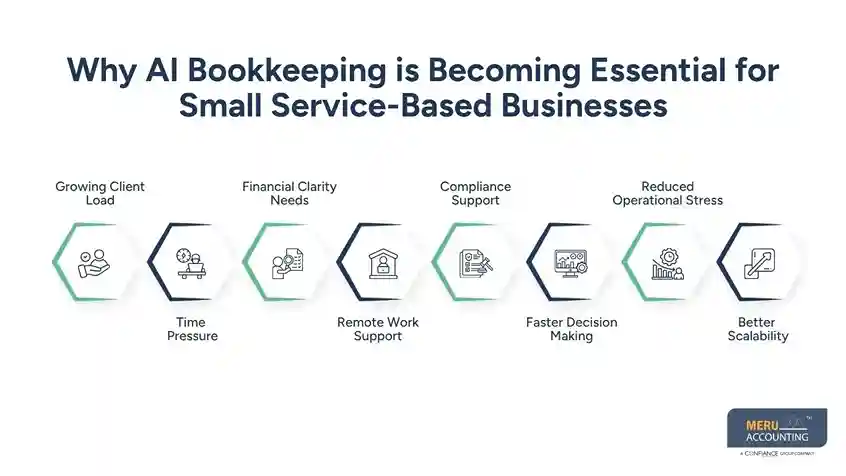
Compliance Support
Tax and reporting rules require accurate and updated records. AI helps maintain clean financial data that supports audits and compliance checks.
Faster Decision Making
Real-time financial updates help service-based businesses respond quickly to changes. Better visibility improves confidence in pricing, hiring, and budgeting decisions.
Reduced Operational Stress
Automated financial tracking reduces the pressure of managing daily bookkeeping tasks. Teams can focus more on client delivery and service quality.
Better Scalability
Growing service businesses need systems that handle increasing transactions without complexity. AI systems scale smoothly as business operations expand.
Key Benefits of Using AI Bookkeeping for Small Businesses
Improved Accuracy
AI systems reduce human errors in calculations and data entry. An AI bookkeeper ensures financial records stay more reliable and consistent.
Time Savings
Routine bookkeeping tasks are completed much faster with automation. This allows business owners to focus more on growth and client work.
Better Decision Making
Real-time financial insights support faster and more informed planning. These insights help owners take better control of daily financial choices.
Scalable System
AI systems can handle increasing transaction volumes as the business grows. No major process changes are needed when scaling operations.
Easy Financial Monitoring
AI bookkeeping for small businesses shows income, expenses, and profit in clear dashboards. This makes financial tracking simple, even for non-accountants.
Cost Efficiency of Using AI Bookkeeping for Small Businesses
Reduced Staffing Costs
Small businesses do not need large accounting teams to manage daily records. An AI bookkeeper handles repetitive tasks at a lower operational cost.
Lower Error Costs
Mistakes in manual bookkeeping can lead to financial losses and corrections. AI reduces these risks by improving accuracy in data handling.
Subscription-Based Tools
Many AI systems run on affordable monthly subscription plans. This makes financial management tools accessible for small businesses.
Less Training Required
Employees do not need deep accounting knowledge to use AI tools. Simple dashboards make it easy to manage financial data.
Long-Term Savings
AI bookkeeping for small businesses helps reduce overall operational costs over time. It improves efficiency, which leads to stronger financial control and savings.
How AI Bookkeeping for Small Businesses Works in Real Time
Bank Feed Integration
AI connects directly with business bank accounts to capture transactions automatically. Every financial movement is recorded in real time without manual input.
Invoice Matching
Incoming payments are matched with issued invoices instantly. This helps track pending dues and improves payment clarity.
Expense Tracking
Business expenses are captured immediately through cards, receipts, or digital payments. This ensures that no transaction is missed or left unrecorded.
Instant Reports
AI bookkeeping for small businesses updates profit, loss, and cash flow reports without delay. This gives owners continuous access to financial performance data.
Alert Systems
An AI bookkeeper sends alerts for low cash balance or unusual spending activity. These alerts help business owners avoid risks and maintain financial control.
How Meru Accounting Supports AI Bookkeeping Solutions
AI-Based Setup Support
Meru Accounting helps businesses implement AI bookkeeping for small business solutions based on their size and needs. Suitable tools are selected to match business structure and financial goals.
Migration Assistance
Businesses moving from QuickBooks, Xero, or manual systems receive complete support. Safe data transfer ensures financial records remain accurate and complete.
Real-Time Monitoring Support
Our team guides clients in understanding dashboards and reports generated through AI systems. Clear financial visibility helps business owners interpret data with confidence.
Hybrid Accounting Model
Meru Accounting combines automation with expert review for stronger accuracy. An AI bookkeeper handles routine tasks while professionals ensure compliance and control.
Global Client Support
Meru Accounting supports clients across the US and other regions with remote services. Services are designed specifically for service-based businesses operating in different markets.
Our Expert Perspective
From our experience at Meru Accounting, small service-based businesses often struggle not because of low revenue, but because of weak financial visibility. When AI bookkeeping for small businesses is applied with proper setup and expert review, owners gain clearer control over cash flow and planning. We have seen businesses reduce reporting delays and improve decision-making speed simply by shifting to structured AI-supported systems.
Key Takeaways
- AI bookkeeping for small businesses improves accuracy and reduces manual work through automation
- Service-based businesses benefit from real-time financial tracking and clearer visibility of cash flow
- Costs reduce significantly as repetitive accounting tasks are handled automatically
- Financial decisions become faster and more informed due to instant reporting and insights
- AI systems support scaling needs and help maintain compliance with financial rules
- An AI bookkeeper still requires human expert review for final financial control and accuracy checks
FAQs
AI bookkeeping for small businesses is a system that uses smart tools to record, track, and manage financial data automatically with minimal manual work. Automation improves speed, accuracy, and consistency in financial records.
Most systems use strong encryption and bank-level protection to secure financial information. Security remains a key focus in modern digital accounting systems.
Small service-based companies can easily adopt AI bookkeeping for small businesses due to simple and user-friendly tools. Non-accountants can manage financial tasks using clear dashboards.
An AI bookkeeper reduces manual workload but does not replace professional accountants. Accountants remain important for review, compliance, and financial planning.
Lower operational costs are achieved through automation of routine tasks, reduced manual workload, and improved accuracy in financial processes.