
Small businesses are under pressure to close books faster, reduce reporting errors, and maintain clear financial control. AI bookkeeping services help streamline the entire financial workflow by processing transactions in real time, improving accuracy, and ensuring that reporting cycles remain consistently updated without delays.
Small firms are increasingly adopting automated bookkeeping tools to access timely financial insights without expanding accounting teams. As transaction volumes grow, AI-driven systems ensure continuous data processing, reducing dependency on manual updates and significantly improving month-end closing efficiency.
What You Will Learn From This Blog
- How small businesses use AI bookkeeping services for faster reporting
- Why financial accuracy improves with automation tools and accounting software
- How invoice and expense tracking becomes easier with structured systems
- Ways predictive analysis changes financial planning for small firms
- Common myths about automated bookkeeping tools and real facts behind them
- How firms like Meru Accounting apply modern systems for client reporting
Introduction To The AI Bookkeeping Services
AI bookkeeping services use intelligent automation to record, sort, and classify financial data, reducing manual entry errors while creating a more structured and continuously updated accounting workflow.
Small businesses benefit from steady and consistent data flow, which makes financial records easier to manage and review over time. Earlier systems relied heavily on spreadsheets and manual posting, but now repetitive tasks are handled with much less effort from finance teams.
Modern accounting software integrates with automated bookkeeping systems to process invoices, receipts, and bank feeds in real time, ensuring faster and more reliable financial data updates. This combination ensures quicker updates in financial records and reduces delays in reporting cycles.
With rule-based learning, expenses and income are categorized more accurately, which improves consistency in financial statements across different months.
As transaction volumes increase, small firms are adopting integrated accounting systems that scale with data growth while maintaining consistent reporting speed and accuracy. This shift also reduces dependency on manual work and helps maintain more reliable financial records for day-to-day decision-making.
How AI Bookkeeping Services Are Transforming Financial Reporting Speed And Accuracy For Small Businesses
Faster Month-End Closing
Automated financial systems reduce the time needed for closing financial books. Transactions are updated in real time, which shortens reporting cycles and helps small businesses prepare statements without long delays.
Reduced Human Entry Errors
Manual mistakes often affect reports and create mismatches in ledgers. With automation, data entry is handled in a structured way, which improves accuracy and builds stronger trust in financial reports.
Real-Time Data Processing
Financial updates happen instantly when linked with accounting software. This allows business owners to view current financial status without waiting for end-of-month summaries.
Better Cash Flow Tracking
Small businesses can monitor inflows and outflows on a daily basis. This supports better payment planning and reduces the risk of cash shortages during operations.
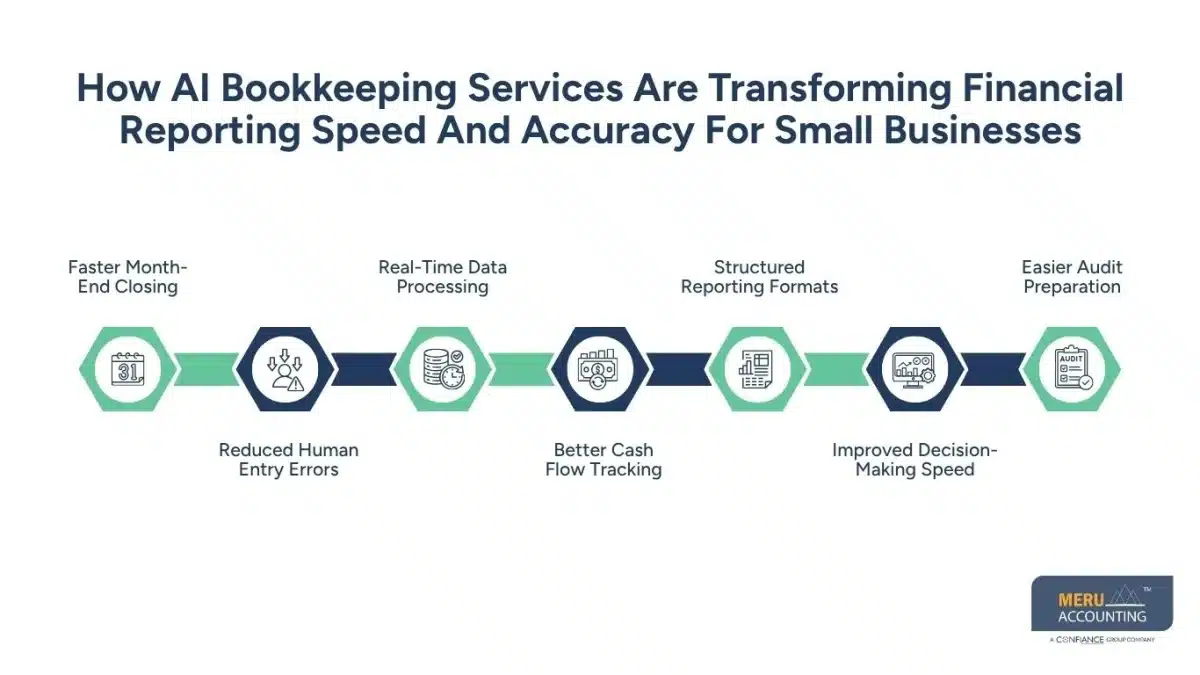
Structured Reporting Formats
AI bookkeeping services combined with accounting systems ensure that financial statements follow consistent reporting formats. This improves clarity and makes comparisons across months easier for decision-making.
Improved Decision-Making Speed
With faster access to updated financial data, business owners can make quicker decisions related to spending, hiring, and investments. They do not need to rely on delayed reports for important financial choices.
Easier Audit Preparation
Clean and organized financial records reduce effort during audits. Automated categorization ensures that supporting documents are easier to trace and verify when needed.
How AI Bookkeeping Services Automate Invoice And Expense Management
Automatic Invoice Capture
Automated systems scan and record invoices directly from email or uploads. This reduces manual data entry and saves time while improving record consistency.
Expense Categorization
Expenses are sorted automatically using accounting software rules. Categories are assigned based on past patterns, which helps maintain structured financial records.
Receipt Matching Systems
Receipts are matched with transactions without manual checks. This improves accuracy in financial reconciliation and reduces errors during review.
Vendor Payment Tracking
Small businesses can track vendor payments easily and avoid missed due dates. This helps maintain better control over outgoing cash flow.
Integration With Accounting Tools
When integrated with accounting software, AI bookkeeping systems ensure that all invoices and financial entries are accurately recorded, improving consistency and reporting reliability across accounting records.
How AI Helps In Predictive Financial Analysis And Forecasting
Revenue Trend Analysis
Automated systems analyze past financial data to identify revenue patterns. Sales behavior becomes easier to understand, which supports better planning for future strategies.
Expense Forecasting
Using accounting software, expense behavior is studied to estimate future costs. Financial planning becomes more structured, with fewer unexpected spending gaps.
Cash Flow Prediction
AI bookkeeping services process historical financial data to predict possible cash shortages or surpluses. Businesses can prepare in advance for financial pressure or investment opportunities.
Risk Identification
Unusual spending patterns are flagged early, allowing corrective action before financial issues grow. Financial stability improves while avoidable losses are reduced.
Budget Planning Support
Financial systems help create more realistic budgets based on past trends. Planning aligns more closely with actual business performance and financial capacity.
How AI Bookkeeping Improves Financial Transparency For Stakeholders
Clear Financial Reporting
Investors and stakeholders receive accurate reports generated through automated systems, which reduces confusion and improves understanding of financial performance.
Financial clarity increases when data is updated in a consistent and structured manner across reporting cycles.
Audit Ready Records
Records maintained through accounting software are well structured and easier to audit when processed by AI bookkeeping services, making verification faster and more reliable.
Proper documentation flow ensures that every transaction can be traced back to its source without difficulty.
Reduced Data Conflicts
Consistent classification reduces disputes in financial interpretation between departments, ensuring that all teams refer to the same financial figures.
Standardized recording practices help avoid differences in reporting across internal teams.
Faster Access To Reports
Stakeholders can access updated reports without waiting for manual compilation, which improves decision-making speed and communication flow.
Real-time financial data access enables faster responses to operational changes, allowing businesses to adjust strategies without relying on delayed reporting cycles.
Improved Trust In Data
Reliable outputs from automated financial systems build confidence among investors and partners, supporting stronger financial relationships.
Consistency in reporting strengthens long-term financial credibility across all stakeholders.
Common Misconceptions About AI Bookkeeping Services
Automation Replaces Human Role
Many believe AI bookkeeping services remove accountants, but they actually reduce manual load while professionals handle analysis. Human review remains important for financial accuracy and decision support.
Only Large Firms Benefit
Small businesses gain strong value when automated systems are paired with simple accounting software systems. Even small teams can handle growing transaction volumes with better efficiency.
Setup is Complex
Modern tools are simple to integrate and require minimal technical knowledge. Most systems offer guided setup that reduces onboarding effort.
High Cost Concern
Many assume high cost, but small firms often save money due to reduced manual work. Lower operational effort often balances or reduces overall accounting expenses.
Lack Of Control Over Data
Businesses still retain full control over financial data processed through automated systems. Access rights and permissions remain managed by the business owner or finance team.
Why Choose Meru Accounting?
Meru Accounting supports small businesses in building structured financial systems using modern tools. We integrate AI bookkeeping services with reliable accounting software to improve reporting speed, accuracy, and overall financial clarity. This approach helps business owners manage financial data in a more organized and consistent way.
Each business receives a customized setup based on its size and operational needs, ensuring smooth adoption of new systems. Companies moving from spreadsheets or older tools are guided through a complete transition process with proper support in accounting software migration. Clients also benefit from real-time financial dashboards powered by automated bookkeeping systems, which provide quicker access to updated reports.
Our skilled accounting team reviews automated outputs to maintain accuracy and compliance across all records. The main focus remains on delivering clear and structured financial reports that help business owners make better and more confident financial decisions supported by AI bookkeeping services.
Our Expert Perspective
From our expert perspective, small businesses often struggle not with data collection, but with delays in reporting and inconsistent classification. The use of AI bookkeeping services combined with structured accounting software has shown clear improvement in reporting timelines and decision readiness. The key is not full automation, but a balanced use of technology with professional review to maintain financial trust and accuracy.
Key Takeaways
- AI bookkeeping services reduce reporting delays for small businesses
- Integration with accounting software improves financial accuracy
- Automation reduces manual errors in invoices and expenses
- Predictive insights support better financial planning
- Small firms gain transparency and faster decision-making ability
FAQs
Automation of financial recording, reporting, and classification of business transactions is the main purpose.
Accurate data handling becomes easier, and reporting cycles become faster with such tools.
Costs usually remain flexible and are often lower than those of manual bookkeeping setups.
Data is protected with encryption and secure access controls in most systems.
Transaction processing happens instantly, reducing manual entry delays significantly.