
AI bookkeeping is changing how small firms handle records, tax data, and cash flow tracking. Many owners now rely on automated systems to reduce manual entry work and keep financial data more organized throughout the year. As small firms grow, financial systems become more important for handling large transaction volumes with fewer errors.
Small firms often face issues like missed entries, delayed reports, and tax stress. AI-powered bookkeeping systems reduce these issues by using pattern detection and rule-based automation. These systems also connect with banking platforms and accounting tools to update records in real time, which keeps books more consistent and easier to manage.
This blog explains how automated bookkeeping systems work, their benefits, limitations, and how small firms can choose the right system. It also shares how professional firms like Meru Accounting support clients in adopting automated bookkeeping systems in a safe and structured way.
What You Will Learn From This Blog
- How financial automation changes financial tracking for small firms
- Key benefits of automation in daily financial operations
- How automated accounting systems differ from traditional accounting systems
- Features to check before choosing a system
- Risks and limits of automation in finance
- How to select the best financial automation service for business needs
- How Meru Accounting supports AI-based financial management
Introduction to AI Bookkeeping In Modern Financial Management
AI bookkeeping systems now record, sort, and classify financial data with minimal manual input. Machine learning helps detect patterns in transactions and assigns correct categories, which supports more structured and accurate financial records for small firms. This reduces dependency on manual entry and improves consistency in day-to-day accounting work.
Automation also plays a key role by pulling data directly from bank feeds, invoices, and payment systems. Income and expenses are recorded in structured formats, which lowers the chances of human error in financial records. This makes it easier for businesses to maintain updated books without waiting for manual reconciliation at the end of the month.
Many small firms are shifting to AI bookkeeping to save time during monthly closing and reduce pressure on internal finance teams. Traditional bookkeeping relies heavily on manual entry and spreadsheets, which often lead to delays and mistakes.
In comparison, modern automated systems use rule-based matching and data syncing to speed up updates and improve accuracy. Due to these advantages, demand for automated bookkeeping solutions is growing across e-commerce, service-based firms, and freelance businesses that require daily financial tracking.
Key Benefits of AI Bookkeeping For Small Businesses
Faster Transaction Processing
- Many businesses adopt the best AI bookkeeping service to ensure real-time transaction tracking and improved financial accuracy.
- Financial updates stay current without waiting for manual entry or month-end closing.
- Cash movement becomes easier to track, which supports quicker decision-making.
Reduced Human Error
- Invoices, receipts, and payments are matched automatically through system-based validation.
- Manual entry mistakes are reduced significantly due to structured automation rules.
- Financial records remain more consistent across reporting periods and internal reviews.
Better Cash Flow Tracking
- Clear visibility is provided into incoming and outgoing cash movements.
- Spending patterns become easier to identify across weekly and monthly cycles.
- Budget planning becomes more structured with clearer financial insights.
Easier Tax Preparation
- Tax-related financial data is organized throughout the year in a structured format.
- Records remain ready for reporting without last-minute sorting or corrections.
- Tax filing becomes more accurate due to clean, updated transaction history.
Lower Operational Cost
- Dependence on large accounting teams for routine bookkeeping tasks is reduced.
- Repetitive work such as data entry and reconciliation is handled through automation.
- Overall bookkeeping expenses reduce while maintaining consistent financial control.
How AI Bookkeeping is Transforming Traditional Accounting Systems
Shift From Manual To Automated Systems
- Repetitive tasks such as data entry and reconciliation are now handled by automated tools.
- Accountants can focus more on reviewing records and analyzing financial performance.
- Financial updates become faster with fewer manual steps involved.
Real-Time Financial Reporting
- AI Bookkeeping systems generate financial reports instantly.
- Profit, loss, and expense data remain available without waiting for monthly closing.
- Business owners gain quicker access to financial performance updates.
Integration With Banking And Payment Tools
- Modern bookkeeping systems connect directly with bank accounts and payment applications.
- Transactions sync automatically without manual importing or exporting of data.
- Financial records stay continuously updated across platforms.
Better Decision Support
- Financial systems identify trends from historical transaction data.
- Cost patterns and revenue cycles become easier to understand.
- Planning decisions improve due to clearer financial visibility.
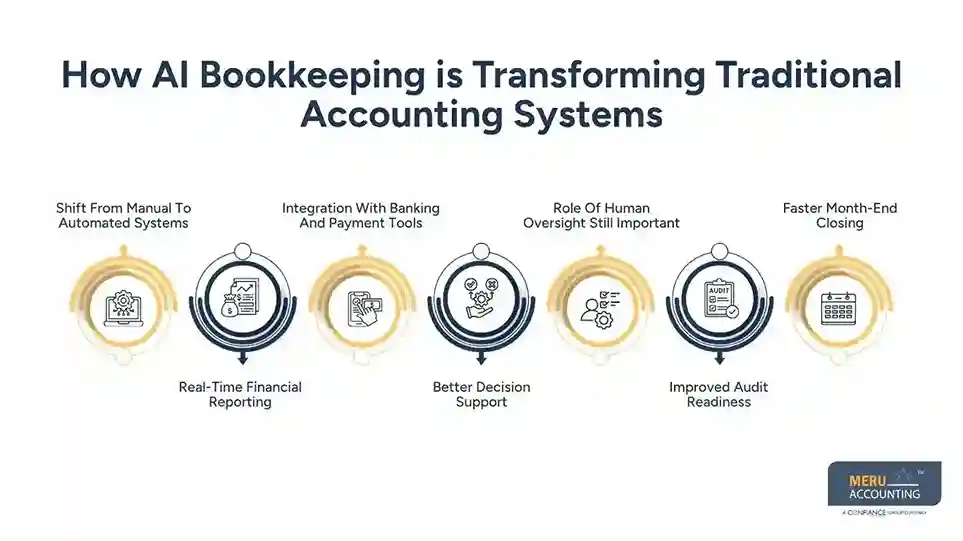
Role Of Human Oversight Still Important
- Automated systems cannot fully replace professional judgment in complex cases.
- Accountants verify final reports to ensure accuracy and compliance.
- Tax rules and regulatory requirements still need human interpretation.
Improved Audit Readiness
- Organized records make audit processes easier and faster.
- Transaction trails remain clear and traceable for verification purposes.
- Audit preparation time reduces due to structured data storage.
Faster Month-End Closing
- Reconciliation time has been reduced significantly due to automated matching systems.
- Financial closing tasks complete faster with fewer manual corrections.
- Teams can finalize reports with improved speed and consistency.
Essential Features of a Reliable AI Bookkeeping System
Automated Data Entry System
- Invoices, receipts, and bank data are captured automatically through system integration.
- Manual workload reduces as routine data entry tasks are handled by the system.
- Financial records stay updated with minimal manual intervention, which is one of the reasons businesses prefer the best AI bookkeeping service for automation efficiency.
Smart Categorization Tools
- Transactions are classified into expense and income groups using structured rules.
- Reporting becomes cleaner and more organized due to accurate categorization.
- Financial analysis becomes easier with properly grouped data sets.
Secure Data Handling
- Strong security protocols protect sensitive financial information from unauthorized access.
- Data encryption ensures records remain safe during storage and transfer.
- System access is controlled through secure authentication methods.
Cloud Access And Sync
- Cloud-based access allows users to view financial records from any location.
- Remote teams can manage and update records without physical systems.
- Data sync ensures consistency across all connected devices, especially in AI-powered bookkeeping systems where real-time updates are critical.
Integration With Accounting Software
- Seamless connection with tools like QuickBooks, Xero, and ERP platforms.
- Financial data flows smoothly between systems without manual transfer.
- Reporting and reconciliation become more efficient through integrated systems.
Challenges and Limitations of AI Bookkeeping For Small Businesses
Data Accuracy Dependence
- System output depends heavily on the quality of input data provided.
- Incorrect or incomplete entries can lead to errors in classification and reporting.
- Regular checks are needed to maintain accuracy in financial records.
Limited Human Judgment
- Complex financial decisions still require human review and interpretation.
- Automated systems may struggle with unusual or non-standard transactions.
- Final approval from accounting professionals remains necessary for accuracy.
Setup And Learning Curve
- Small firms often need time to understand system functions and workflows.
- Initial setup may require effort depending on business size and data volume.
- Training is often needed to ensure proper use of features.
Compliance Risk Concerns
- Financial systems must follow tax rules and accounting standards.
- Incorrect configuration can lead to reporting and compliance issues.
- Regular monitoring is required to ensure alignment with regulatory requirements.
System Dependency Issues
- Operations depend on stable internet and software availability, which is an important consideration when selecting the best AI bookkeeping service for business continuity.
- Technical disruptions can temporarily affect access to financial data.
- Backup systems are important to avoid data access delays.
How To Choose The Best AI Bookkeeping Service For Your Business
Check Automation Quality
- The best AI bookkeeping service should handle invoices, expenses, and bank reconciliation with minimal manual effort.
- Automation must reduce repetitive tasks and maintain consistent financial records across all transactions.
- Accuracy in processing entries is a key factor when evaluating any automated bookkeeping service.
Review Security Standards
- Data encryption must be used to protect sensitive financial information.
- Service providers should follow recognized financial compliance and security rules.
- Access controls and secure login systems are important for data safety.
Look At Software Integration
- The system should connect smoothly with accounting tools and banking platforms.
- Integration reduces manual data transfer and improves record consistency.
- Compatibility with existing business software improves overall efficiency.
Evaluate Customer Support
- Reliable providers offer timely assistance during setup and daily usage.
- Support teams should help resolve technical and operational issues quickly.
- Clear guidance and training resources improve user experience.
Compare Pricing Plans
- Pricing should match business size and transaction volume.
- A transparent cost structure helps avoid hidden charges.
- Flexible plans allow businesses to scale as needs grow.
Top Factors to Consider Before Adopting AI Bookkeeping Tools
Business Size And Needs
- Tools must match the transaction volume and complexity of the business.
- Proper selection ensures smooth handling of daily financial records without overload.
Industry Type
- Different industries require different settings, especially retail, SaaS, and service firms.
- System configuration should align with industry-specific workflows for accurate reporting.
Data Privacy Requirements
- Financial automation systems must follow strict privacy rules for handling financial data.
- Strong encryption and access control protect sensitive business and customer information.
- Secure handling within automated financial systems reduces the risk of data misuse or breaches, especially when using the best AI bookkeeping service with advanced encryption protocols.
Scalability Options
- The system should grow with the business and support increasing data loads over time.
- Scalable solutions ensure consistent performance even as transaction volume increases.
Vendor Reliability
- Choose trusted providers with proven experience in financial automation solutions, as the best AI bookkeeping service typically comes from vendors with strong industry credibility.
- Reliable vendors offer stable performance, regular updates, and long-term support.
Why Choose Meru Accounting?
Meru Accounting provides structured financial support for small and mid-sized firms that are adopting automated financial systems. We help businesses shift from manual processes to digital systems in a controlled and secure way, ensuring financial records remain accurate during the transition.
We also support clients in selecting the right financial automation service based on business type, transaction volume, and reporting needs. Our approach ensures proper setup with correct classification rules, clean data flow, and compliance checks so that financial records remain well-organized and reliable.
Along with implementation, we offer continuous review and monitoring support to maintain accuracy in financial reporting, aligning with the standards expected from the best AI bookkeeping service. This includes reconciliation checks, reporting assistance, and system oversight to ensure data stays aligned with tax and accounting requirements.
By combining professional accounting expertise with modern financial tools, we help businesses maintain clear, structured, and usable financial data that supports better decision-making and long-term stability.
Our Expert Perspective
From our experience working with small firms across different industries, financial data issues often arise due to delayed recording and poor categorization.
Automated accounting systems reduce this gap by keeping records updated in near real time, which helps maintain better financial clarity throughout the year.
However, we also observe that automated systems still require human checks to ensure accuracy and compliance with tax regulations, even when using the best AI bookkeeping service. Without proper review, even well-structured data can lead to reporting gaps or classification errors that affect decision-making.
When automated accounting systems are combined with professional oversight, small firms gain stronger financial control and face fewer challenges during year-end closing. This balanced approach supports both efficiency and accuracy in financial management.
Key Takeaways
- Digital accounting systems cut down on manual work and increase processing speed
- AI-powered bookkeeping systems give better cash flow visibility for small firms, particularly when implemented through the best AI bookkeeping service
- Human review is still needed for accuracy and compliance
- Financial management tools must be chosen based on business needs
- Security and integration are key factors in system selection
- Professional support can make adoption smoother and safer
FAQs
AI Bookkeeping is software that records and sorts financial data automatically. Manual entry is reduced as records stay updated with system-based processing.
Safety is ensured when strong security and encryption systems are used. Regular monitoring is still important for reliable financial control.
No, it cannot fully replace accountants. Human review is still needed for tax filing and financial decisions.
Financial records are organized throughout the year, making tax filing faster and more accurate.
The best service depends on business size, software needs, and integration options. Firms should compare features before choosing.