Are real estate taxes deductible when you own more than one home, rental unit, or investment property? In many cases, yes. But the tax rule can change based on how each property is used. A rental home, a home used for part of the year, and a home held for your own use may not get the same tax treatment.
For rental property, real estate taxes are often treated as a rental cost and may be used to offset rental income. For a home you use for yourself, the rules can be tied to itemized deductions and the state and local tax, or SALT, limit.
When you own more than one property, good records are key. Each tax bill, payment, use date, and rental share should be kept by property. The right method can lower tax risk and make tax filing much clearer.
What You Will Learn From This Blog
- How real estate tax rules work for more than one property.
- When rental property taxes can be claimed as a rental cost.
- How personal-use and mixed-use property can change the tax result.
- How to track tax bills and payments for each property.
- What SALT limits may apply to personal property taxes.
- Common errors that can cause a tax claim to be wrong.
- How a tax pro can sort tax costs across many properties.
- How Meru Accounting can keep property books and tax records in order.
How Does The Property Tax Deduction Work?
Tax On Real Property
Are real estate taxes deductible when a local tax body bills you for land or a home? In general, state and local real property taxes may be deductible when the tax meets IRS rules. The tax must be based on the value of real property and be levied for the public good.
Rental Property Tax
For a rental home, real estate tax is often a rental cost. The IRS says common rental costs, such as taxes, can be taken from rental income when the cost meets the rules.
Personal Property Tax
A home that you use for your own stay may fall under a stricter set of rules. The tax may be part of your itemized property tax deduction, but the SALT cap can limit the amount you can claim on Schedule A.
More Than One Home
Owning two or more homes does not mean each tax bill gets the same tax result. Each home must be looked at based on its use, tax type, and how the cost was paid.
Tax Paid At Closing
A tax bill paid at the time of a home sale can need care. If you pay real estate tax that the seller owed and the seller does not pay you back, the amount may be added to your property basis rather than treated as a tax paid by you for a current deduction.
Keep Each Tax Bill
Keep the tax bill, proof of payment, closing papers, and property records. Good files make it easier to show which property the cost belongs to and why the amount was claimed.
Are Real Estate Taxes Deductible On Rental Properties?
Rental Tax As A Cost
Are real estate taxes deductible on a home that is rented to tenants? In general, real estate taxes paid for a rental property can be treated as a rental expense. The cost is usually reported with the rental activity rather than as a personal itemized tax.
Tax And Rental Income
A rental owner may have rent from many units and tax costs for each unit. Each tax bill should be tied to the right property so the rental income and costs are clear.
Part-Year Rental
A home may start as a personal home and later become a rental. In that case, the yearly tax cost may need to be split based on the period of rental use and personal use. The IRS gives an example where yearly tax and other costs are split when a home changes to rental use.
Mixed Personal Use
A rental home that is also used by the owner needs more care. Tax costs may need to be split between rental and personal use. The rental share may be used with the rental activity, while the personal share follows personal tax rules.
Part Of A Home
Renting just one part of a home can also call for a split. The IRS notes that real estate taxes for the rental part may be treated as rental costs, while the personal part remains subject to personal tax rules.
Fair Rental Use
The tax result can also depend on how many days a home is rented and how many days it is used for personal use. A vacation home can have special rules when personal use is high.
Are Real Estate Taxes Deductible For Investment Properties?
Property Held For Income
Are real estate taxes deductible for an investment property that is held to earn rent? In many cases, tax paid on such a property can be treated as a cost of the rental activity when the property is held for rental use.
Property Held For Sale
A property held for sale may have a different tax result from a rental home. Tax costs and other carrying costs need to be reviewed based on the type of activity and tax rules that apply.
Vacant Rental Property
A rental home does not need to have a tenant every month for all tax rules to stop. The IRS says some ordinary and necessary costs may still be claimed when a property is held for rent but is vacant.
Investment Property Records
Keep a file for each investment home. The file can show the tax bill, date paid, rent record, bank entry, and use of the home.
Multiple Investment Homes
When an owner has five, ten, or more homes, one combined tax file can make review hard. A property-by-property record gives a clear view of tax cost and rental results.
Tax Basis Matters
Not every tax-like cost qualifies for a current property tax deduction. Some costs tied to a home can form part of the home’s tax basis. That basis may then affect future gain, loss, or depreciation.
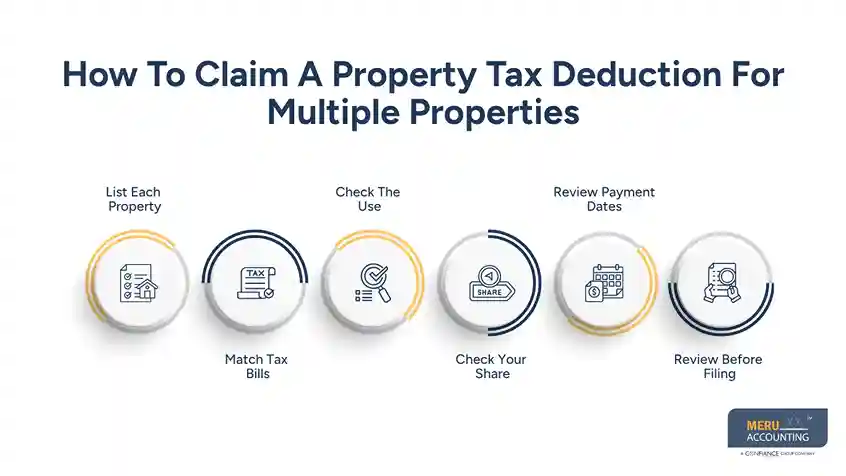
How To Claim A Property Tax Deduction For Multiple Properties
List Each Property
Start with a full list of homes, units, land, and other real property. Add the property address, type, use, ownership share, and tax year.
Match Tax Bills
Match each tax bill to the right property. Do not place all tax payments in one broad account if that makes it hard to tell which home paid the cost.
Check The Use
Mark each property as rental, personal, mixed use, or another type. The use of the home can change where the tax cost is claimed.
Check Your Share
If you own only part of a rental property, your share may be based on your ownership share. IRS guidance gives an example where a person with a one-half share can claim one-half of a rental cost they paid.
Review Payment Dates
For many rental owners using the cash method, rental costs are generally claimed in the year they are paid. Keep bank records that show the date and amount paid.
Review Before Filing
Before the tax return is filed, compare tax bills with the books and bank records. A final review can catch duplicate payments, missing bills, and wrong property codes.
optional anymore
on running the business
What Limits Apply To Real Estate Tax Deductions?
SALT Limit
Are real estate taxes deductible without a limit when a person owns many personal homes? Not always. Personal state and local taxes can be subject to the SALT limit on Schedule A. Current IRS guidance says the overall SALT deduction is subject to a combined limit, with special rules based on filing status and income.
Rental Tax Rules
Rental tax costs can be treated in a different way from personal property tax. A rental tax cost may be part of the rental activity rather than part of the personal SALT claim.
Personal Use
If you use a rental home for personal stays, the tax cost may need to be split. Only the part tied to rental use may be treated as a rental cost in the manner set by the IRS.
Local Benefit Tax
Not every charge from a local body is a deductible real estate tax. Some charges for local benefits that add value to a property must be added to the property’s basis instead.
Other Tax Charges
Transfer taxes, stamp taxes, HOA fees, and some service charges are not the same as deductible real property taxes and may not qualify for a property tax deduction. The IRS lists several taxes and fees that are not deductible on Schedule A.
Income Limits
Some tax claims can also face other limits based on the type of property, rental activity, personal use, or the owner’s income. A tax pro should review the full return rather than looking at the tax bill alone.
Common Property Tax Deduction Mistakes To Avoid
Mixing Property Records
One common error is putting tax costs for all homes into one account. Separate records make it easier to see the tax cost for each property and reduce the risk of a wrong claim.
Claiming Personal Costs As Rental Costs
A personal-use share should not be treated as a rental cost just to raise the rental expense total. The IRS requires a fair split when a property has both rental and personal use.
Missing Ownership Share
A co-owner should not claim the full tax bill when only part of the property is owned. The amount should be checked against the ownership share and payment record.
Ignoring Closing Papers
Tax paid at closing can be easy to code in the wrong way. Some amounts may be part of basis, while other tax amounts may be deductible based on the facts.
Treating Every Fee As Tax
A bill from a city or county may include more than real estate tax. Service fees and local benefit charges can have a different tax result.
Failing To Keep Proof
A tax return should be backed by good records. Keep tax bills, payment proof, closing files, rental records, and notes on personal use for each property.
How Tax Professionals Handle Real Estate Taxes For Multiple Properties
Review The Property List
A tax pro first checks all properties owned by the client. The review can include homes, rental units, land, and mixed-use property.
Check Property Use
Each property is then reviewed based on its use. Rental, personal, mixed-use, and vacant rental property can have different tax treatment.
Match Books To Tax Forms
The books should match the tax records. Rent, tax payments, repairs, insurance, and other costs should be tied to the right property.
Review Special Rules
A tax pro can review SALT limits, rental loss rules, personal-use rules, ownership shares, and tax basis issues. The goal is to claim valid costs, including an appropriate property tax deduction, without treating a non-deductible cost as a write-off.
Keep A Clear Audit Trail
A clean file should show how each number was found. Tax bills, bank entries, invoices, closing papers, and property reports can form a clear record.
Plan Before Tax Time
Tax work is easier when property records are kept during the year. A monthly or quarterly review can find gaps before the annual return is due.
How Meru Accounting Can Help With Multiple Property Records
Keep Property Books
Meru Accounting can keep income and costs grouped by property. Separate books make it easier to see rent, tax, repair, and other costs for each home.
Track Tax Payments
Our team can record property tax bills and payments in the right accounts. Each entry can be tied to the right property and bank record.
Keep Records Ready
Meru Accounting can keep bills, bank data, and property records in a clear order for review. Tax pros can then work from cleaner records when preparing returns.
Review Property Data
Our team can compare property records with bank activity and other source data. Missing or odd entries can be flagged for review before tax filing.
Support Owner Reports
Property owners can get reports that show income and key costs by property. Such reports can give a clear view of cash flow and property results.
Our Expert Perspective
Are real estate taxes deductible is not a question that should be answered from the tax bill alone. In our experience, the right answer starts with the use of the property, the type of tax, the owner’s share, and the way the cost was recorded.
For owners with many properties, keeping each tax bill tied to one property is one of the best ways to reduce errors. Meru Accounting focuses on clean property-level books so owners and tax pros have better records when tax work begins.
Key Takeaways
- Are real estate taxes deductible depends on how the property is used and what type of tax was paid.
- Rental property taxes can often be treated as rental expenses under IRS rules.
- Personal property tax can be subject to the SALT limit.
- Mixed-use homes may need a split between rental and personal use.
- Property tax paid at closing needs a review of the closing papers and tax basis.
- Local benefit charges may not get the same tax treatment as normal property tax.
- Each property should have its own clear tax and payment records.
- A tax pro should review the full facts before a return is filed.
- Good books can make tax review clearer and reduce the risk of wrong claims.
FAQs
Yes. Are real estate taxes deductible on rental property? In many cases, paid real estate tax can be treated as a rental expense when the property is held for rental use, and the IRS rules are met.
Yes, but the rules can differ by property. Rental homes may use rental expense rules, while personal homes may be subject to itemized deduction and SALT rules.
Often, yes, but the tax cost may need to be split between rental and personal use. The IRS requires allocation when a property has both uses.
No. Some local benefit charges, transfer taxes, service fees, and other charges may not qualify as a normal property tax deduction. Some costs may instead be added to property basis.
Keep the tax bill, proof of payment, bank records, closing papers, ownership details, and rental-use records. For many properties, keep these records by property so each claim can be traced to its source.
optional anymore
on running the business