
Bank reconciliation services give businesses a structured way to compare bank records with their accounting books. When you manage several checking, savings, credit, payroll, or merchant accounts, reviewing every transaction by hand can become difficult. Small differences can turn into larger reporting errors when they aren’t identified and resolved on time.
For this reason, many businesses use bank reconciliation services to review cash records, identify missing entries, and keep account balances aligned with their books. The IRS also advises businesses to reconcile their checking accounts and maintain records that support income, expenses, and tax returns.
In this blog, we’ll explain how reconciliation works when a business has multiple accounts, why regular reviews matter, and when outsourced bank reconciliation services may fit your accounting needs.
What You Will Learn From This Blog
- Why businesses with many bank accounts need regular account checks.
- How bank reconciliation works from statement review to final balance.
- What common errors can appear across several accounts.
- When outsourced bank reconciliation services may be useful.
- How good account checks can improve the quality of financial records.
- What to look for when choosing a service provider.
What are Bank Reconciliation Services?
Bank reconciliation services compare the balance shown by a bank with the balance recorded in the accounting system. The process checks deposits, checks, card payments, transfers, and other cash entries and matches them with the related entries in the books. This comparison shows whether the bank and accounting records agree and brings attention to any difference that needs review.
The review also looks for items that may appear on the bank statement but are missing from the books, such as bank fees, interest, service charges, or other transactions. Each difference is checked to find its cause, which may be a missing entry, timing gap, wrong amount, or other record issue. When needed, the correct entry is recorded in the right account after review.
Bank reconciliation services also include checking bank statements against invoices, receipts, payment records, and other source files. The items reviewed, differences found, and changes made can be kept as a clear audit trail. These records give the finance team support for its accounting entries and help maintain documents needed to support business income and expenses reported for tax purposes.
Why do Businesses Need Bank Reconciliation Services for Multiple Accounts?
More Accounts Mean More Checks
A business may use separate accounts for payroll, sales, taxes, savings, credit cards, or different units. More accounts mean more records to compare each month.
Cash Can Move Between Accounts
Transfers between company accounts can create confusion if one side is recorded but the other side is not. Regular checks can find such gaps before month-end reports are closed.
Errors Can Affect Reports
A wrong bank entry can change the cash figure shown on the balance sheet. Bank reconciliation services give finance teams a way to find these errors before reports are used.
Tax Records Need Good Support
Bank data often links to income, expenses, and tax records. The IRS states that business records should clearly show income and expenses and support amounts reported on tax returns.
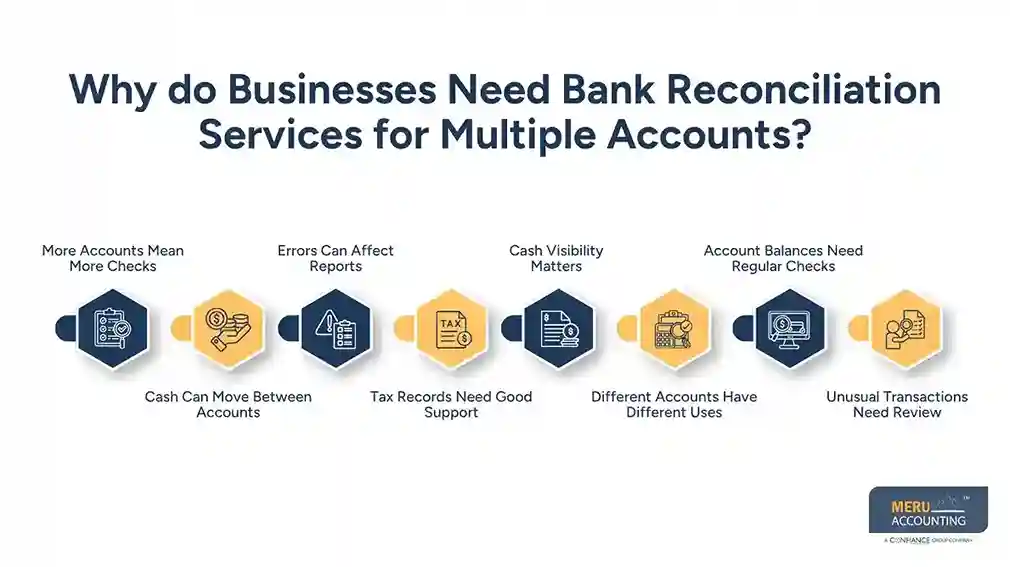
Cash Visibility Matters
A firm may have cash in several places but still face a shortfall in one account. A full account review gives management a better view of the cash that is actually available.
Different Accounts Have Different Uses
Each account may serve a different business need, such as payroll, taxes, sales receipts, or vendor payments. Reviewing them by purpose makes it easier to spot unusual activity.
Account Balances Need Regular Checks
A business may show cash in several accounts, but the book balance may not match the bank balance. Regular bank reconciliation services can identify these gaps before they affect financial reports.
Unusual Transactions Need Review
Large transfers, unexpected charges, or payments from an unfamiliar source may need further checking. Reviewing account activity can bring these entries to the attention of the finance team.
How Bank Reconciliation Works Across Multiple Business Accounts
Gather the Bank Statements
The first step is to collect statements for all accounts for the same review period. The finance team should also gather the matching ledger data from the accounting system.
Match Each Transaction
Deposits, withdrawals, checks, card charges, transfers, and other entries are compared. A matched item is marked so the same transaction is not checked twice.
List Unmatched Items
Items that appear on the bank statement but not in the books are listed for review. The same applies to book entries that have not yet appeared on the bank statement.
Review the Differences
The team then checks why each gap exists. It may be a timing issue, bank fee, data entry error, duplicate entry, or missing transaction.
Post Needed Corrections
Once the cause is known, valid changes are made in the accounting records. The account is then checked again to confirm that the adjusted balance agrees with the bank data.
Check Transfers Between Accounts
Transfers should be matched on both the sending and receiving accounts. This reduces the risk of recording the same movement twice or missing one side of the transfer.
Review Bank Fees and Interest
Bank fees, interest, and other charges may appear on statements without a matching book entry. These items should be checked and recorded in the correct account when valid.
Complete a Final Balance Check
After differences are reviewed and corrections are posted, the final book balance is compared with the bank balance. Any remaining difference should have a clear reason and supporting record.
Common Challenges of Reconciling Multiple Bank Accounts
High Transaction Volumes
A busy firm may have hundreds or thousands of bank entries each month. Manual checks can take more time and can make it harder to spot small errors.
Duplicate or Missing Transactions
A transaction may be entered twice or may not be entered at all. These gaps can cause the book balance to differ from the bank balance.
Unidentified Bank Charges
Monthly fees, wire fees, card fees, and other charges may appear first on the bank statement. If they are not entered in the books, the account will not match.
Timing Differences Between Records and Statements
A deposit may be recorded before the bank posts it, while a check may remain unpaid for some time. These timing gaps are common and need to be tracked.
Errors in Bookkeeping Records
A payment of $1,250 entered as $1,520 can create a clear difference. Reviewing the source record can show whether the bank or the books contain the error.
optional anymore
on running the business
How Bank Reconciliation Services Improve Financial Accuracy
Better Cash Records
Regular checks keep cash figures closer to the actual bank position. This gives finance teams a stronger base for monthly reports and cash planning.
Earlier Error Detection
Small errors are easier to fix when they are found soon after they occur. Waiting for year-end can make the source of an old difference much harder to trace.
Cleaner Month-End Closing
When accounts are checked on a set schedule, fewer open items remain at month-end. This can make the closing process more orderly.
Stronger Record Support
Bank statements, ledger entries, and source documents can be linked during the review. The IRS requires business records to support items reported on tax returns.
Clearer Financial Review
Owners and finance teams can review cash balances with more confidence when account differences have been checked. This does not replace financial judgment, but it gives decision-makers cleaner data.
When Should a Business Consider Bank Reconciliation Services?
The Business Has Several Accounts
Multiple bank accounts can make manual review hard to manage. A set process can keep each account on the same review cycle.
Transaction Counts are Rising
As sales, payroll, vendor bills, and transfers increase, account checks take more time. A business may need a dedicated process before the work starts to delay reporting.
Bookkeeping Errors Keep Appearing
Repeated balance gaps can point to weak entry checks or unclear workflows. Regular reconciliation can show where the same type of error keeps coming from.
Month-End Close Takes too Long
If finance staff spend too much time finding old bank differences, account review may need a better process. A clear monthly schedule can reduce the backlog.
The Business is Growing
New locations, payment channels, cards, or bank accounts add more records to review. At this stage, bank reconciliation services can provide a repeatable process across accounts.
Benefits of Using Outsourced Bank Reconciliation Services for Multiple Accounts
Access to Skilled Accounting Staff
Outsourced bank reconciliation services give a business access to staff who work with account matching and review tasks. This can be useful when an internal team has limited time.
A Set Review Process
An outside team can follow a fixed process for statements, matching, open items, and corrections. This gives the business a clear way to track pending work.
Less Work for Internal Staff
Finance staff can spend less time on repeated matching work and more time on tasks that need their direct review. The amount of work shifted outside can be set by the business.
Better Handling of Account Growth
As the number of accounts rises, outsourced bank reconciliation services can provide extra capacity without requiring the business to add a full internal team for this task.
Regular Reporting of Open Items
The provider can share a list of unmatched entries, missing records, and items that need client input. This makes it easier to know what still needs action.
How Meru Accounting Provides Bank Reconciliation Services
Review of Multiple Accounts
Meru Accounting reviews bank records against accounting entries for the accounts included in the agreed work scope. The process can cover business checking, savings, credit, and other account types.
Matching and Difference Checks
The team checks deposits, payments, transfers, fees, and other entries against the books. Differences are noted so the cause can be reviewed before corrections are made.
Support for Month-End Work
Meru Accounting can align reconciliation work with a business’s month-end accounting cycle. This gives finance teams a clearer account status before reports are prepared.
Clear Exception Lists
Unmatched items can be listed for review instead of being left without a note. This gives the business a record of entries that need more data or a decision.
Work Across Different Accounting Systems
Meru Accounting provides accounting and bookkeeping services for businesses using systems such as QuickBooks, Xero, Zoho Books, NetSuite, and Odoo. The exact process depends on the system and account setup.
Our Expert Perspective
When you manage several business accounts, the challenge isn’t simply reviewing more statements. You need to know whether every difference identified through bank reconciliation services has a valid explanation and supporting record.
A useful reconciliation review should answer three questions: what changed, why did it change, and which record supports the entry? That could mean checking a bank statement against an accounting entry, invoice, receipt, transfer record, or bank fee. Reviewing these records makes it easier to separate a genuine timing difference from an error that needs correction.
For businesses with a high transaction volume, outsourced bank reconciliation services can be useful when the internal team doesn’t have enough time for consistent account reviews. We recommend maintaining a clear record of unmatched items, documenting the reason for adjustments, and reviewing unusual transactions before the accounts are closed. Management should still retain control over approvals, corrections, and financial decisions.
Key Takeaways
- Multiple bank accounts require a clear and regular reconciliation process.
- Bank reconciliation services compare bank data with accounting records to identify differences.
- Common issues include missing entries, duplicate records, bank fees, timing gaps, and bookkeeping errors.
- A consistent reconciliation process can make cash records and month-end reports more reliable.
- Outsourced bank reconciliation services can add accounting capacity when your internal staff has limited time.
- You should keep bank statements and source records that support your accounting entries.
- A good review process should track unmatched items until they’re resolved.
FAQs
Bank reconciliation services check several bank accounts against business records to find differences and keep balances correct.
Businesses need bank reconciliation services to track cash, find record errors, and confirm that account balances match bank records.
To reconcile multiple accounts, compare each bank statement with the matching ledger, check differences, and record valid adjustments.
Common problems include missing entries, duplicate transactions, bank fees, timing gaps, wrong amounts, and unrecorded transfers.
Outsourced bank reconciliation services can provide regular account checks when a business has many transactions or limited internal accounting staff.
optional anymore
on running the business