Month-end close can become hard to manage when a real estate investor has many units, loans, tenants, vendors, and bank accounts to track. The best virtual assistants for real estate investors can take on key accounting work and keep each month on track.
For an investor, month-end close is more than checking whether rent came in. It may include bank checks, rent review, vendor bills, loan data, repairs, owner draws, and property-level reports. The IRS also notes that rental records should support income, expenses, financial statements, and tax returns.
The best virtual assistants for real estate investors should know how these tasks fit into the close process and when an issue needs review by an accountant or tax expert.
What You Will Learn From This Blog
- Why month-end close matters for real estate investors.
- How to assess the best virtual assistants for real estate investors before hiring one.
- Which real estate virtual assistant tasks can be part of a month-end close.
- What an outsourced virtual assistant for real estate can manage.
- Which records and checks should be part of a good close process.
- What questions to ask before giving an assistant access to financial data.
Why Month-End Close Matters for Real Estate Investors
Know Where Each Property Stands
A monthly close gives an investor a clear view of rent, costs, cash, and debt for each property. The best virtual assistants for real estate investors can sort data by property so one unit does not hide an issue in another.
Catch Missing Rent
Rent may be late, short, or posted to the wrong property. A monthly review can compare rent reports with bank activity and tenant data. This is one of the useful real estate virtual assistant tasks in a close cycle.
Review Property Costs
Repairs, tax, insurance, utilities, and management fees can change from month to month. The best virtual assistants for real estate investors can flag high or unusual costs for review before reports are closed.
Keep Records Ready
The IRS says records should support income and expenses reported on tax returns. Receipts, bills, statements, and other source files can be kept with the related entries.
Build a Clear Monthly Report
A close can end with a profit and loss report, balance sheet, cash view, and property report. These reports give investors a base for review, tax work, and future planning.
How to Choose the Best Virtual Assistants for Real Estate Investors for Month-End Close Support
Check Real Estate Accounting Skills
The best virtual assistants for real estate investors should understand rent, repairs, property tax, mortgage payments, deposits, and owner draws. Basic data entry alone may not be enough for a property portfolio.
Review Their Closing Process
Ask how the assistant checks bank data, open bills, rent income, loan entries, and unusual changes. A clear close checklist shows that the person follows a set process rather than only entering data.
Ask About Property-Level Work
A portfolio may have separate bank accounts, loans, owners, or legal entities. The person handling the accounts should know how to keep these records separate and flag entries that may belong to another property or entity.
Check Tool Experience
Ask which accounting systems they have used, such as QuickBooks or Xero. Tool knowledge matters because the assistant must know how to enter, review, and trace data within the system.
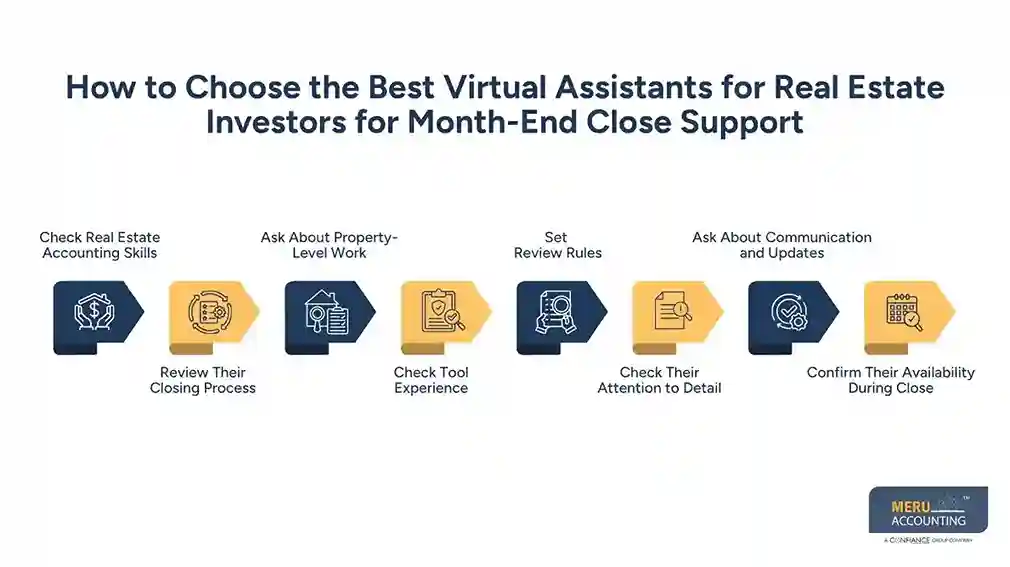
Set Review Rules
The best virtual assistants for real estate investors should know what they can handle and what needs approval. Tax positions, complex entries, and major adjustments may need review by a qualified accountant or tax professional.
Check Their Attention to Detail
Month-end close involves many small entries, from rent deposits to vendor bills and loan payments. The best virtual assistants for real estate investors should have a clear way to check data and flag items that do not match.
Ask About Communication and Updates
Ask how often the assistant shares progress, reports missing documents, and raises questions. Clear updates make it easier to know what is complete and what still needs review.
Confirm Their Availability During Close
Month-end work often follows a set deadline, so availability matters. The best virtual assistants for real estate investors should be able to work within the agreed close schedule and meet reporting timelines.
optional anymore
on running the business
Real Estate Virtual Assistant Tasks During Month-End Close
Bank Reconciliation
One of the main real estate virtual assistant tasks is matching bank activity with accounting entries. Missing checks, duplicate entries, or uncleared items can then be listed for review.
Rent and Deposit Checks
The assistant can compare rent reports with bank deposits and accounting records. This may show unpaid rent, short payments, deposits posted to the wrong account, or entries that need more detail.
Vendor Bill Review
Bills for repairs, cleaning, lawn care, utilities, and management fees can be checked and coded. The real estate virtual assistant tasks should include flagging unclear or unusually high bills rather than making tax judgments.
Loan Data Checks
Mortgage payments often include both principal and interest. An assistant can match payment data with lender statements and flag entries that do not match the expected split.
Property Expense Review
The real estate virtual assistant tasks may also include checking recurring costs, property tax bills, insurance, repairs, and other operating costs. This creates a cleaner base for the monthly report.
What an Outsourced Virtual Assistant for Real Estate Can Handle
Data Entry and Coding
An outsourced virtual assistant for real estate can enter invoices, bills, deposits, and other approved transactions into the accounting system. Coding rules should be set in advance.
Document Collection
A virtual assistant can gather bank statements, vendor bills, receipts, rent reports, and loan statements in one organized folder. This makes it easier to find missing documents during the monthly close.
Account Reconciliation
A virtual assistant can review bank and credit card activity against accounting records and list any unmatched transactions. Clear review rules should be set before the work begins.
Monthly Reports
A virtual assistant can prepare draft profit and loss statements, balance sheets, rent summaries, and property-level reports for review. These reports give investors a clear view of monthly financial activity.
Issue Lists
An outsourced virtual assistant for real estate can keep a month-end list of missing bills, unmatched deposits, old checks, unclear charges, and other open items. This gives the investor a clear list to review.
Common Month-End Close Issues a Virtual Assistant Can Help Identify
Duplicate Transactions
A bank feed or manual entry can create duplicate income or expense records. The best virtual assistants for real estate investors can compare entries and flag possible duplicates before the close is final.
Missing Transactions
A payment may appear on a bank statement but not in the ledger. The real estate virtual assistant tasks can include matching bank activity with accounting records and listing gaps.
Wrong Property Coding
A repair bill for Property A may be entered under Property B. A property-level review can spot such errors and send them back for correction.
Capital Cost Confusion
Not every property cost is treated in the same way. The IRS states that certain improvements must be capitalized rather than treated as current rental expenses.
The person handling the accounts should flag such costs for review by a qualified accounting or tax professional instead of deciding the tax treatment independently.
Old Open Items
Uncleared checks, unpaid bills, or deposits that have stayed open for months can make reports harder to read. A close review can list these items and show their age.
Questions To Ask Before Hiring a Real Estate Virtual Assistant
Can You Handle Property-Level Records?
Ask whether the assistant has worked with several properties or entities at once. The best virtual assistants for real estate investors should be able to keep each property’s data clear.
What Month-End Tasks Do You Perform?
Ask for a clear list of work, such as bank checks, rent review, bill entry, loan checks, and report preparation. This shows what you are actually paying for.
How Do You Handle Errors?
Ask how the assistant records and reports errors. A good process should leave a clear trail instead of silently changing a past entry.
Who Reviews Tax Questions?
A real estate virtual assistant should not be expected to make complex tax decisions. Ask whether tax or accounting issues are sent to a qualified professional for review.
How Is Data Kept Safe?
Ask how files, passwords, accounting access, and client data are handled. Access should be limited to what the assistant needs for the work.
Partner With Meru Accounting For Real Estate Accounting Support
Meru Accounting provides accounting and bookkeeping services for businesses and real estate-related needs. Its team can work with accounting systems such as QuickBooks, Xero, Zoho Books, NetSuite, and Odoo.
For investors who need recurring month-end work, we provide transaction entry, reconciliation, account review, reporting, and other accounting work based on the agreed process. The best virtual assistants for real estate investors should fit into a wider accounting process where routine work is checked, and complex matters are reviewed by the right professional.
A Defined Close Process
Meru Accounting can set a monthly workflow for source files, bank data, bills, reconciliations, and reports. This gives each month a clear order of work.
Property-Level Reporting
Where the accounting setup allows it, reports can be arranged by property or entity. This can make it easier to see income and costs without mixing unrelated activity.
Review Before Reporting
Month-end work should not end with data entry. Entries and reports can be checked against source records so open items are known before the period is marked complete.
Accounting System Experience
Meru Accounting works with several accounting platforms, including QuickBooks and Xero. This can be useful when an investor already has an established accounting system.
Our Expert Perspective
For real estate investors, the value of a virtual assistant is not just the number of tasks completed. The key is whether the work follows a repeatable close process, keeps property data clear, and flags issues before they become larger problems.
Key Takeaways
- The best virtual assistants for real estate investors should understand both routine accounting work and the needs of property owners.
- Month-end close should cover bank activity, rent, bills, loans, property costs, and open items.
- Real estate virtual assistant tasks should be based on a clear checklist.
- An outsourced virtual assistant for real estate can handle routine work while complex tax matters stay with a qualified professional.
- Source records should be kept with enough detail to support accounting and tax reporting.
- Property-level checks can make it easier to find errors and unusual changes.
- Access to financial systems should be limited and based on the assistant’s role.
- A clear review process matters as much as the task list.
FAQs
A real estate virtual assistant can check bank data, enter bills, review rent, match loan data, organize files, and prepare draft monthly reports.
Month-end close gives investors a clear view of property income, costs, cash, and open items. It also makes it easier to find missing or unusual transactions.
Yes. An outsourced virtual assistant for real estate can handle routine bank reconciliation when the process and review rules are clear.
No. A virtual assistant can flag items for review, but complex tax treatment should be handled by a qualified tax or accounting professional.
Check their accounting experience, property-level work, software skills, month-end process, data security steps, and rules for sending complex issues to an accountant.
optional anymore
on running the business