
A bookkeeper for real estate agents’ work is not just about entering numbers into a ledger. Real estate agents often receive commissions after several steps, including a closed deal, broker review, deductions, and bank payment. A small error at any step can make income reports hard to match.
Accurate records should show where each commission came from, what was deducted, when the money was received, and how the amount reached the bank. The IRS also states that business records should clearly show income and expenses and include records that support tax returns.
For agents, real estate commission bookkeeping should link the deal, broker statement, payment, and bank entry. Accurate real estate accounting also gives agents a clear view of income, costs, and profit.
What You Will Learn From This Blog
- How a bookkeeper for real estate agents can track commissions from closing to bank deposit.
- Why clean real estate commission bookkeeping matters for tax and cash flow records.
- How real estate accounting can keep income and expense records in order.
- How to match broker statements with bank transactions.
- Which commission errors can cause wrong income reports.
- When a real estate agent may benefit from outsourced bookkeeping support.
What Does a Bookkeeper for Real Estate Agents Do?
Track Each Commission
A bookkeeper for real estate agents records each commission by deal, date, broker, and amount. The record should show gross commission, deductions, and the net amount paid to the agent.
Match Broker Statements
Broker statements often contain more detail than a bank feed. A bookkeeper for real estate agents can compare the statement with the expected commission and check each deduction before posting the final entry.
Record Business Costs
Agents may pay for ads, signs, MLS fees, travel, software, dues, and other business costs. Proper real estate accounting places these costs in the right account and keeps proof with the entry.
Keep Deal Files
A clear deal file can include the closing statement, broker statement, invoice, payment record, and bank entry. Accurate real estate commission bookkeeping keeps these records linked so an agent can trace a payment later.
Prepare Reports
Monthly profit and loss reports can show commission income and business costs. A bookkeeper for real estate agents can keep these reports current so the agent does not have to rebuild the year at tax time.
Why Accurate Commission Records Matter for Real Estate Agents
Know True Income
Commission income can vary from month to month. Accurate records show what was earned and what was actually received, giving agents a better view of cash flow.
Catch Missing Payments
A closed deal does not always mean the money is already in the bank. Real estate commission accounting can flag deals with no matching payment or deposits that do not match broker records.
Track Deductions
Broker fees, transaction fees, referral fees, and other charges can reduce the amount paid to an agent. Real estate accounting should show these items clearly rather than treating every bank deposit as gross income.
Prepare Tax Records
The IRS says business records should support income, expenses, and amounts reported on tax returns. A bookkeeper for real estate agents can keep the source records in order, while tax treatment should be reviewed by the proper tax professional.
Review Business Results
Clean commission records make monthly reports more useful. An agent can compare closed deals, commission income, operating costs, and profit without sorting through old bank statements.
Real Estate Commission Bookkeeping: Proven Ways to Avoid Errors
Use A Deal-Level Record
Give every transaction a clear reference, such as the property address, client name, or deal number. A real estate commission bookkeeping system works better when each payment can be tied to one specific deal.
Record Gross And Net Amounts
Do not record only the amount that reaches the bank. Record the gross commission first, then show broker fees, referral fees, or other deductions that explain why the final deposit is lower.
Keep Broker Statements
Broker statements are key records for commission work. A bookkeeper for real estate agents should keep each statement with the related deal so the payment, fees, and final amount can be checked later.
Review Referral Fees
Referral income and referral costs should have clear records and account names. Good real estate accounting makes it easier to see which amounts came from commissions and which were paid for referrals.
Set A Monthly Review
Review commission records at least once each month to find missing deposits, duplicate entries, or wrong account codes. A bookkeeper for real estate agents can use the same review list each month to keep the process consistent.
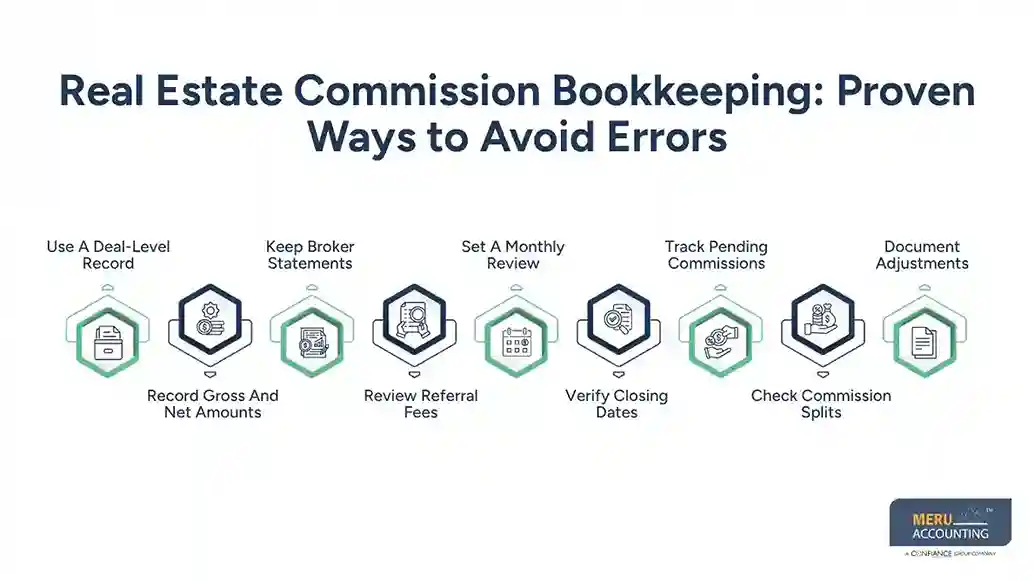
Verify Closing Dates
Check the closing date against the broker statement and transaction file before posting the commission. A clear date trail can reduce errors when an agent has several deals that close within the same week.
Track Pending Commissions
Keep a list of closed deals where the related commission has not reached the bank. Real estate commission bookkeeping should flag these items so the agent can check whether the payment is pending, delayed, or missing.
Check Commission Splits
Review the agreed commission split before recording the final amount. A wrong split can cause an incorrect income entry when a deal includes a co-agent, team member, brokerage fee, or other agreed share.
Document Adjustments
Keep a note for any change made to a commission record, such as a fee correction, refund, or revised broker statement. Clear notes give the bookkeeper for real estate agents a record of why the original amount was changed.
optional anymore
on running the business
Real Estate Accounting Practices That Keep Agent Records Organized
Separate Business And Personal Funds
A separate business bank account makes income and expense review much easier. Mixing personal and business payments can make real estate accounting less clear and can create extra work when records are reviewed.
Use Clear Account Names
Accounts should be easy to understand, such as commission income, advertising, office costs, travel, dues, and software. Clear names make real estate commission bookkeeping easier to review.
Keep Supporting Records
Receipts, invoices, statements, and proof of payment should stay with the related entry. The IRS notes that supporting documents are important for entries in the books and tax returns.
Review Unpaid Items
Open commission items should be checked each month. A bookkeeper for real estate agents can compare expected payments with deposits and mark each item as paid, pending, or needing review.
Keep A Consistent Process
The same process should be used for every deal. Consistent real estate accounting makes it easier to find gaps and compare one month with another.
How To Reconcile Broker Statements With Bank Transactions
Start With The Broker Statement
Begin with the broker statement because it shows the commission details. Check the deal, gross amount, deductions, and net amount before looking for the matching bank deposit.
Find The Bank Deposit
Search the business bank account for the matching amount and date. A bookkeeper for real estate agents should also check nearby dates because deposits may not reach the bank on the same day as the broker payment.
Check The Difference
If the broker shows $12,000 gross and $1,000 in fees, the bank may show $11,000. Real estate commission bookkeeping should record the difference rather than treating the lower deposit as the full commission.
Investigate Missing Items
A missing deposit may be a timing issue, a returned payment, or an entry that was not posted. Real estate accounting should leave a clear note for any item that cannot yet be matched.
Close The Reconciliation
Once each commission is matched, mark the item as cleared. A bookkeeper for real estate agents can then review the remaining unmatched items and ask the agent or broker for details.
Common Commission Bookkeeping Mistakes Real Estate Agents Should Avoid
Recording Only Bank Deposits
A bank deposit shows cash received, not always the full commission earned. Commission income tracking should include the broker statement so gross income and deductions can be reviewed.
Ignoring Small Fees
Small transaction fees can add up across many deals. Proper real estate accounting records these costs in the right category instead of leaving them mixed with commission income.
Posting A Payment Twice
Duplicate entries may happen when a broker statement and bank feed are both entered as income. A bookkeeper for real estate agents should check the source before adding a new transaction.
Waiting Until Tax Time
Year-end cleanup can take much longer when months of commission records are missing. Monthly real estate commission bookkeeping keeps errors closer to the date when they occurred.
Mixing Personal Costs
Personal spending should not be placed in business expense accounts just because it came from the same bank account. A bookkeeper for real estate agents can flag unclear items for review instead of guessing their tax treatment.
How Meru Accounting Provides Bookkeeping Services for Real Estate Agents
Commission Record Review
Meru Accounting provides commission record review services by checking broker statements against bank activity. Our team records each deal under the right income entry and checks fees and deductions.
Monthly Bookkeeping
Meru Accounting provides monthly bookkeeping services to keep real estate business records current. Our team records income, expenses, and account activity throughout the month.
Reconciliation Services
Meru Accounting provides bank and card reconciliation services for real estate agents. Our team matches recorded entries with account activity and reviews unmatched transactions.
Financial Reporting
A bookkeeper for real estate agents can help maintain accurate records that support monthly financial reports showing commission income and business costs. Our reports give agents a clear view of their business income, expenses, and profit.
Tax-Ready Bookkeeping
Meru Accounting provides bookkeeping services that keep commission and expense records organized for tax work. Our team maintains the books and supporting records for review by the agent’s tax professional.
Our Expert Perspective
Accurate commission bookkeeping starts with connecting each deal to its broker statement, deductions, payment, and bank deposit rather than recording only the cash received. Monthly reviews can help identify missing payments, duplicate entries, incorrect splits, and unclear fees before they become larger year-end issues. Keeping bookkeeping records separate from tax decisions also helps ensure that financial records remain organized while tax treatment is reviewed by the appropriate professional.
Key Takeaways
- Keep a separate record for each real estate deal.
- Match every broker statement with the related bank payment.
- Record gross commission, fees, and net payment with care, giving a bookkeeper for real estate agents a clear basis for accurate income reporting.
- Keep receipts, statements, invoices, and payment records together.
- Use clear account names for income and costs.
- Review unmatched transactions before closing each month.
- Keep tax records based on reliable source documents.
- Use professional bookkeeping support when commission volume becomes hard to manage.
FAQs
A bookkeeper for real estate agents tracks commissions, broker fees, expenses, bank deposits, and financial records.
Real estate agents can track commission income by matching each broker statement with the related bank deposit and deal record.
Reconcile commission payments by comparing the gross commission, broker deductions, net payment, and matching bank transaction.
Real estate agents should keep broker statements, closing records, invoices, receipts, bank records, and proof of commission payments.
Real estate agents should reconcile commission records each month to find missing payments, duplicate entries, and recording errors early.
optional anymore
on running the business