
Meru Accounting

Top 10 Commission Reconciliation Tips for Bookkeeping for Mortgage Brokers

Contents
Want to learn more?

Subscribe for business tips, tax updates, financial fundamental and more


    Top 10 Commission Reconciliation Tips for Bookkeeping for Mortgage Brokers

    Commission income is a key part of a mortgage broker’s cash flow. Yet, broker commissions can be hard to track when lenders pay at different times, deals change after settlement, or clawbacks occur. Strong bookkeeping for mortgage brokers keeps each loan, payment, fee, and adjustment tied to the right record.

    Precise records also make month-end work easier. They give you a clear view of earned income, cash received, unpaid commissions, and lender changes. For firms with many loans, a sound Mortgage Broker Accounting process can also cut the risk of missed or double-counted income.

    What You Will Learn From This Blog

    • Understand how commission reconciliation works for mortgage brokers and why regular checks matter.
    • Explore ten practical ways to review lender commission records and identify payment differences.
    • Learn how Mortgage Broker Accounting can keep loan income records accurate and well organized.
    • Identify common commission errors that may lead to missing, delayed, or incorrect payments.
    • See how bookkeeping for mortgage brokers can maintain clear and reliable financial records.
    • Find out when outsourcing accounting and bookkeeping can make sense for a growing mortgage brokerage.

    What Is Bookkeeping for Mortgage Brokers and Why Does It Matter?

    Bookkeeping for mortgage brokers involves keeping clear and accurate records of loan fees, lender payments, business costs, and other financial activity linked to each deal. Every loan should have a complete record that connects the deal file with the related accounting entry and bank transaction. 

    Key details such as the loan ID, lender name, client name, settlement date, expected commission, and payment status give you a clear record to review. Brokers should also compare the commission expected from each settled loan with the lender statement and bank receipt. 

    This check is the basis of commission reconciliation and can reveal short payments, missing receipts, or other differences before they affect the monthly accounts.

    Payment dates also need close attention because lenders may pay commissions after settlement rather than on the settlement date. Recording both the expected payment date and the actual receipt date gives you a clearer view of income due and cash received. Commission amounts can also change due to loan changes, fee adjustments, refunds, or clawbacks, so each change should have a clear reason and source. 

    Accurate and well-maintained bookkeeping for mortgage brokers records the original commission, each adjustment, and the final amount received. Every entry should be supported by a source document, such as a lender statement, settlement report, broker system, or bank record. 

    Good financial management isn't
    optional anymore
    Meru Accounting handles the accuracy, so you can focus
    on running the business

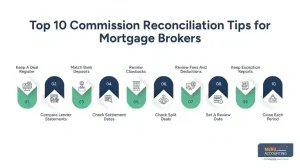
    Top 10 Commission Reconciliation Tips for Mortgage Brokers

    Keep A Deal Register

    Create one deal register for all active and settled loans. Record the loan ID, lender, settlement date, expected commission, payment date, and amount received. A central register gives mortgage brokers a clear source for each income check.

    Compare Lender Statements

    Do not rely only on bank deposits. Compare lender statements with your own records for every payment cycle.

    The check should confirm the loan, gross commission, fees, deductions, and net amount received. This helps identify payment differences and keeps commission records accurate.

    Match Bank Deposits

    A bank deposit may contain payments for several loans. Break the deposit into the right loan records rather than posting one lump sum.

    That step keeps income data clear and makes bookkeeping for mortgage brokers easier to review later.

    Check Settlement Dates

    Use settlement dates to group loans due for payment. A loan that settled last month but has no commission receipt should be placed on a follow-up list.

    Accurate Mortgage Broker Accounting should show both settled loans and unpaid expected income.

    Review Clawbacks

    Clawbacks can reduce income after a payment has already been received. Record each clawback against the original loan rather than posting it as an unrelated cost. The original commission and later change should remain easy to trace.
    Top 10 Commission Reconciliation Tips for Mortgage Brokers-​bookkeeping for mortgage brokers​

    Check Split Deals

    Some broker firms split income between brokers, branches, or referral partners. Record the gross amount first, then post each agreed share. Clear rules reduce disputes and help maintain consistent commission records.

    Review Fees And Deductions

    Lender statements may show fees or other deductions before the net payment reaches the bank. Check the gross figure against the final cash receipt.

    A difference is not always an error, but bookkeeping for mortgage brokers should make every difference easy to explain and trace.

    Set A Review Date

    Choose a fixed date for each commission review. Weekly checks may suit firms with many settlements, while smaller firms may use a monthly cycle.

    A fixed routine keeps bookkeeping for mortgage brokers from becoming a year-end clean-up task.

    Keep Exception Reports

    Make a short list of items that do not match. Examples include missing payments, wrong amounts, duplicate entries, and unexplained clawbacks.

    Focus first on open exceptions instead of reviewing every closed item again.

    Close Each Period

    Before closing a month, confirm that all settled loans due for payment have been checked. Mark open items for the next period with a note.

    A clear close process gives Mortgage Broker Accounting a better base for monthly reports.

    How Mortgage Broker Accounting Supports Accurate Commission Tracking

    Use A Clear Chart Of Accounts

    A well-structured chart of accounts makes bookkeeping for mortgage brokers easier to manage and review. Clear account names make reports easier to read.

    A broker may also need separate accounts for clawbacks, referral fees, and other income adjustments.

    Use Loan-Level Records

    Loan-level records show where income came from. Rather than posting one monthly total, retain the detail needed to trace each payment.

    That detail is useful when a lender payment differs from the expected amount.

    Set Clear Rules

    Clear procedures also give bookkeeping for mortgage brokers a consistent approach to recording commissions, payments, and adjustments. The exact accounting treatment should follow the firm’s accounting basis and advice from its accountant.

    Strong Mortgage Broker Accounting starts with rules that staff can apply in the same way.

    Review Open Items

    Unpaid commissions should sit on a review list until resolved. Staff can then contact the lender or check the deal record.

    Regular review keeps bookkeeping for mortgage brokers focused on both cash received and income still due.

    Use Monthly Reports

    Monthly reports can show commission income, clawbacks, unpaid amounts, and major changes. These reports give owners a better view of results.

    They also give your accountant useful data for financial review and tax work.

    Common Commission Reconciliation Mistakes Mortgage Brokers Should Avoid

    Posting Deposits As One Entry

    Accurate bookkeeping for mortgage brokers should separate each loan-related receipt for easier tracking and reconciliation.

    Split the amount by loan so each receipt can be traced.

    Ignoring Small Differences

    Small gaps can point to fees, tax issues, split errors, or later adjustments. Do not leave them open without a note.

    A clear reason is better than a forced match.

    Missing Clawbacks

    Clawbacks can arise after the first commission payment. Failing to record them can overstate income.

    Each clawback should link to the loan and original payment.

    Double Counting Income

    Accurate bookkeeping for mortgage brokers helps prevent duplicate entries by matching lender records with actual bank receipts.

    Commission Reconciliation should make sure the bank entry clears the amount already recorded, rather than creating a second income entry.

    Mixing Personal And Business Costs

    Personal spending should not sit in business accounts without proper treatment. Mixed records make review harder and can affect financial reports.

    Separate business and personal transactions from the start.


    How Bookkeeping for Mortgage Brokers Can Improve Financial Accuracy

    Reduce Data Gaps

    A full deal register gives your team one place to check loan data. Missing fields become easier to spot before month-end close.

    Accurate bookkeeping for mortgage brokers gives each commission entry a clear source.

    Keep Cash Flow Clear

    Expected commissions and actual receipts are not always the same. Tracking both gives owners a better view of cash due and cash on hand.

    That view can aid cash planning and payment decisions.

    Make Month-End Easier

    When loan records are checked during the month, fewer items remain at month-end. Staff can focus on open differences instead of rebuilding past records.

    A set monthly review routine can make the close more orderly.

    Give Owners Better Reports

    Owners need more than a bank balance. They may want to know which commissions were earned, which are unpaid, and which amounts were reversed.

    Clean records make those reports more useful for business decisions.

    Keep Records Ready

    A broker may need records for an accountant, lender query, internal review, or tax work. Keeping source documents with each entry makes these requests easier to handle.

    Strong bookkeeping for mortgage brokers is built around records that can be checked.


    When to Outsource Mortgage Broker Accounting and Bookkeeping

    Deal Volume Grows

    More loans mean more lender statements, bank receipts, splits, and adjustments. Manual checks can take more staff time as volume rises.

    Outsourcing bookkeeping for mortgage brokers can provide a consistent process without requiring a full in-house accounting team.

    Errors Keep Appearing

    Repeated mismatches, duplicate entries, or missing clawbacks may show that the current process needs a fresh review.

    An outside team can review the workflow and set clear checks for Mortgage Broker Accounting.

    Owners Lack Time

    Broker owners often need to focus on clients, lenders, and new deals. Spending hours on transaction checks may not be the best use of that time.

    A trained bookkeeping team can take over routine records while the owner keeps control of key reports.

    Month-End Takes Too Long

    A long month-end close can point to weak records or late reconciliation. A defined workflow can move checks closer to the date of each payment.

    That approach gives bookkeeping for mortgage brokers a steady monthly rhythm.

    Better Review Is Needed

    Some firms already have bookkeepers but need an extra review layer. A second team can check key accounts, open items, and monthly reports.

    The aim is not just data entry. The goal is clear records that management can trust.

    Why Mortgage Brokers Choose Meru Accounting for Bookkeeping

    Commission Record Management

    Meru Accounting can manage commission records for settled loans, lender payments, fees, and adjustments. Our team can keep each transaction linked to the right loan and source record.

    Lender Statement Checks

    As part of our bookkeeping for mortgage brokers, our team can compare lender statements with your internal records and bank activity. Differences can then be listed, checked, and followed up before they affect monthly reports.

    Clawback Tracking

    Clawbacks need to be tied to the original commission entry. Meru Accounting can record these changes clearly so your income reports reflect the amounts actually retained by the business.

    Monthly Reconciliation

    A fixed monthly review can keep open commission items from building up. Our team can check expected income, received payments, unpaid amounts, and adjustments as part of the regular bookkeeping cycle.

    Clear Financial Reports

    Effective bookkeeping for mortgage brokers should provide reports that show more than cash in the bank. Meru Accounting can maintain records that give you a clear view of commission income, expenses, unpaid amounts, and monthly results.

    Scalable Bookkeeping Support

    As loan volume grows, manual commission checks can take more time. Meru Accounting can provide ongoing bookkeeping support that fits your transaction volume and reporting needs.

    Our Expert Insight

    From an accounting perspective, commission reconciliation should go beyond checking whether money reached the bank. The key is to match the loan record, settlement date, lender statement, expected commission, bank receipt, and any later adjustment. 

    Timing can also create errors because a loan may settle in one period while the related commission arrives weeks later, so the records should clearly show when income was earned and when cash was received based on the accounting method used. 

    Clawbacks need the same care because each reduction should remain linked to the original loan rather than being treated as an unrelated adjustment. In our view, bookkeeping for mortgage brokers should focus more attention on exceptions such as missing payments, duplicate entries, unexpected amounts, unexplained deductions, and old unmatched items. 

    For firms with many loans, assigning ownership of open items and using an ageing list for unpaid commissions can make reviews more useful. Accurate commission records come from tracing the full transaction from loan to lender statement to bank receipt, rather than checking totals alone.

    Key Takeaways

    • Keep a separate record for each loan and its related commission.
    • Match every lender statement with the corresponding bank receipt to maintain accurate bookkeeping for mortgage brokers.
    • Track expected commission income separately from the cash actually received.
    • Record each clawback against the loan from which it originated.
    • Review split deals and lender deductions to confirm that payments are accurate.
    • Maintain a clear list of all unresolved commission differences.
    • Follow fixed dates for regular commission reconciliation reviews.
    • Close each accounting period only after all open items have been reviewed.
    • Link source documents to each transaction to support organized bookkeeping for mortgage brokers and simplify future reviews.
    • Consider outside Mortgage Broker Accounting support as your loan volume grows.

    FAQs

    Mortgage brokers reconcile commission payments by matching lender statements, expected commission, bank deposits, loan records, fees, and clawbacks for each settled loan.

    Commission reconciliation in mortgage broker accounting is the process of checking that the commission earned on each loan matches the amount reported and paid by the lender.

    Mortgage broker commissions can be tracked by recording each loan, lender, settlement date, expected commission, payment received, deductions, and any later adjustments.

    Common causes include missing lender payments, duplicate entries, wrong commission amounts, unrecorded clawbacks, split-payment errors, and bank deposits that are not matched to loans.

    Mortgage brokers should reconcile commission payments at least once a month, while firms with high loan volume may choose weekly checks to find payment errors sooner.

    Good financial management isn't
    optional anymore
    Meru Accounting handles the accuracy, so you can focus
    on running the business