
In the real estate sector, money moves through many stages, and each stage must be recorded with care. Bookkeeping for real estate developers plays a key role in keeping project costs, income, and cash flow in order. Without clear records, companies managing multiple sites can face confusion, delays in reporting, and tax issues.
For firms handling more than one property at a time, bookkeeping for real estate developers is not just record-keeping. It becomes a system that supports planning, cost control, and better decisions. In large firms, even small errors in records can impact profit across several projects.
This is where real estate developer accounting becomes important. It helps in tracking project-wise spending, loan use, contractor payments, and sales income in a structured way. When combined with proper bookkeeping, it gives a full financial view of each project.
In this blog, you will understand how structured financial recording supports real estate firms that manage multiple projects and how it improves control, compliance, and growth.
What You Will Learn From This Blog
- How bookkeeping for real estate developers supports multi-project control
- Key challenges faced in financial tracking across sites
- Role of real estate developer accounting in financial accuracy
- Importance of project-wise reporting and tax compliance
- Benefits of outsourcing bookkeeping work
- Practical ways to improve financial clarity in real estate firms
Understanding Bookkeeping For Real Estate Developers
Bookkeeping for real estate developers is mainly built on a project-based recording system, where each construction site is treated as an independent financial unit.
All costs and income are recorded separately for every project, which helps avoid confusion when a company is handling multiple developments at the same time. This structure ensures that financial data remains clear, organized, and easy to review for each individual property.
In real estate, expenses such as land purchase, labor, construction materials, and permits need to be carefully tracked. With proper bookkeeping for real estate developers, every cost is assigned to the correct project, which supports accurate profit calculation and better financial understanding.
At the same time, income from sales of flats, offices, or plots is also recorded project-wise, making it easier to identify which developments are performing well and which are facing delays in revenue generation.
Modern systems have made bookkeeping for real estate developers more efficient through digital tools that support automated tracking and reduce manual errors. These systems improve speed and accuracy, especially for large firms managing multiple projects.
In addition, strong bookkeeping is closely linked with financial planning, as it supports budgeting, forecasting, and future investment decisions based on real project performance data.
Importance Of Bookkeeping For Real Estate Developers In Multi-Project Management
Clear Financial Control
When a company manages many projects, control becomes difficult. Bookkeeping for real estate developers helps maintain clear records for each project.
Better Cash Flow Management
Real estate projects often face cash delays. With proper records, companies can track inflows and outflows and plan payments better. This helps avoid liquidity issues during critical construction phases.
Improved Decision Making
Management can compare project performance. This helps in choosing where to invest more or reduce spending. It also supports long-term planning based on real financial results.
Reduced Financial Errors
Accurate real estate developer accounting reduces mistakes in reporting, billing, and vendor payments. This improves overall financial accuracy and reduces the risk of costly corrections later.
Investor Confidence
Clear financial records build trust with investors and banks, improving funding chances. It also shows transparency in how each project is managed financially.
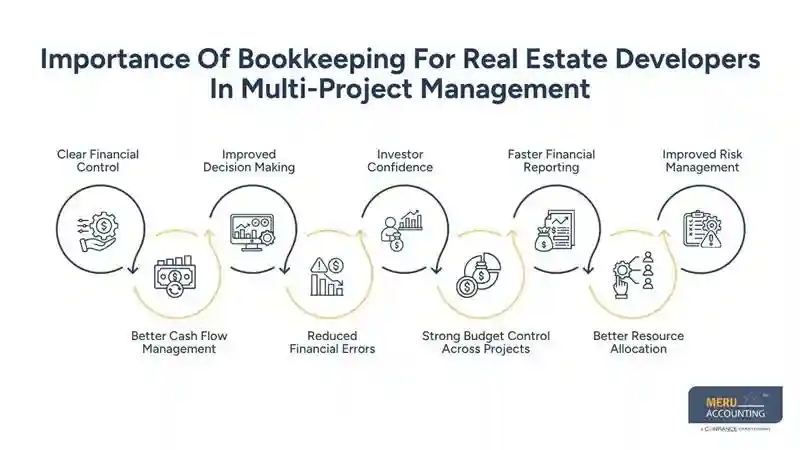
Strong Budget Control Across Projects
With proper bookkeeping, budgets can be tracked separately for each project. This prevents overspending and keeps construction costs under control.
Faster Financial Reporting
Accurate records help in preparing reports quickly for management and stakeholders. This improves decision-making speed in active projects.
Better Resource Allocation
Funds, labor, and materials can be allocated more efficiently. It ensures each project gets the right resources at the right time.
Improved Risk Management
Financial tracking helps identify cost overruns and delays early. This allows management to take corrective action before issues grow larger.
Key Challenges In Real Estate Developer Accounting For Multiple Projects
- Without proper bookkeeping for real estate developers, project costs often get mixed across sites. This creates confusion in tracking true project profitability.
- Delayed expense updates can distort financial reports and planning. It becomes harder to understand real-time project performance.
- Managing contractor payments is complex across multiple projects. Each site has different vendors, increasing the chances of errors or delays.
- Loan allocation becomes unclear when funds are shared across projects. Without structured real estate developer accounting, tracking usage is difficult.
- Regulatory pressure requires accurate and timely reporting. Lack of proper systems can lead to compliance risks and penalties.
Role Of Real Estate Developer Accounting In Financial Control And Compliance
Ensuring Financial Accuracy
Real estate developer accounting ensures that every transaction is recorded correctly and supported with proof. This helps maintain transparency and reduces the chances of errors in financial records.
Compliance With Tax Laws
Proper accounting helps meet tax rules like GST and income tax requirements. It ensures filings are done on time with accurate financial data.
Audit Readiness
Good records make audits smoother and reduce risk of penalties. It also helps auditors verify data quickly without delays or missing documents.
Financial Reporting Support
It helps create balance sheets, income reports, and project summaries. These reports give a clear view of overall business performance.
Risk Control
With structured bookkeeping for real estate developers, financial risks can be identified early. This allows management to take corrective action before issues grow.
Project-Wise Financial Tracking In Bookkeeping For Real Estate Developers
Separate Project Accounts
Each project should have its own account in bookkeeping for real estate developers to avoid overlap. This helps maintain clear financial separation between different developments.
Budget Vs Actual Analysis
Tracking planned vs actual spending helps control costs. It also highlights where overspending or savings are happening.
Revenue Segmentation
Income must be recorded project-wise to understand profit levels. This makes it easier to evaluate which project is performing better financially.
Stage-Wise Cost Tracking
Costs should be tracked at each stage, like planning, construction, and finishing. This gives better visibility into where money is being used during the project lifecycle.
Real-Time Monitoring
Modern systems allow real-time updates in real estate developer accounting, improving accuracy. This helps management make quick and informed financial decisions.
Tax Compliance And Regulatory Requirements In Real Estate Developer Accounting
GST Management
Proper bookkeeping for real estate developers ensures correct GST filing for sales and services. It helps avoid errors in tax calculation and late submission issues.
Income Tax Reporting
Accurate records support correct income declaration and reduce penalties. This also ensures financial statements match actual project earnings.
TDS Tracking
Payments to contractors often involve TDS, which must be recorded properly. Proper tracking avoids mismatches during tax filing and audits.
RERA Compliance Support
Real estate rules require project transparency supported by clear accounting. This helps maintain compliance with reporting requirements for each project.
Audit Support Documents
All records in real estate developer accounting must be backed by invoices and agreements. This makes audits smoother and reduces verification delays.
How Outsourced Bookkeeping For Real Estate Developers Improves Efficiency
Cost Savings
Outsourcing reduces the need for large in-house teams. This helps companies save on salaries, training, and infrastructure costs.
Expert Handling
Professionals handle bookkeeping for real estate developers with better accuracy. Their experience reduces errors and improves financial clarity.
Time Efficiency
Internal teams can focus on project work while experts manage records. This improves overall productivity across departments.
Technology Use
Outsourced firms use advanced tools for real estate developer accounting. These tools improve speed, reporting quality, and data accuracy.
Scalable Support
Services can grow as project numbers increase. This makes it easier for companies to manage expansion without hiring pressure.
Why Choose Meru Accounting For Real Estate Financial Management
Meru Accounting provides structured support for real estate firms managing multiple projects. Our team handles bookkeeping for real estate developers with clear project separation, accurate reporting, and strong tax support.
We also offer complete real estate developer accounting services that include vendor tracking, cost control, cash flow analysis, and compliance reporting. Our approach focuses on clarity, accuracy, and timely updates.
With experience across global real estate clients, Meru Accounting helps businesses reduce financial errors and improve decision-making. Our systems are designed to support multi-project environments with ease and reliability.
Our Expert Perspective
In our experience working with multi-project real estate firms, the biggest challenge is not recording transactions but maintaining consistent project-wise discipline across all developments. When bookkeeping for real estate developers is structured properly from the beginning, it significantly reduces financial confusion as projects scale. Strong real estate developer accounting systems ultimately act as a control layer that supports both profitability and long-term financial stability.
Key Takeaways
- Bookkeeping for real estate developers helps manage multiple projects with clarity
- Project-wise tracking improves cost control and profit analysis
- Real estate developer accounting supports tax compliance and audits
- Outsourcing improves speed, accuracy, and efficiency
- Strong bookkeeping reduces financial errors and supports growth
FAQs
It helps track project costs, income, and cash flow in an organized way. This improves financial control across multiple projects.
It is used to manage financial records, tax reporting, and compliance for real estate projects.
It separates each project’s finances so companies can clearly see profit and cost for every site.
Yes, outsourcing saves time, reduces errors, and provides expert financial support.
Common issues include mixed costs, delayed entries, and complex contractor payments.