
Strong financial records shape better business decisions, and bookkeeping practices play a central role in this process. When records are clear, updated, and well organized, businesses can understand where money is earned and where it is lost.
In recent years, innovative accounting tools have changed how financial data is managed, making it faster to record, sort, and review transactions. Modern businesses now rely on these financial recording methods not only for compliance but also for profit planning.
When combined with modern intelligent accounting systems, these practices reduce manual effort and provide more accurate financial insights. This combination helps businesses manage costs, track income patterns, and improve overall financial health.
What You Will Learn From This Blog
- How bookkeeping practices directly affect business profit
- The role of AI bookkeeping software in financial accuracy
- Ways bookkeeping helps control costs and reduce errors
- How businesses improve forecasting using financial records
- Challenges in adopting modern bookkeeping tools
- Practical insights from real financial management experience
How Bookkeeping Practices Directly Influence Client Profitability
Accurate Transaction Recording
Clear financial recording methods ensure every transaction is recorded properly. Missing entries are reduced significantly, and financial confusion stays under control. Accurate records make profit calculation more reliable for businesses.
Better Cost Tracking
Businesses often lose profit due to untracked expenses every month. Strong financial recording methods highlight unnecessary spending patterns in detail. Management reduces avoidable costs early through better visibility.
Improved Cash Flow Clarity
Cash flow becomes easier to understand with consistent financial recording methods. Money entering and leaving appears clearly across all accounts. Businesses avoid sudden cash shortages through improved visibility.
Reduced Financial Errors
Manual errors affect profit reporting across many business operations regularly. Structured bookkeeping practices reduce data entry mistakes across bookkeeping systems. Profit results become more accurate and trustworthy for decision-making.
Support For Profit Decisions
Profit decisions depend on reliable financial data for better accuracy. Well-managed financial recording methods provide clear reports across operations. Pricing, budgeting, and investment choices become more informed consistently.
Evolution of Bookkeeping Practices With Technology Integration
Shift From Manual Records
Earlier bookkeeping methods depended fully on manual record-keeping methods. Paper-based systems often created delays and missing information in reports. Businesses struggled with slow and error-prone financial tracking processes.
Introduction of Digital Tools
Digital tools improved financial recording methods by making data entry faster. Businesses started moving away from paper records toward organized systems. Financial data became easier to store, access, and manage.
Automation in Financial Tasks
Automation reduced repetitive accounting work across many financial operations. Tasks like invoice entry and reconciliation became faster and more consistent. Businesses saved time while improving accuracy in daily records.
Integration With Smart Systems
Modern systems combine financial recording methods with analytics tools effectively. Deeper financial understanding becomes possible beyond basic transaction records. Businesses gain clearer insight into overall performance trends.
Role of AI in Bookkeeping
AI bookkeeping software enhances bookkeeping practices by identifying patterns, errors, and financial trends automatically across large datasets. Predictive insights help businesses plan future financial strategies better.
Role of AI Bookkeeping Software in Transforming Financial Management
Automated Data Entry
Automated systems reduce manual entry work across accounting tasks significantly. Software reads invoices and receipts and records them accurately. Finance teams save time and reduce repetitive workload daily.
Real-Time Financial Updates
Businesses using modern tools can view financial data instantly. Real-time access supports faster and more accurate decisions. Financial visibility improves across all operational levels consistently.
Error Detection System
Advanced systems identify mismatched entries across financial records quickly. Reporting mistakes reduce significantly with continuous system checks. Accuracy improves across all accounting and reporting activities.
Smart Categorization
Advanced financial tools automatically group expenses and income into relevant categories. Reports become easier to read and analyze for businesses. Financial records become more structured and consistent across systems.
Strong Data Security
Modern systems protect sensitive financial data using advanced security layers. Risk of data loss reduces across digital environments significantly. Businesses gain stronger trust in financial system safety.
Key Benefits of Using AI Bookkeeping Software For Businesses
Faster Financial Processing
With AI bookkeeping software, financial tasks are completed faster, reducing delays in reporting and analysis. Businesses experience smoother monthly closing cycles with improved efficiency. Processing speed increases across all accounting operations consistently.
Improved Accuracy in Records
When combined with structured bookkeeping methods, AI tools ensure higher accuracy in financial records and reduce human error. Data consistency improves across all transaction records significantly. Financial reporting becomes more reliable for decision-making.
Time Saving For Teams
Finance teams spend less time on repetitive tasks when using advanced tools, allowing focus on analysis. Manual workload is reduced significantly across daily accounting activities. Productivity increases across financial departments consistently.
Better Decision Support
Reliable data from advanced tools helps management make informed business decisions. Financial insights become clearer and more actionable for planning. Strategic decisions improve across budgeting and forecasting processes.
Scalability For Growing Businesses
As businesses expand, financial management systems help manage larger transaction volumes smoothly. System performance remains stable even during rapid growth phases. Financial operations scale without losing accuracy or control.
How Bookkeeping Practices Enhance Cost Control And Expense Tracking
Identifying Unnecessary Spending
Strong financial recording methods highlight expenses that do not add value to the business, helping reduce waste.
Cost leakages become easier to detect across monthly financial activity. Businesses gain clearer visibility over spending behavior patterns.
Budget Monitoring
Businesses can compare planned budgets with actual spending using structured financial tracking methods to maintain control.
Variance analysis becomes easier across departments and cost centers. Spending discipline improves across operational activities.
Vendor Expense Analysis
Detailed records in bookkeeping practices help evaluate vendor costs and renegotiate better terms.
Supplier performance becomes easier to measure through clear financial data. Businesses strengthen long-term vendor relationships through informed decisions.
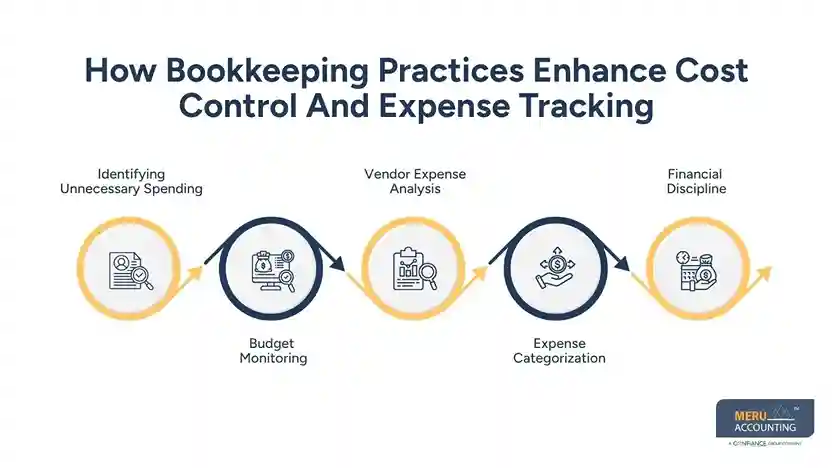
Expense Categorization
With AI bookkeeping software, expenses are grouped automatically, making it easier to track spending patterns. Financial reports become more structured and easier to interpret.
Tracking efficiency improves across multiple expense categories. Decision-making becomes faster with clear expense classification systems.
Financial Discipline
Consistent financial recording methods build discipline in financial management, ensuring controlled spending habits.
Organizations maintain better oversight across all expense categories. Long-term financial stability becomes easier to achieve.
Strengthening Financial Forecasting Through Advanced Bookkeeping Practices
Data-Based Forecasting
Reliable bookkeeping practices provide historical data that supports future financial planning. Accurate records create a strong base for long-term financial estimates. Businesses gain clearer direction when planning future budgets and goals.
Trend Identification
Businesses can identify income and expense trends for better forecasting. Patterns in financial activity become easier to detect over time. Seasonal changes in revenue and costs also become more visible.
Revenue Prediction
Past records from structured financial systems help estimate future revenue more accurately. Sales patterns from previous months support stronger financial assumptions. Revenue planning becomes more stable with consistent data tracking.
Risk Planning
Financial risks can be identified early through structured bookkeeping procedures, allowing better preparation. Early warning signs in cash flow become easier to detect. Businesses can plan corrective actions before major losses occur.
Business Growth Planning
Forecasting supported by modern accounting tools helps businesses plan expansion with reduced uncertainty. Growth decisions become more data-driven and financially balanced. Resource allocation improves across new business opportunities.
Challenges in Adopting AI Bookkeeping Software and How to Overcome Them
Initial Setup Complexity
Some businesses find accounting software difficult to set up initially. Proper onboarding reduces this challenge. Step-by-step guidance from experts makes system configuration easier for teams.
Data Migration Issues
Moving old records into accounting systems can be time-consuming, but structured planning helps. Clean and organized data preparation reduces errors during the migration process.
Staff Training Needs
Employees must understand both bookkeeping practices and new tools for smooth operation. Proper training reduces errors and improves daily financial task handling efficiency.
Cost Concerns
Small businesses may worry about cost, but the long-term benefits of AI bookkeeping software often outweigh expenses. Improved accuracy and time savings reduce overall operational financial pressure.
System Integration Limits
Some systems may not connect easily, but modern accounting tools offer flexible integration options. Careful system selection ensures smoother data flow across business platforms.
Why Choose Meru Accounting for Smarter Financial Management
Meru Accounting provides businesses with structured accounting and bookkeeping services using proven bookkeeping practices and modern tools like AI bookkeeping software. Our services are designed to improve financial clarity, accuracy, and control across different industries.
Our experienced team delivers customized accounting solutions and reporting systems that minimize errors, enhance financial visibility, and support better decision-making. By combining professional bookkeeping practices with smart automation tools, Meru Accounting enables businesses to monitor financial performance efficiently.
We also provide professional services that support businesses in transitioning from manual processes to advanced digital systems. Our solutions ensure smooth data migration, improved workflow management, and better technology adoption for finance teams, helping businesses achieve greater efficiency and financial control.
Our Expert Perspective
At Meru Accounting, our experience in financial management shows that businesses with disciplined bookkeeping practices achieve stronger financial stability and improved profit performance over time.
When AI bookkeeping software is integrated with structured processes, businesses gain faster reporting, improved accuracy, and greater control over financial operations.
We have observed that companies facing challenges with cash flow management often achieve better outcomes when consistent financial processes are implemented.
The use of advanced technology further enhances financial visibility by reducing reporting delays, improving data analysis, and providing clearer insights into cost patterns. This combination creates a stronger financial foundation for informed decision-making and sustainable business growth.
Key Takeaways
- Strong bookkeeping practices directly influence profit levels
- AI bookkeeping software reduces manual errors and saves time
- Cost control becomes easier with structured financial records
- Forecasting improves with accurate and updated data
- Businesses gain better financial clarity and decision support
- Combining human oversight with AI tools creates stronger outcomes
FAQs
Bookkeeping practices are methods used to record business income and expenses in an organized way so that financial activity is clear and trackable.
AI bookkeeping software reduces manual work, improves accuracy, and gives real-time financial updates that help small businesses make better decisions.
Yes, bookkeeping practices help identify unnecessary expenses and improve financial planning, which leads to better profit management.
Most advanced financial tools are designed to be user-friendly, but proper training is helpful for smooth usage.
Combining both improves accuracy, saves time, and provides better financial insights for long-term planning.