
In the modern business environment, bookkeeping services for businesses play a key role in keeping financial records clean, accurate, and ready for tax needs. Every company, whether it offers services or sells products, depends on structured records supported by professional bookkeeping services available in the industry to understand income, costs, and profit.
However, the way they use financial tracking systems is not the same. Their needs, transaction types, and reporting styles differ widely. Service-based companies mostly deal with time, clients, and project billing.
Product-based companies handle stock, purchases, and sales movement. Because of these differences, the use of bookkeeping services for business changes based on how the company operates. In this blog, we will explain these differences in simple terms so business owners can make better decisions.
What You Will Learn From This Blog
- How service-based and product-based companies manage financial records differently
- Why are bookkeeping services for businesses important for both product-based and service-based businesses?
- How each business model uses financial tracking systems
- Common problems faced without proper bookkeeping services for a business
- How to choose the right support based on your business type
Understanding Bookkeeping Services For Different Types of Businesses
Bookkeeping services for businesses involve the systematic recording, classification, and management of financial transactions. While the core purpose remains the same across all companies, their application changes based on whether the business is service-based or product-based.
Service-based businesses mainly focus on client invoices, project billing, service income, and timely payment tracking. Since there is no physical inventory, financial records are centered around time, labor costs, and receivables management, making cash flow monitoring the key priority.
On the other hand, product-based businesses require a more detailed financial structure that includes inventory tracking, purchase records, stock movement, production costs, and sales reporting.
Every unit of product must be recorded accurately to calculate true profit margins and maintain correct stock valuation. This makes financial management more complex compared to service firms, as it directly connects inventory levels with revenue and cost of goods sold.
Key Differences Between Service-Based And Product-Based Businesses
Key Area | Service-Based Businesses | Product-Based Businesses | Impact on Bookkeeping |
Revenue Generation Method | Earn from time, expertise, or projects | Earn from selling physical goods | Bookkeeping is used differently to track income sources |
Type Of Transactions | Record invoices and service fees | Record purchase orders, inventory, and sales | Transaction structure changes record-keeping approach |
Cost Structure | Lower physical costs, higher labor costs | Higher costs for manufacturing, storage, and logistics | Expense classification varies by business model |
Inventory Management | No inventory required | Inventory is essential for operations | Inventory tracking is only needed for product businesses |
Financial Reporting Needs | Focus on project profitability | Focus on stock valuation and sales margins | Reporting format differs based on business type |
How Service-Based Companies Use Bookkeeping Services For Business
Project-Based Income Tracking
Service companies often manage multiple projects at the same time, each with different billing terms and timelines.
Proper financial recording, along with bookkeeping services offered by professionals, helps separate income for every project, improving clarity in profit analysis.
Time And Billing Records
Many service firms charge clients based on hours worked or milestones completed. Using bookkeeping services for business, they can record time logs accurately and convert them into clear invoices.
This reduces billing errors and ensures timely payments with better transparency.
Expense Monitoring
Expenses such as software subscriptions, employee salaries, travel costs, and office supplies must be tracked carefully.
Regular tracking helps control spending and identify areas where cost savings are possible.
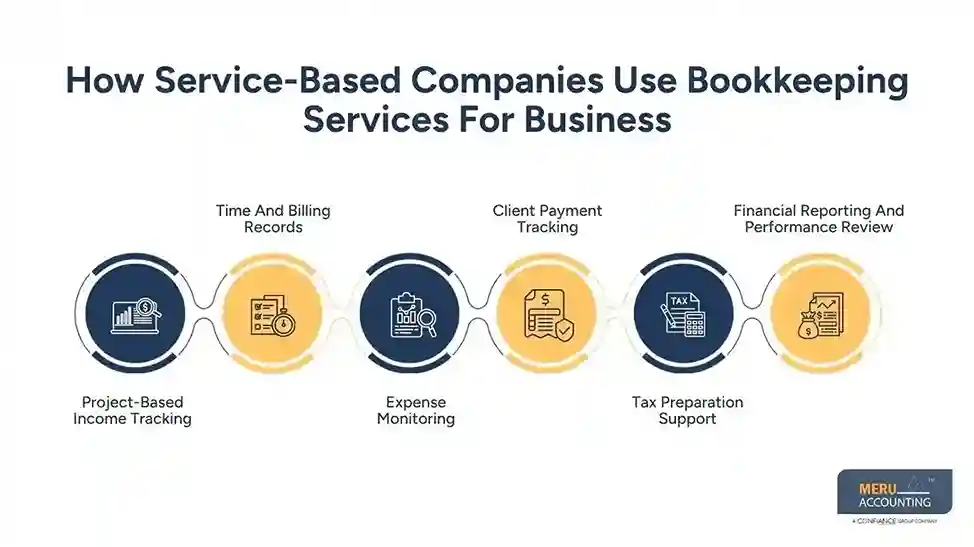
Client Payment Tracking
Delays in client payments are common in service industries, especially when working with multiple clients. Proper tracking helps monitor outstanding invoices and ensures timely follow-ups for better cash flow.
Tax Preparation Support
Accurate financial records are essential during tax filing and audits. Organized data helps reduce errors and makes annual tax preparation smoother and more reliable.
Financial Reporting And Performance Review
Clear financial reports help service businesses understand project profitability and overall performance. Regular reporting supports better decision-making and helps identify which services are generating the highest returns.
How Product-Based Companies Use Bookkeeping Services For Business
Inventory Tracking System
Product companies depend heavily on inventory for daily operations and sales planning. Stock levels, purchase costs, and product movement are recorded in an organized manner for better control.
Purchase And Supplier Records
Every raw material purchase is recorded to maintain clear supplier accounts and payment schedules. Supplier relationships stay smooth with proper tracking of dues, credit terms, and payment timelines.
Cost Of Goods Calculation
Product pricing depends on production cost, including raw materials, labor, and overhead expenses.
Using bookkeeping services for business, companies can calculate accurate cost per unit and set profitable pricing. Accurate costing supports better margin control and reduces pricing errors in product strategy.
Sales And Revenue Tracking
Sales records are maintained for each product to understand demand and performance. Product-wise tracking helps identify high-performing items and supports better revenue planning.
Stock Valuation Reports
At the end of financial periods, stock value is calculated for reporting and compliance. Accurate valuation supports balance sheet preparation and gives a clear view of financial position.
Profit Margin Analysis By Product
Detailed records help businesses understand which products generate higher or lower profit margins. Regular analysis supports better pricing decisions and improves overall product strategy for long-term growth.
Common Challenges Businesses Face Without Proper Bookkeeping Services For Business
Poor Financial Visibility
Businesses often struggle to understand their real income and expenses without structured records and the bookkeeping services offered to maintain them.
Clear financial tracking becomes difficult, leading to confusion in day-to-day decision-making.
Tax Filing Errors
Incorrect or incomplete records often result in mistakes during tax filing and reporting. Proper support helps reduce compliance risks and avoids penalties or delays.
Cash Flow Problems
Untracked transactions can lead to sudden cash shortages and financial stress. Regular monitoring of money movement helps maintain stability in operations.
Missed Payments And Receivables
Businesses may forget pending payments and overdue invoices without a structured system. Using bookkeeping services for business, companies can track receivables and ensure timely follow-ups. Better tracking improves cash flow and reduces the risk of missed collections.
Decision-Making Delays
Lack of accurate financial data slows down planning and business decisions. Reliable records and the bookkeeping services offered by professionals help management take faster and more confident decisions.
How To Choose The Right Bookkeeping Services Offered For Your Business Type
Understand Your Business Model
Start by identifying whether your business is service-based or product-based. Clear understanding of your operations helps in selecting the right financial support system.
Check Industry Experience
Select providers who have experience in handling similar types of businesses. Industry knowledge improves accuracy and ensures better handling of financial records.
Evaluate Technology Use
Modern tools help in faster processing, better accuracy, and reduced manual errors. Digital systems also make financial tracking easier and more transparent.
Look At Reporting Quality
Clear and structured financial reports support better planning and decision-making. Good reporting helps business owners understand performance without confusion.
Consider Scalability
Business needs change as operations grow and expand over time. Using bookkeeping services for business, companies can ensure their financial systems scale smoothly with growth. Flexible systems support long-term stability and reduce future operational issues.
Why Choose Meru Accounting
Meru Accounting provides structured and reliable financial support for businesses across industries. We offer tailored bookkeeping services for businesses designed for both service-based and product-based companies.
Our team understands different financial needs and delivers accurate bookkeeping services offered that match your business model. From daily transaction recording to tax-ready reports, we ensure complete support.
We focus on:
- Clean and organized financial records
- Industry-specific bookkeeping systems
- Accurate reporting for better decisions
- Support for global clients, especially US and Canada-based businesses
- Scalable bookkeeping services for business solutions as your company grows
With Meru Accounting, businesses gain clarity, control, and confidence in financial management.
Our Expert Perspective
Many businesses underestimate how different their financial needs are until records become complex and hard to manage. In our experience, service-based companies usually struggle with project tracking and timely billing, while product-based companies face challenges in inventory control and cost accuracy. A well-structured system helps avoid these gaps early.
At Meru Accounting, we have seen that consistent bookkeeping practice improves not only compliance but also business decision quality. When records are updated regularly, owners gain a clear picture of performance without confusion. This clarity supports better planning and reduces financial stress during growth phases.
Key Takeaways
- Service and product businesses use bookkeeping services for business in different ways
- Service firms focus on billing, projects, and time tracking
- Product firms focus on inventory, purchases, and sales
- Proper bookkeeping services offered improve financial accuracy and tax readiness
- Choosing the right provider depends on the business model and scale
FAQs
They are services that record and organize financial transactions like income, expenses, and invoices to keep business records clean and correct.
They need it to track project income, client payments, and expenses accurately for better financial control.
They use it for inventory tracking, purchase records, sales monitoring, and cost calculation.
Businesses may face tax errors, cash flow issues, and unclear financial reports.
Choose based on your business type, experience of the provider, reporting quality, and scalability needs.