A SaaS startup can have $50,000 sitting in its bank account and still have a very different revenue picture in its books. Here’s why: a customer may pay $12,000 upfront for a one-year software plan. The cash has arrived, but the company has not earned the full $12,000 on that day. Part of that amount relates to service that will be provided in future months. This is where bookkeeping services for SaaS startups need to go beyond basic transaction entry.
The records must show what was billed, what was paid, what was earned, and what is still owed to customers through the service term.
For a growing SaaS business, bookkeeping services for SaaS startups also need to connect accounting data with billing, customer activity, expenses, and management reports. Without that link, a founder may look at one number while the accounting records tell a very different story.
What You Will Learn From This Blog
- How common SaaS pricing models affect bookkeeping.
- Why a customer payment is not always the same as earned revenue.
- How deferred revenue fits into SaaS accounting.
- Which financial reports a SaaS founder should review each month.
- Which SaaS metrics need reliable accounting data behind them.
- What to check before choosing bookkeeping services for SaaS startups.
- When outsourced bookkeeping for SaaS companies may make sense for a growing business.
What to Look For in Bookkeeping Services for SaaS Startups
SaaS Accounting Experience
Ask a book firm what it does when a client moves from a month plan to a year plan midway through a deal. That can show more than a long list of bookkeeping tasks.
Good bookkeeping services for SaaS startups should know how to track repeat bills, renewals, plan changes, stops, credits, refunds, and held sales.
Revenue Tracking
A SaaS firm can have many sales sums at once: bills sent, cash received, recurring sales, and booked sales.
These sums should not be seen as the same. Bookkeeping services for SaaS startups should keep the books clear so the gap between these sums can be seen and explained.
Month-End Close
Month-end should not mean just pulling a bank file and then being done.
A full close can have bank and card checks, money due in, bills due, held sales, pay, costs, and other checks on the balance sheet. This gives the founder a sound base for month-to-month calls.
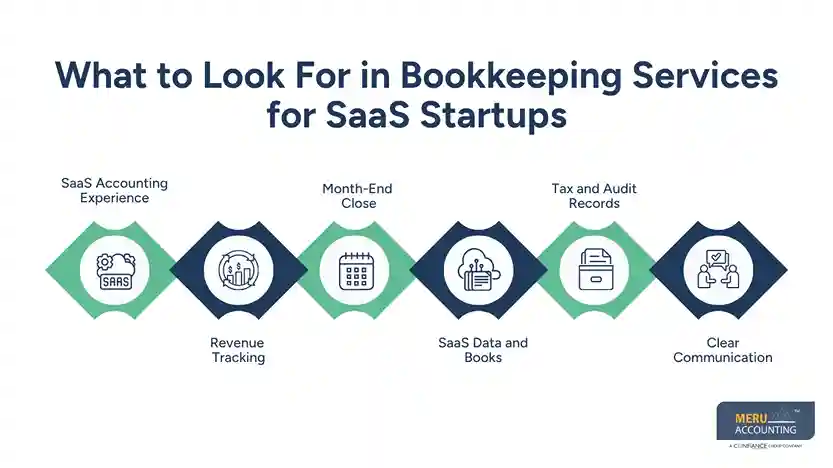
SaaS Data and Books
Your billing system may know how many customers renewed last month. Your accounting system may know how much revenue was recorded. Those two systems need to tell a consistent story.
If the data does not line up, MRR reports and financial statements can become hard to trust. Outsourced bookkeeping for SaaS companies should include checks between key systems when the setup requires them.
Tax and Audit Records
Tax filings and financial reviews rarely depend on one spreadsheet alone. Contracts, invoices, receipts, payment records, and accounting entries may all matter.
For bookkeeping services for SaaS startups, keeping this trail organized makes it easier to explain unusual transactions and respond to questions later.
Clear Communication
A good accounting process should not leave a founder staring at a report and wondering, “What does this number mean?”
The provider should explain unusual entries, missing records, corrections, and month-end issues in plain language. Outsourced bookkeeping for SaaS companies should also have clear rules for questions and approvals.
Understanding SaaS Revenue Models And Their Bookkeeping Impact
Monthly Subscriptions
Imagine a customer pays $500 for access to your software for one month. The transaction looks simple because the billing term and service period match.
But the accounting team still needs to record the invoice, payment, and revenue correctly. Bookkeeping services for SaaS startups should keep those steps connected.
Annual Subscriptions
Annual plans create a common accounting trap.
A customer pays $12,000 in January for 12 months of access. The bank balance rises by $12,000, but the full amount is not automatically January revenue. The accounting treatment depends on the contract and when the promised service is provided.
Usage-Based Plans
Some SaaS firms charge for API calls, storage, users, transactions, or other usage.
The invoice may change every month. Bookkeeping services for SaaS startups should be able to trace those changes back to the billing records and the terms agreed with the customer.
Tiered and Per-Seat Pricing
A customer might start with 20 users and later add 15 more. The monthly bill then changes, but the accounting record should still match the contract and billing data.
This is one reason SaaS bookkeeping needs more than a basic bank-feed process.
Add-Ons and Professional Services
SaaS companies often sell more than software access. They may charge for setup, training, consulting, implementation, or other services.
These items can have different accounting treatment from the core subscription. Outsourced bookkeeping for SaaS companies should identify these income streams instead of putting every customer charge into one broad revenue bucket.
Discounts, Refunds, and Credits
A $1,000 subscription can become a $900 invoice after a discount. A later refund or customer credit can change the final amount again.
These adjustments should be recorded with enough detail to explain why the original amount changed. That makes future account reviews much easier.
How SaaS Revenue Recognition Works
Identify the Customer Contract
Start with the actual agreement, not just the invoice.
Review the contract term, price, renewal terms, cancellation rights, discounts, promised services, and other conditions. Bookkeeping services for SaaS startups should use this information when setting up the accounting process.
Identify Performance Obligations
A SaaS contract can contain more than one promise.
For example, a customer may buy software access plus a separate consulting service. The accounting treatment may differ if those services are distinct under the applicable revenue rules.
Determine the Transaction Price
The amount a company expects to receive may not always equal the headline price on the sales proposal.
Discounts, refunds, credits, usage fees, and other contract terms can affect the transaction price. These details need to be reviewed before revenue is recorded.
Allocate the Transaction Price
If a contract has more than one performance obligation, the transaction price may need to be allocated among those obligations.
FASB’s revenue guidance explains that the assessment of whether goods or services are distinct can affect this process.
Recognize Revenue When Earned
This is where SaaS accounting differs from simply watching the bank account.
Revenue is generally recognized when the related performance obligation is satisfied. For a standard subscription, that can mean recognizing revenue over the period in which the customer receives access to the software.
Keep Deferred Revenue Updated
Suppose a customer pays $12,000 upfront for 12 months.
The cash is received, but the amount tied to future service remains unearned until that service is provided. Bookkeeping services for SaaS startups should maintain the deferred revenue schedule and reconcile it to the general ledger during the close.
Financial Reporting For SaaS Startups
Profit and Loss Statement
The P&L tells you what the business earned and spent during a given period.
For a SaaS startup, the report becomes more useful when revenue is recorded in the right period, and costs are classified consistently. Bookkeeping services for SaaS startups should keep those records ready for monthly review.
Balance Sheet
The balance sheet can reveal issues that a P&L may not show.
Accounts receivable can show unpaid customer bills, while deferred revenue can show amounts received for future service. Both can matter when a founder is assessing the company’s financial position.
Cash Flow Statement
A SaaS company can report revenue and still face a cash shortage.
The cash flow statement shows where money actually moved. It can show whether cash is coming from customers, being used for payroll, going toward software costs, or being spent on growth.
Accounts Receivable Aging
An aging report answers a simple question: which customers have not paid, and how long have those invoices been outstanding?
That information can be useful for collection work and cash planning. It can also reveal when reported sales are not turning into cash as expected.
Deferred Revenue Schedule
Deferred revenue deserves its own review because it connects billing with revenue recognition.
The schedule should show the amount billed or collected, the amount recognized, and the remaining balance. Bookkeeping services for SaaS startups should reconcile this schedule with the ledger.
Management Reporting
A founder may want more than a standard P&L.
Monthly management reports can bring together revenue, expenses, cash, receivables, deferred revenue, and selected SaaS metrics. Outsourced bookkeeping for SaaS companies can provide this reporting structure when an internal finance team is still small.
Key SaaS Metrics Your Bookkeeping Should Support
Monthly Recurring Revenue (MRR)
MRR gives a monthly view of recurring subscription income.
It is useful for SaaS management, but it is not the same as GAAP revenue. Stripe also notes that MRR is a business metric rather than GAAP revenue.
Annual Recurring Revenue (ARR)
ARR gives management an annual view of recurring income.
A common method used in bookkeeping services for SaaS startups is to annualize recurring monthly revenue, but the company should define how it calculates ARR and use that method consistently.
Customer Acquisition Cost (CAC)
CAC looks at the cost of acquiring customers.
The exact formula can differ by company. For example, a SaaS firm may include sales and marketing costs over a set period and divide them by the number of new customers acquired during that period.
Customer Lifetime Value (LTV)
LTV is an estimate of the value a customer may generate over the customer relationship.
It depends on assumptions such as revenue, gross margin, retention, and customer life. Because it is an estimate, the method used to calculate it should be clear.
Churn and Retention
Churn tells you how much business is being lost. Retention looks at how much business remains.
Looking at customer churn and revenue churn together can give a better view of what is happening, especially when customer sizes vary.
Gross Margin
Gross margin shows how much revenue remains after the costs tied to delivering the service are considered.
For SaaS companies, the cost base can include hosting, software infrastructure, and customer support, depending on how the company defines its cost of revenue.
How to Choose the Best Bookkeeping Services for SaaS Startups
SaaS Industry Experience
Do not only ask, “Do you work with startups?” Ask whether the provider has handled subscription billing, deferred revenue, refunds, customer credits, and SaaS reporting. Bookkeeping services for SaaS startups should fit the way your business actually earns money.
Scalability as Your Startup Grows
Your accounting needs at 20 customers will not look the same at 2,000 customers.
More invoices, more employees, more plans, more payment data, and perhaps more legal entities can change the workload. Bookkeeping services for SaaS startups should be able to adjust as those needs grow.
Accounting Software and Billing Integrations
Find out which accounting and billing systems the provider knows.
Outsourced bookkeeping for SaaS companies can be easier to manage when billing, payment, payroll, and accounting records can be checked against each other instead of being copied from one system to another by hand.
Reporting and Communication Processes
Ask for a clear answer to three questions: What reports will I receive? When will I receive them? Who reviews them?
Also ask how missing documents, unusual transactions, and corrections are handled. A defined process is more useful than a promise of “regular updates.”
Data Security and Financial Controls
Financial records should not be open to everyone in the company.
Ask how user access is managed, whether multi-factor authentication is used, how data is stored, and who can approve or change financial records. Access should match each person’s role.
Pricing and Service Structure
A low monthly fee may not tell you the full cost.
Check whether the fee includes reconciliations, month-end close, accounts receivable, reporting, and cleanup work. Also ask how extra transactions or special projects are charged.
How Meru Accounting Provides Bookkeeping Services for SaaS Startups
SaaS-Focused Bookkeeping
Meru Accounting provides bookkeeping services for SaaS startups with recurring revenue, customer billing, operating costs, and monthly accounting needs.
The work can be set around the startup’s accounting system, billing process, transaction volume, and reporting needs rather than forcing every business into one fixed workflow.
Revenue and Billing Records
Meru Accounting reviews billing and accounting records so invoices, customer payments, credits, refunds, and other adjustments are properly reflected in the books.
This gives the business a clearer trail between customer activity, billing records, cash received, and accounting entries.
Monthly Account Review
Meru Accounting reviews key accounts as part of the monthly bookkeeping process.
Bank accounts, credit cards, receivables, payables, and other material accounts can be checked against source records before monthly reports are prepared.
SaaS Reporting Data
A SaaS founder may need to look at both accounting figures and operating metrics.
Bookkeeping services for SaaS startups can keep the underlying revenue, expense, cash, receivable, and other accounting data organized so management has a better base for monthly reporting.
Software and Process Fit
Meru Accounting works with accounting platforms such as QuickBooks, Xero, Zoho Books, NetSuite, and Odoo.
The right setup depends on the startup’s size, billing process, existing systems, transaction volume, and reporting needs.
Ongoing Accounting Support
A startup’s books can change quickly, making bookkeeping services for SaaS startups important as new customers, employees, pricing plans, and payment terms are added.
Meru Accounting provides accounting and bookkeeping services based on the company’s records and processes, with the aim of keeping the monthly books organized as those changes take place.
Our Expert Perspective
One thing founders may miss is that SaaS books start with the deal, not the bank feed.
If a client pays $24,000 for a two-year plan, the book team needs to know what the payment is for and when the work is due. A cash view alone can hide this time gap.
We also see a mix-up between SaaS stats and book data. MRR can rise while GAAP sales take a new path. This does not mean one is wrong. Each one has a set use.
For us, bookkeeping services for SaaS startups should make this gap easy to see. When a founder asks why cash, MRR, held sales, and book sales do not match, the books should show why.
That is the true test of a SaaS book process: not if the sheet looks neat, but if each sum can link back to real deals, bills, pays, and book rules.
Key Takeaways
- SaaS books need to track plan terms, bills, refunds, credits, and held sales.
- Bookkeeping services for SaaS startups should report cash in hand from sales that have been earned.
- A full-year plan paid up front is not, by rule, a full year’s sales in the month of payment.
- ASC 606 sets the main U.S. GAAP rules for sales from deals with clients.
- MRR and ARR are key work stats, but they do not take the place of core book reports.
- CAC, LTV, churn, hold rate, and gross margin need clear and sound source data.
- Outsourced bookkeeping for SaaS companies can be used when bookkeeping work grows past what a founder or small in-house team can do.
- Bookkeeping services for SaaS startups should be able to scale as the client base and deal count grow.
FAQs
Bookkeeping services for SaaS startups can cover deal logs, bank checks, money due in, bills due, held sales, month-end close, and key book reports.
SaaS plan sales are often booked over the time the SaaS service is used, based on the deal and the rules for sales records.
Deferred revenue is cash a client has paid for SaaS work that the firm has not yet done.
A SaaS startup should track its P&L, balance sheet, cash flow, money due in, held sales, and key SaaS stats.
Ask about SaaS work, sales rules, held sales, bookkeeping tools, billing tools, month-end close, reports, data checks, fees, and how they share updates. Bookkeeping services for SaaS startups should fit how your firm bills clients and logs sales.