
Bookkeeping startups often begin with limited staff, small budgets, and high pressure to manage financial records correctly from day one. In early growth stages, owners try to handle accounts on their own, which often leads to errors, stress, and delayed financial decisions. Outsourcing early helps reduce these risks and builds a strong base for financial control.
Early support from a bookkeeping service for startups allows founders to focus on clients, service quality, and growth instead of spending long hours on record-keeping. It also improves accuracy in financial data, which is important for tax filing and business planning.
Many studies, including reports from small business advisory groups such as the U.S. Small Business Administration, show that poor financial tracking is one of the main reasons early-stage businesses face cash flow issues.
What You Will Learn From This Blog
- Why do bookkeeping startups face early financial pressure
- How outsourcing improves accuracy and control
- Risks of managing accounts without expert help
- Benefits of early financial support for growth
- How to choose the right support system
- Why firms like Meru Accounting help startups scale safely
Understanding The Concept Of Bookkeeping Startups In The Modern Business Environment
Bookkeeping startups usually begin with very simple systems, such as spreadsheets or basic accounting software. At this early stage, business activity may be limited, but it still requires a clear structure to avoid confusion in the future.
Even small gaps in recording income or expenses can create problems later when the business grows, and financial data becomes more complex. A strong early setup helps maintain order and reduces the risk of mistakes building up over time.
Another important factor is the need for accurate records from the beginning. Even small errors in early entries can turn into larger issues during tax filing, audits, or financial reviews.
Clean and well-organized records help build trust in financial data and make it easier for owners to understand the real position of their business. Along with this, most bookkeeping startups rely on tools like QuickBooks or Xero to manage transactions, but these tools alone are not enough without proper accounting knowledge and handling.
As the business grows, compliance needs also increase. Tax rules, reporting standards, and filing requirements become more detailed and strict, which adds pressure on early-stage companies.
At the same time, many founders face financial visibility challenges because they do not have a clear view of cash flow or future expenses. This makes it difficult to plan hiring, pricing, or expansion decisions with confidence, highlighting the need for proper financial structure from the start.
Key Reasons Bookkeeping Startups Should Outsource Early
Reduced Operational Burden
Outsourcing helps bookkeeping startups remove the heavy task of daily record-keeping. This gives founders more time for client work and business planning.
Access To Skilled Professionals
Experienced accountants handle complex records with strong financial understanding skills. Errors are significantly reduced due to expert-level financial oversight.
Better Cash Flow Control
Structured reporting helps track income and expenses in real time. Overspending risks decrease through improved visibility of financial movement.
Strong Tax Compliance
Outsourced teams ensure accurate tax filing and timely submissions always. Penalties reduce as compliance requirements are met without delays.
Scalable Financial Systems
Outsourced services grow easily with expanding business financial needs smoothly. Hiring pressure reduces during rapid growth and expansion phases.
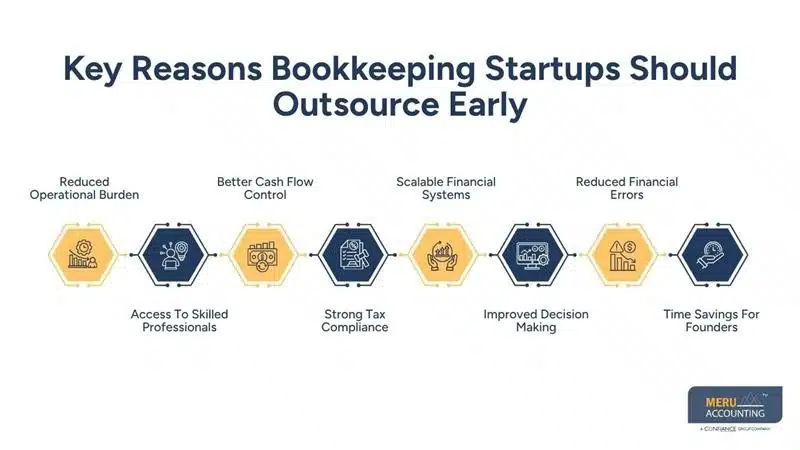
Improved Decision Making
Clear financial reports support better planning for business growth steps. Startup owners understand profit trends and cost patterns more clearly.
Reduced Financial Errors
A professional review helps detect mistakes in records before the reporting stage. Accuracy improves through consistent monitoring and structured accounting processes.
Time Savings For Founders
Outsourcing frees up significant time spent on routine bookkeeping tasks daily. Founders invest saved time into sales and client acquisition efforts.
Common Challenges Faced By Bookkeeping Startups Without Outsourcing
Frequent Data Errors
Manual entry mistakes are common when accounts are handled internally. These errors can affect financial reports and tax filings. Small mistakes often remain unnoticed until major reporting issues arise later.
Time Management Issues
Owners spend long hours managing accounts instead of focusing on growth activities. This slows down business progress. Important business tasks often get delayed due to accounting workload pressure.
Lack Of Financial Expertise
Many businesses do not have trained accountants in the early stages and often avoid using a bookkeeping service for startups, which leads to weak financial decisions. This often leads to weak financial decisions and incorrect interpretation of data, which impacts planning and budgeting choices.
Missed Tax Deadlines
Without structured systems, deadlines are often missed, leading to penalties and stress. Late filings also create compliance risks and unnecessary financial burden.
Poor Decision Making in Bookkeeping Startups
Without clear reports, it becomes difficult for bookkeeping startups to make informed business choices. Limited financial visibility often leads startups toward incorrect planning decisions.
How Outsourcing Helps Scale Bookkeeping Startups Faster
Improved Financial Accuracy
Outsourced teams ensure all records are checked and corrected for bookkeeping startups. This improves trust in financial data. Regular review processes reduce the chances of repeated accounting errors.
Faster Reporting Cycles
Businesses receive timely reports, which help in faster decision-making and planning. Quick reporting enables faster responses to financial changes.
Better Resource Use
Instead of hiring full-time staff, companies can use outsourcing for flexible support. Operational costs stay controlled while workload management becomes easier.
Stronger Compliance Structure
Experts ensure all rules are followed correctly, reducing legal risks. Proper filing systems help avoid penalties and compliance-related stress.
Support For Business Growth
With clean financial data from a bookkeeping service for startups, companies can attract investors and plan expansion. Strong financial clarity supports better long-term growth planning decisions.
Key Features To Look For In A Bookkeeping Service For Startups
Industry Experience
Choose providers who understand early-stage business accounting needs clearly. Practical exposure helps handle common financial issues with higher accuracy.
Software Expertise
A bookkeeping service for startups should be skilled in tools like Xero, QuickBooks, or Zoho Books. Proper tool usage ensures faster processing and improved record management quality.
Transparent Reporting
Clear reports help track performance without confusion or missing details. Regular updates improve understanding of income, expenses, and cash position.
Flexible Pricing Models
Services should align with budget constraints and early-stage business needs. Flexible plans help maintain financial balance during growth phases.
Strong Communication
Regular updates help avoid misunderstandings in financial records and reporting. Consistent communication supports faster resolution of accounting-related queries.
In-House Vs Outsourced: What Works Best For Bookkeeping Startups
Factor | In-House Model | Outsourced Model |
Cost Differences | Hiring in-house staff increases salary, training, and infrastructure costs. | Outsourcing is more cost-friendly and reduces fixed expenses. |
Skill Availability | Limited expertise depends on one employee or a small team. | Access to wider financial expertise and experienced professionals. |
Scalability Factor | Scaling requires new hiring and training efforts. | A bookkeeping startups can easily adjust workload based on demand. |
Risk Management | Higher chances of errors and compliance gaps. | Reduced risks due to professional oversight and review systems. |
Focus On Core Work | Time spent on admin and accounting tasks increases. | Focus remains on growth, clients, and business development. |
Real Benefits Of Early Outsourcing For Long-Term Growth
Strong Financial Foundation
Early outsourcing builds a clean and structured financial system for businesses. Well-organized records help maintain consistency in daily accounting operations.
Investor Readiness
Well-maintained records improve chances of securing funding or investment. Clear financial data increases trust among potential investors and partners.
Reduced Stress Levels
Founders feel less pressure when financial tasks are handled by a bookkeeping service for startups and expert professionals. Time savings allow more focus on customers and business development work.
Long-Term Cost Savings
Avoiding errors and penalties helps reduce long-term financial loss. Efficient systems lower unnecessary spending and improve cost control.
Better Business Strategy
Accurate data supports smarter planning and growth decisions. Reliable insights help improve forecasting and business direction planning.
Why Startups Choose Meru Accounting?
Meru Accounting provides dedicated financial support designed for early-stage businesses across different industries. We help companies manage accounts, tax filings, and reporting with accuracy and care. Strong systems and expert handling ensure smooth financial operations from the beginning stage.
Startup-Focused Financial Systems
Meru Accounting builds structured systems that match the needs of startups from day one. These systems reduce confusion and improve financial clarity in daily operations.
Expert Accounting Team
Our team includes experienced professionals who understand global accounting standards and startup challenges. Each member focuses on accuracy, compliance, and timely financial reporting.
Technology Driven Support
We work with tools like QuickBooks, Xero, and Zoho Books to simplify financial tracking. Modern tools help speed up reporting and improve data accuracy across processes.
Scalable Service Model
As businesses grow, services can be expanded without disruption or delays. Flexible support ensures smooth handling of increasing financial workloads over time.
Global Client Experience
Meru Accounting supports clients across the USA and other regions with reliable guidance. International exposure helps manage diverse financial requirements with confidence and precision.
Key Takeaways
- Bookkeeping startups face early financial pressure without structured systems
- Outsourcing improves accuracy, compliance, and decision-making
- Early support helps reduce cost, stress, and long-term errors
- A bookkeeping service for startups provides scalable and skilled support
- Strong financial systems help startups grow faster and attract investment
- Meru Accounting offers reliable support for early-stage business accounting
FAQs
Outsourcing helps reduce errors and saves time for core business tasks. It also improves financial accuracy from the start.
Yes, outsourcing is often more cost-effective and gives access to skilled professionals without hiring full-time staff.
Yes, many providers offer flexible pricing that fits small budgets and early-stage needs.
It ensures records are accurate, deadlines are met, and filings follow tax rules correctly.
No, startups still have full access to reports and data while experts manage the technical work.