

Many businesses spend valuable time managing routine bookkeeping tasks instead of focusing on business growth. A bookkeeping virtual assistant helps solve this challenge by handling things with precision and better procedural accuracy. This support allows finance teams to complete important work more quickly and with greater productivity.
As businesses expand, accounting responsibilities also increase with more demanding efficiency. Many organizations combine the expertise of a bookkeeping virtual assistant with a virtual accountant to improve efficiency and support better financial management. Such a superior, flexible approach helps businesses increase financial functionality while controlling operating costs.
What You Will Learn From This Blog
- Understand the role of a bookkeeping virtual assistant.
- Understand bookkeeping and how support improves financial operations.
- Discover how a virtual accountant complements finance teams.
- Related common bookkeeping tasks handled remotely.
- On how businesses improve reporting accuracy smartly.
- Learning the benefits of flexible bookkeeping support.
- About best practices for integrating remote professionals.
- On how bookkeeping support contributes to business growth.
Understanding a Bookkeeping Virtual Assistant
What Is a Bookkeeping Virtual Assistant?
A bookkeeping virtual assistant is a trained professional who manages routine bookkeeping tasks from a location that is remote using secure, superior accounting software and cloud-based systems. Instead of hiring additional in-house staff, businesses can receive productive outcomes with it at less cost and better processes.
These professionals assist with recording financial transactions, reconciling bank accounts, tracking expenses, and organizing financial records. A major part of businesses also work with a virtual accountant for superior accounting activities such as financial reporting and compliance reviews.
This combination allows organizations to maintain accurate financial records while improving efficiency across the finance department.
Why Businesses Are Hiring Bookkeeping Virtual Assistants
Business owners often find that bookkeeping responsibilities increase with growth in business. Processing invoices, recording expenses, and maintaining financial records require a greater attention to detail and superior attention to detail.
It supports businesses in managing these responsibilities with fewer full-time staff, with better cost benefits. A beneficial approach like this provides flexibility while reducing pressure at various other levels,
Businesses also benefit from access to experienced professionals who understand modern accounting software and standardized bookkeeping procedures.
Tasks Managed by a Bookkeeping Virtual Assistant
It performs many essential financial tasks that keep accounting records accurate and organized.
Common types of responsibilities include:
- Recording daily financial transactions.
- Managing accounts payable.
- Monitoring accounts receivable.
- Reconciling bank accounts.
- Maintaining general ledgers.
- Tracking business expenses.
- Assisting with month-end bookkeeping.
An accountant may also review financial reports, analyze accounting records, and assist with tax preparation. Together, it helps businesses maintain reliable and more suitable financial information that helps for supportive decisions.
How a Bookkeeping Virtual Assistant Strengthens Your Finance Team
Improves Daily Financial Operations
Routine bookkeeping tasks require accuracy and all-around consistency. Late or delayed recording of transactions can affect financial reporting and decisions.
Bookkeeping completes these activities using a structured flow of work and secure systems. Daily bookkeeping remains current, allowing finance managers to access information depending on the need and whenever required.
Instead of spending time on repetitive work, internal accounting staff can suitably focus on budgeting and various financial analyses.
Businesses that also engage a virtual accountant benefit from financial oversight and professional review of records.
Supports Better Financial Accuracy
Accurate bookkeeping is the foundation of financial reporting. Every transaction must be recorded correctly, which supports budgeting and various management reports.
Follows established bookkeeping procedures that reduce manual errors, improving consistency as well. Regular reconciliations and transaction reviews help maintain financial information.
According to the International Federation of Accountants, consistent accounting practices and accurate financial records contribute to stronger financial reporting for better decision-making.
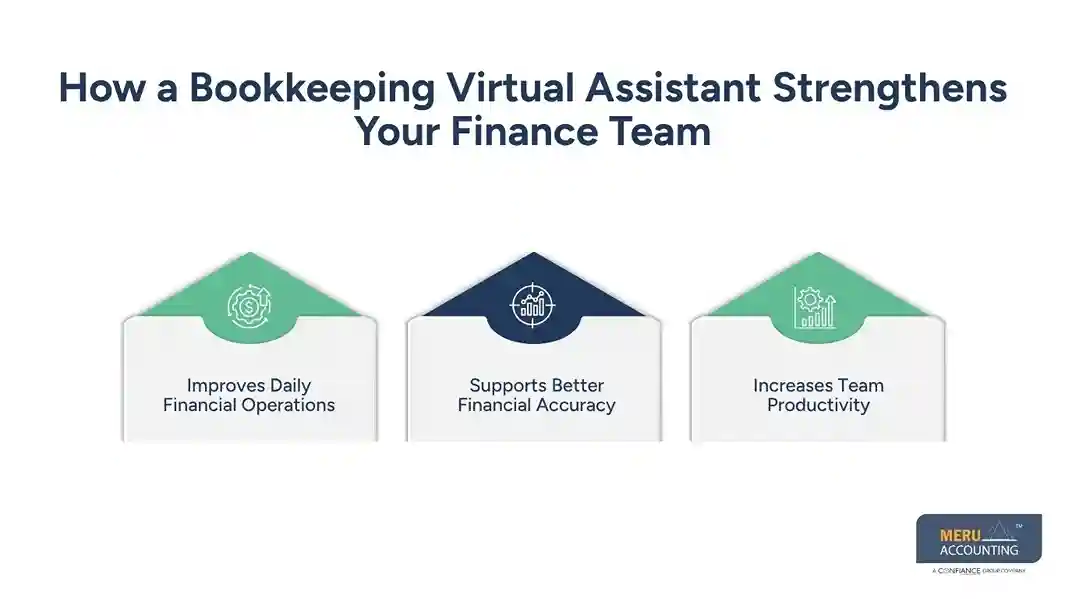
Increases Team Productivity
As businesses grow, finance teams often spend more time completing routine bookkeeping than supporting business strategy. This can reduce overall productivity and delay important financial projects.
It helps distribute routine work across experienced professionals. Daily bookkeeping tasks continue without interrupting higher-level accounting activities.
For example, a wholesale business processing hundreds of supplier invoices each month can assign transaction recording and reconciliations to a bookkeeping virtual assistant. Internal finance managers can then concentrate on financial planning and performance analysis.
According to the International Organization for Standardization, standardized processes improve consistency, efficiency, and quality across business operations.
optional anymore
on running the business
Additional Benefits of a Bookkeeping Virtual Assistant
Helps Manage Business Costs
Expanding an in-house bookkeeping team often increases various levels of operating expenses. Businesses must consider recruitment costs, salaries, employee benefits, training, and various other parameters that can be cost-affecting in the longer term.
In such situations, virtual bookkeeping helps reduce costs by providing professional support without increasing permanent staff that requires ample other processes. Businesses pay for the services they need while maintaining accurate financial records.
Many organizations also work with a virtual accountant to manage financial reporting in a more productive way. Such a combination provides dependable support while improving cost efficiency.
The savings created through flexible bookkeeping support can be invested in various productive business growth and also in the enhancement of customer service.
Improves Financial Organization
Well-organized financial records help businesses complete reporting and tax preparation more efficiently. Missing documents or incomplete bookkeeping can delay various important work.
A bookkeeping virtual assistant maintains organized transaction records and supporting documents that are needed throughout the working cycle. This structured approach improves financial visibility and reduces time with informational issues.
Supports Business Growth
Growing businesses usually experience higher transaction volumes and more complex financial responsibilities. Without additional bookkeeping support, finance teams may struggle to maintain reporting accuracy.
A bookkeeping assistant provides flexible support as business needs change. Additional bookkeeping resources can be added during busy periods without expanding permanent staff.
For example, a professional services company opening a second office may experience higher invoice volumes and increased banking activity. It can manage daily transaction recording while internal finance leaders focus on business expansion.
Working alongside an accountant also helps businesses prepare financial reports that support planning and future investment decisions.
Best Practices for Working with a Bookkeeping Virtual Assistant
Define Responsibilities Clearly
A successful working relationship begins with clearly defined responsibilities. Businesses should identify which bookkeeping tasks will be managed remotely and which activities will remain with the internal finance team.
Responsibilities may include:
- Daily bookkeeping.
- Bank reconciliations.
- Expense tracking.
- Accounts payable support.
- Accounts receivable updates.
- Financial record maintenance.
- Payroll documentation.
- Monthly bookkeeping reports.
Clear expectations improve communication and help maintain consistent financial processes.
Use Secure Accounting Systems
Financial information should always be protected through secure accounting software along with suitable procedures that are required.
Businesses should provide it with access only to the systems required for assigned work. Secure passwords, multi-factor authentication, encrypted communication, and regular backups are required and also help to keep things secure.
An accountant should follow document security procedures when reviewing financial reports. The same goes for accounting records.
Strong security practices build confidence while supporting responsible financial management.
Review Financial Reports Regularly
Although routine bookkeeping can be delegated, business owners should continue reviewing financial information regularly.
Monthly reports, expense summaries, and cash flow statements help to understand various performance metrics. Regular reviews also allow businesses to identify unusual transactions before they become a major issue.
A bookkeeping virtual assistant prepares accurate bookkeeping records, while a virtual accountant provides additional financial insight along with required and beneficial reporting and professional analysis.
Such a combination helps with financial oversight and supports better business decisions.
Why Businesses Choose Meru Accounting
Businesses choose Meru Accounting because they need dependable bookkeeping support that improves performance with the least amount of complexity. Our bookkeeping services help businesses maintain accurate financial records while supporting smooth daily operations with the utmost efficiency.
Our experienced professionals manage bookkeeping, accounts payable, accounts receivable, payroll support, bank reconciliations, expense tracking, financial documentation, and other bookkeeping activities in a smarter and more reliable way. Our accounting services also provide financial reporting and guidance that support better business decisions.
Our team follows structured workflows, secure accounting systems, and recognized accounting practices to maintain reliable information. We work with businesses across different industries and understand the importance of accurate bookkeeping that helps the organization in various productive ways.
Whether your business needs daily bookkeeping support or additional accounting expertise, Meru Accounting provides practical solutions designed for it. Our bookkeeping assistant services can support business goals in a very accurate manner.
From Our Expert Perspective
In our experience, businesses often underestimate how much time routine bookkeeping consumes each week. Finance teams frequently spend valuable hours recording transactions instead of reviewing financial performance or supporting management decisions.
Another common observation is that businesses sometimes delay reconciliations till month endSuch procedures create pressure and increase the possibility of reporting errors.
A bookkeeping virtual assistant helps maintain current financial records, making reporting more efficient. When combined with a virtual accountant, businesses gain both reliable bookkeeping support and experienced guidance with need.
Organizations that establish clear responsibilities, regular communication, and consistent review procedures generally achieve stronger financial control and better operational efficiency.
Key Takeaways
- Basically, a virtual assistant manages routine financial tasks efficiently.
- Accurate bookkeeping improves financial reporting.
- Provides additional accounting expertise.
- Organized financial records support compliance.
- Flexible bookkeeping reduces operating costs.
- Professional bookkeeping supports business growth.
- Consistent financial reviews improve decision-making.
FAQs
It records financial transactions, reconciles accounts, tracks expenses, and supports daily accounting activities that are needed with growing demand or workload.
It mainly handles routine bookkeeping tasks, while a virtual accountant focuses on financial reporting and accounting guidance.
Small businesses, growing companies that need support with it, professional firms, and e-commerce businesses often benefit from it.
Yes. It helps growing businesses manage increasing transaction volumes while maintaining accurate financial records and efficient accounting processes.
A bookkeeping virtual assistant improves financial operations by maintaining accurate bookkeeping records, completing reconciliations on time, reducing administrative work, and supporting reliable financial reporting.
optional anymore
on running the business