Managing payroll for one client is one thing. Managing it for several clients, each with different pay schedules, employee data, tax needs, and reporting rules, is a different challenge. Payroll software for accounting professionals can help firms keep this work organized while giving their teams a clear view of each client’s payroll.
The right software should do more than process paychecks. It should help accounting teams review payroll data, track taxes and liabilities, manage client records, and connect payroll activity with the accounting books. These features become even more useful as a firm takes on more clients and adds staff.
In this blog, we’ll look at the key features growing accounting firms should consider, how multi-client payroll software can support daily work, and what to check before choosing a system.
What You Will Learn From This Blog
In this blog, you will learn:
- What payroll software does for accounting firms
- Why growing firms may need more than a basic payroll tool
- Key features to look for in payroll software for accounting professionals
- How multi-client payroll software can help manage client work
- Ways to check payroll taxes and liabilities
- What to look for as your firm grows
- How payroll support can work with your current software
What Is Payroll Software for Accounting Professionals?
Payroll software for accounting professionals helps firms manage payroll work for business clients. It can hold pay data, track pay runs, create reports, and help staff check payroll tax and pay items.
A key need for an accounting firm is the ability to keep each client’s data apart. Staff may need to move from one client to the next without losing track of pay dates, tax items, or payroll records.
Good payroll software for accounting professionals may also link with an accounting system. This can help move payroll data into the books and cut down on manual entry.
The exact tools vary by plan. Some systems may offer tax filing, while others may focus more on payroll data, reports, and firm work. So, firms should check what each plan does before they choose a tool.
Why Growing Accounting Firms Need Specialized Payroll Software
A small client list may be easy to track with a basic setup. That can change once a firm has many clients with their own pay dates, staff, tax rules, and pay types.
This is where multi-client payroll software can help. It lets a firm work with many client accounts from a setup made for firm use. Staff can keep client data, pay runs, and reports tied to the right business.
Growing firms may also need:
- More than one pay cycle
- Support for hourly and salaried staff
- Clear user roles
- Client-level reports
- Tax and liability checks
- Links to accounting tools
- A way to review past payroll data
- Easy access for more than one team member
The best payroll software for accounting professionals should support the way the firm works today while leaving room for more clients later.
Managing Payroll for Multiple Clients Without Mixing Data
Handling many clients calls for a clear process. Even the best multi-client payroll software cannot replace good review steps.
Start by setting up each client with the right company details, pay schedule, employee data, tax settings, and accounting link. Keep client files and reports tied to the right account.
Before each pay run, review the data for that client only. Check hours, rates, new hires, pay changes, deductions, and other key items. After the run, review payroll reports and related entries.
A simple review flow may look like this:
Client setup → Pay data review → Payroll run → Tax and liability check → Accounting entry → Bank/payment match → Month-end review
This process helps reduce the risk of mixing data between clients. It also gives the firm a clear trail for each payroll cycle.
optional anymore
on running the business
Key Features to Look for in Payroll Software for Accounting Professionals
Not all payroll tools are made for accounting firms. When you compare systems, look at the features that affect daily work, review, and client service.
1. Multi-Client Payroll Management
A firm may need to run payroll for many businesses at once. Multi-client payroll software should make it easy to move between client accounts while keeping each set of data separate.
Look for clear client lists, account views, pay schedules, and report tools. These small items can save time when a team handles many pay runs each month.
2. Payroll Processing and Pay Schedules
Different clients may pay staff each week, every two weeks, twice a month, or once a month. The system should let the firm set the right pay cycle for each client.
It should also support key pay types, such as hourly and salaried wages. A clear pay review screen can help staff check hours, rates, deductions, and other pay data before a run is done.
3. Payroll Tax and Liability Tracking
Payroll does not end when staff gets paid. Tax withholdings, employer taxes, benefits, and other liabilities still need to be tracked.
A good system should give the team clear reports that show what is due, what has been paid, and what may need review. This can help the firm spot a gap before it grows into a larger issue.
4. Client and Firm Reports
Accounting firms need reports for more than one reason. A client may need payroll summaries, while the accounting team may need wage, tax, or liability data for the books.
Look for report tools that are easy to filter, view, save, or export. Payroll software for accounting professionals should make it easy to get the data needed for both client work and book review.
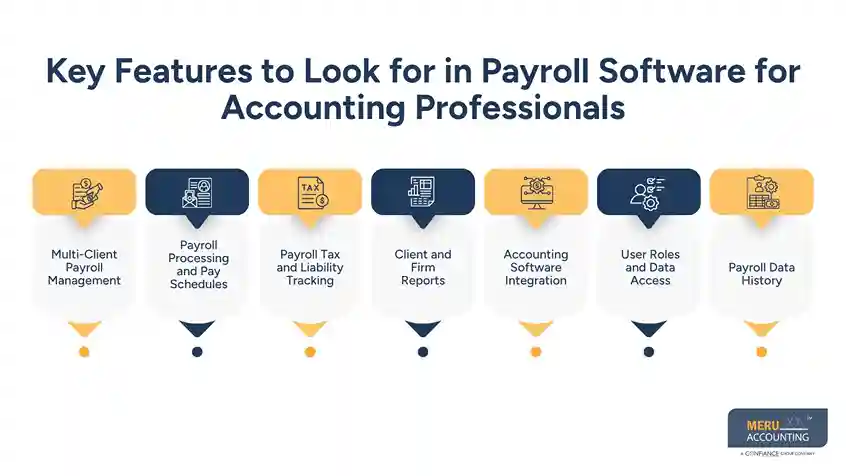
5. Accounting Software Integration
Payroll data often needs to flow into the accounting books. A good link with QuickBooks, Xero, or another accounting system can cut down on data entry.
Still, an integration does not remove the need for review. Payroll entries, tax liabilities, bank payments, and other items should still be checked as part of the accounting process.
6. User Roles and Data Access
A growing firm may have staff with different jobs. One person may enter payroll data, another may review it, and a manager may need final access.
User roles can help limit who can view or change certain data. This matters when a firm has many clients and more team members.
7. Payroll Data History
A firm may need to check past pay runs, reports, or payroll changes. Easy access to past data can help when a client asks a question or when the books need review.
This is also useful during cleanup work. Staff can compare current records with past payroll data to find gaps or items that need correction.
Managing Payroll for Multiple Clients Without Mixing Data
Handling many clients calls for a clear process. Even the best multi-client payroll software cannot replace good review steps.
Start by setting up each client with the right company details, pay schedule, employee data, tax settings, and accounting link. Keep client files and reports tied to the right account.
Before each pay run, review the data for that client only. Check hours, rates, new hires, pay changes, deductions, and other key items. After the run, review payroll reports and related entries.
A simple review flow may look like this:
Client setup → Pay data review → Payroll run → Tax and liability check → Accounting entry → Bank/payment match → Month-end review
This process helps reduce the risk of mixing data between clients. It also gives the firm a clear trail for each payroll cycle.
Payroll Compliance and Liability Checks
Payroll errors can affect more than a paycheck. A missed tax item or wrong liability balance can lead to poor books and extra work later.
Payroll software for accounting professionals can help staff track payroll taxes and other liabilities, but the firm still needs to review the data.
Useful checks may include:
- Federal and state payroll tax data
- Employee withholdings
- Employer tax amounts
- Benefit and deduction balances
- Payroll liability accounts
- Payroll payments
- Payroll journal entries
- Bank activity tied to payroll
For firms using multi-client payroll software, these checks should be done at the client level. Each business may have its own pay setup, tax needs, benefit plans, and payroll schedule.
The software can help show the data. The accounting team still needs to use its judgment to spot errors, gaps, or unusual changes.
Meru Accounting’s Payroll Management Services
Payroll needs to tie back to the books. Meru Accounting helps firms review payroll data, record payroll costs, check liabilities, and match payroll payments so client records stay accurate through each pay cycle and month-end close.
Our payroll management services include:
- Payroll review: Pay data, wages, deductions, benefits, and payroll reports
- Payroll accounting: Payroll expenses and journal entries
- Tax and liability checks: Payroll taxes, withholdings, and liability balances
- Payment matching: Payroll payments and bank activity
- Month-end review: Payroll accounts, entries, and balances
- Cleanup and catch-up: Old payroll records and unresolved items
- Tax-ready records: Organized payroll data for tax and year-end work
We work with QuickBooks, Xero, and Zoho Books, along with the payroll and accounting systems a client already uses. This lets us support the existing workflow without adding extra steps.
Our Expert Insight
One issue we often see in payroll work is a mismatch between the payroll report and the general ledger. The payroll run may be correct, but the related wage, tax, or benefit accounts can still carry an old balance. These issues are easy to miss when payroll is reviewed only as a pay run.
For accounting firms, we recommend comparing payroll reports with the books on a set schedule. A quick check of payroll expense, liability balances, and payroll payments can catch small gaps before they affect the month-end close. This kind of review matters even when the firm uses payroll software for accounting professionals or multi-client payroll software.
Key Takeaways
- Payroll software for accounting professionals helps firms manage payroll work across client accounts.
- Growing firms need tools that support multiple clients, pay schedules, reports, and user roles.
- Multi-client payroll software can help keep client data separate and easier to manage.
- Payroll tax and liability checks should be part of the review process.
- Payroll integrations can cut down on data entry but do not replace accounting review.
- The best system should fit the firm’s current workflow and support future growth.
- Payroll management support can help firms keep payroll data and accounting records in sync.
FAQs
Look for client management, pay schedule support, reports, tax tracking, accounting links, user roles, and clear data access. The best fit depends on the firm’s client count and workflow.
Yes. Multi-client payroll software is made to help firms manage separate payroll accounts for different businesses. Features vary by provider and plan.
No. Payroll software can process and track payroll data, but the books may still need journal entries, liability checks, payment matching, and month-end review.
Many payroll systems can connect with major accounting platforms. The type of sync and data shared can vary, so firms should check the exact integration before setup.
Yes. Payroll software for accounting professionals can help a small firm set a clear process before its client list grows. It can also reduce manual work and make payroll review more consistent.
optional anymore
on running the business