
Business bookkeeping and accounting play a direct role in how fast and accurately companies close their books each month. Many businesses struggle with delays, errors, and missing data, which slows reporting and affects decisions.
With structured systems and expert support, these delays can be reduced or fully removed. This blog explains how the right approach to business accounting and bookkeeping helps create faster and more reliable month-end closing processes.
Month-end closing is a critical financial task for every business. It ensures that all transactions are recorded, accounts are balanced, and reports are ready for review. However, delays often occur due to poor record-keeping, manual errors, and a lack of proper systems.
When businesses adopt business accounting and bookkeeping, they gain better control over financial data. This helps reduce confusion, improve reporting speed, and support timely decision-making. A structured approach ensures that every transaction is tracked and verified without last-minute stress.
What You Will Learn From This Blog
- How business bookkeeping and accounting improve month-end processes
- Main causes behind delays in closing financial records
- Practical steps to speed up month-end closing
- Role of a fully managed bookkeeping and accounting service
- Benefits of outsourcing bookkeeping tasks
- Ways to reduce financial errors and improve accuracy
Introduction To Business Bookkeeping And Accounting In Modern Businesses
Business bookkeeping and accounting form the base of financial control in modern businesses. They involve recording, organizing, and reviewing all financial transactions, including sales, expenses, payroll, and taxes.
When records are maintained properly, businesses gain clear and accurate financial data, which reduces confusion and supports smoother operations. Well-managed records also make it easier to track income and expenses, especially during critical periods like month-end closing.
With the shift from manual processes to digital systems, many businesses now rely on accounting software instead of spreadsheets. This change helps reduce human errors, improves speed, and ensures that financial data is updated regularly.
Structured and organized data not only simplifies reporting but also allows teams to access information quickly when needed. As a result, businesses can maintain consistency and avoid delays caused by missing or incorrect data.
Accurate financial records also play an important role in decision-making and compliance. Business owners can review performance, identify trends, and plan future actions based on reliable data.
At the same time, proper bookkeeping ensures that businesses meet tax and legal requirements, reducing the risk of penalties. Overall, a strong system of business bookkeeping and accounting supports both daily operations and long-term financial stability.
What Causes Month-End Closing Delays?
Incomplete Financial Records
Missing invoices or unrecorded expenses can slow down the closing process. Teams spend extra time finding and correcting data. This often leads to last-minute adjustments that delay final reporting.
Manual Data Entry Errors
Manual work often leads to mistakes. These errors require review and correction before closing. Rechecking entries increases workload and extends the closing timeline.
Lack Of Standard Processes
Without clear steps, teams may follow different methods. This creates confusion and delays. Inconsistent workflows also make it harder to track progress and accountability.
Poor Communication Between Teams
In business bookkeeping and accounting workflows, finance, sales, and operations teams must share data. Lack of coordination leads to missing information. Delays in data sharing can hold up the entire closing process.
Delayed Bank Reconciliation
If bank accounts are not updated regularly, it becomes harder to match records at month-end. This results in more time spent resolving differences and verifying balances.
Why Business Bookkeeping And Accounting Is Critical For Timely Closures
Ensures Real-Time Data Availability
With business bookkeeping and accounting, transactions are recorded regularly. This reduces last-minute workload and improves overall financial data accessibility.
Improves Accuracy Of Financial Records
With proper business bookkeeping and accounting, accurate records mean fewer corrections during the closing process each month. Reliable data also builds confidence in reports prepared for management review.
Supports Faster Reconciliation
Regular updates make it easier to match bank statements and accounts. This reduces discrepancies and saves time during the month-end closing process.
Reduces Dependency On Manual Work
Automation tools reduce errors and save time across accounting operations. They also help streamline repetitive tasks and improve consistency across processes.
Builds A Consistent Closing Process
Standard methods help teams follow the same steps every month consistently. This consistency ensures smoother workflows and more predictable financial closing timelines.
Common Challenges Businesses Face During Month-End Closing
High Volume Of Transactions
Large numbers of transactions increase complexity and time required for review. This makes it harder to track errors and complete closing tasks on time.
Lack Of Skilled Staff
Without trained professionals, errors and delays are more common. Teams may struggle to handle complex entries and financial adjustments properly.
Poor Data Organization
Unstructured data makes it difficult to find and verify information. This leads to confusion and delays when preparing reports and reconciliations.
Inconsistent Reporting Methods
Different formats and tools create confusion during consolidation. It becomes harder to compare data and ensure accuracy across reports.
Limited Use Of Technology
Businesses not using modern tools often face slower processes. Manual systems increase workload and reduce efficiency during closing activities.
Role Of A Fully Managed Bookkeeping And Accounting Service In Streamlining Closures
Centralized Financial Management
A fully managed bookkeeping and accounting service keeps all financial data organized centrally. This improves access, visibility, and control over business financial records daily.
Regular Data Updates
Transactions are recorded daily or weekly, reducing month-end workload significantly. This ensures records remain current and minimizes last-minute data entry pressure.
Expert Review And Monitoring
Professionals review records to ensure accuracy and compliance with regulations. This reduces errors and helps maintain reliable financial reporting standards.
Standardized Processes
A fully managed bookkeeping and accounting service follows clear steps consistently. This ensures uniform workflows and reduces confusion across different financial tasks.
Use Of Advanced Tools
Modern software improves speed, reduces errors, and enhances reporting accuracy. It also supports automation and simplifies complex accounting processes efficiently.
Step-By-Step Process Of Faster Closures With Business Bookkeeping And Accounting
Daily Transaction Recording
In effective business bookkeeping and accounting workflows, recording transactions regularly ensures that no important financial data is missed. This keeps records updated and reduces workload during month-end closing tasks.
Weekly Account Reviews
Frequent checks help identify errors early and avoid delays in closing. This allows timely corrections and improves the overall accuracy of financial records.
Timely Bank Reconciliation
Matching bank statements regularly reduces work required at month-end closing. It also helps identify discrepancies quickly and maintain accurate account balances.
Automated Reporting Systems
Automation helps generate reports quickly and accurately for better decision-making. It reduces manual effort and ensures consistency across financial reporting processes.
Final Review And Adjustments
Before closing, a final check ensures all data is correct and complete. This step confirms accuracy and prepares accounts for smooth and timely closure.
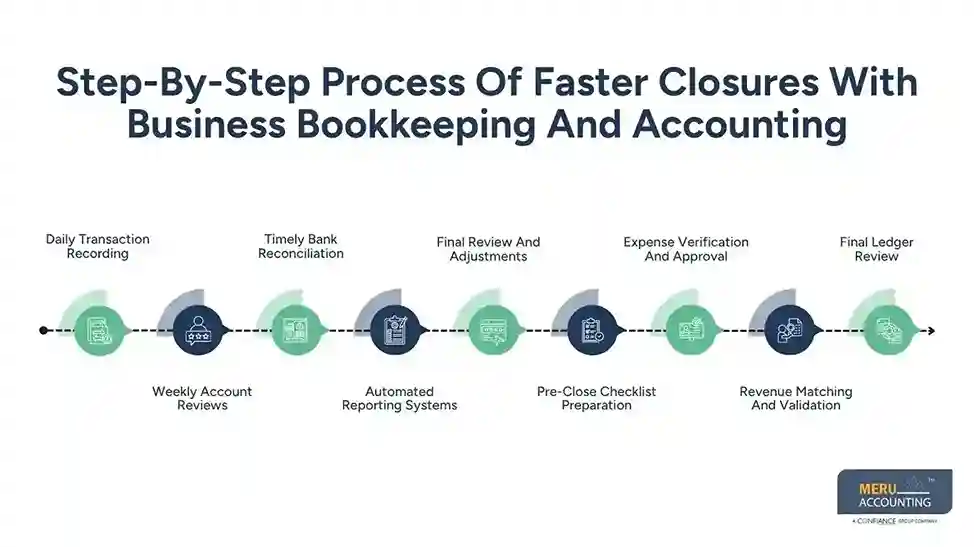
Pre-Close Checklist Preparation
A checklist ensures all required tasks are completed before final closing. It helps teams stay organized and avoid missing important accounting steps.
Expense Verification And Approval
In structured business bookkeeping and accounting workflows, all expenses are verified and approved before final entry into records. This reduces errors and ensures only valid costs are included in reports.
Revenue Matching And Validation
Recorded revenue is matched with invoices and supporting documents carefully. This ensures accuracy and prevents mismatches in financial statements.
Final Ledger Review
The general ledger is reviewed thoroughly before closing financial books. This helps confirm completeness and correctness of all recorded transactions.
Benefits Of Outsourcing To A Fully Managed Bookkeeping And Accounting Service
- A fully managed business bookkeeping and accounting service provides access to skilled professionals who understand financial processes clearly and accurately.
- Outsourcing helps businesses reduce costs by avoiding the need for in-house staff, training, and additional infrastructure expenses.
- Expert teams ensure improved accuracy by maintaining correct, updated, and well-verified financial records throughout the process.
- Structured systems used in a fully managed bookkeeping and accounting service support faster closing cycles and timely financial reporting.
- Business owners can focus on core activities and growth while experts handle day-to-day financial recording and reporting tasks.
Error Reduction Through Professional Business Bookkeeping And Accounting Practices
Regular Data Validation
In structured business bookkeeping and accounting systems, frequent checks ensure that errors are identified early. This helps prevent small mistakes from becoming larger financial issues later.
Automated Systems
Automation reduces manual mistakes and improves accuracy. It also speeds up processing and ensures more reliable financial data entry.
Standard Operating Procedures
Clear guidelines help maintain consistency in financial tasks. It ensures every process in business bookkeeping and accounting is followed in a structured and uniform manner.
Segregation Of Duties
Different roles reduce the risk of errors and fraud. This also improves accountability across all financial activities and records.
Continuous Monitoring
Ongoing review ensures that financial records remain accurate. It helps detect issues quickly and supports timely corrections in accounts.
Why Choose Meru Accounting For Your Business Needs
Meru Accounting offers experienced support for businesses seeking reliable business bookkeeping and accounting services. With years of experience in bookkeeping and accounting across multiple industries, the team understands different business requirements and reporting challenges.
This experience helps in handling financial records with greater accuracy and consistency, especially for businesses that deal with frequent transactions and reporting needs.
The services at Meru Accounting are designed to match the specific needs of each business. Instead of a one-size-fits-all approach, customized solutions are provided based on company size, industry type, and financial complexity.
The use of advanced accounting tools further improves accuracy, reduces manual effort, and supports faster processing of financial data.
Along with technical expertise, Meru Accounting also provides reliable ongoing support to clients. Businesses receive continuous guidance for managing accounts and improving financial clarity.
A strong focus in business bookkeeping and accounting services is placed on timely reporting, ensuring that financial statements and reports are delivered without delays. This helps businesses make better decisions and maintain smooth financial operations throughout the year.
Our Author Perspective And Industry Insight
From our professional standpoint, one of the most common issues observed across businesses is the lack of structured financial processes. According to the U.S. Small Business Administration (SBA), poor financial management is a major reason many small businesses face instability and reporting delays.
When businesses adopt business bookkeeping and accounting, they shift from reactive financial handling to more planned and controlled financial management.
In practical experience, businesses that maintain regular records and use a fully managed bookkeeping and accounting service often achieve significantly faster month-end closings.
In many cases, closing time is reduced by nearly 30–50% due to better data flow and reduced correction work. This improvement not only strengthens reporting accuracy but also builds trust with stakeholders and supports more informed business planning and decision-making.
Key Takeaways
- Business bookkeeping and accounting helps reduce month-end delays
- Regular data updates improve accuracy and speed
- Fully managed bookkeeping and accounting service ensures consistency
- Automation reduces manual errors and saves time
- Outsourcing provides access to skilled professionals
- Structured processes lead to faster financial reporting
FAQs
Month-end closing is the process of reviewing and finalizing all financial records at the end of a month. It ensures that accounts are accurate and complete.
Delays often happen due to missing data, manual errors, and lack of proper systems.
It keeps financial records organized and updated, making it easier to close accounts on time.
It is a service where experts handle all bookkeeping and accounting tasks for a business.
Yes, outsourcing can save time, reduce errors, and provide access to experienced professionals.