A restaurant’s financial health isn’t always reflected in its daily sales. A packed weekend, a new menu, or a steady stream of takeout orders may look promising, but none tells you how much money the business actually keeps. CFO services for restaurants help owners get a better handle on the numbers that shape their business, from food and labor costs to cash reserves and long-term profit.
As a restaurant grows, financial decisions also get more complex. You may need to set a budget for a new location, review rising supplier costs, or decide whether current sales can support more staff. An outsourced CFO can help you assess these decisions and plan your next move without adding a full-time executive to your payroll.
So, when does a restaurant need this kind of financial support, and what should owners expect from an outsourced CFO?
What You Will Learn From This Blog
- What CFO services for restaurants include and how they work.
- What an outsourced CFO does beyond basic accounting.
- Seven signs that your restaurant may need CFO support.
- Are outsourced CFOs for restaurants worth the cost?
- How to get your books and team ready for CFO support.
- How Meru Accounting can help with restaurant finances.
What Are CFO Services for Restaurants?
CFO services for restaurants are financial planning and advisory services that help owners understand the health of their business. These services go beyond recording sales, paying bills, and preparing reports. They use financial data to guide choices about costs, cash flow, growth, and profit.
An outsourced CFO works with your team on a part-time or ongoing basis. The level of support depends on your needs, size, and goals. For example, a small restaurant may need help with cash flow and cost checks, while a growing chain may need budgets, sales forecasts, and plans for new sites.
Unlike a bookkeeper, who tracks daily money in and out, a CFO looks at what the numbers mean and what steps the owner should take next.
optional anymore
on running the business
What Does an Outsourced CFO Do for a Restaurant?
A restaurant CFO helps turn financial data into clear steps. The work may cover several areas:
1. Cash Flow Forecasting and Financial Planning
A restaurant may make strong sales but still face cash flow gaps due to rent, payroll, food orders, and loan payments. An outsourced CFO builds cash flow forecasts to show when money is likely to come in and go out.
This helps owners plan for slow weeks, seasonal dips, large bills, and other cash needs before they become a problem.
2. Food Cost and Labor Cost Analysis
Food and labor are two of the main costs in a restaurant. A CFO reviews these costs against sales to find areas where the business may be losing profit.
For example, if food costs rise from 30% to 36% of sales, the CFO can help find the cause. It may be higher supplier prices, food waste, poor stock control, or menu prices that no longer cover costs.
3. Budgeting and Expense Control
An outsourced CFO helps set budgets for food, labor, rent, utilities, marketing, and other costs. They also compare actual results with the budget each month.
This gives owners a clear view of where spending is on track and where action is needed.
4. Profit Margin and Financial Performance Analysis
Sales alone do not show how well a restaurant is doing. A CFO looks at gross profit, operating costs, net profit, and other key measures.
They can also review profit by menu item, sales channel, or location. This helps owners see which parts of the business bring in the best returns.
5. Financial Reporting and Business Strategy
A CFO turns reports into useful insights. They may review monthly results, set targets, plan for growth, and help owners decide when to hire staff, change prices, or add a new site.
The goal is to help owners make choices based on real numbers rather than guesswork.
7 Signs Your Restaurant Needs an Outsourced CFO
Not every restaurant needs a CFO from day one. But as costs, sales, and daily tasks grow, basic bookkeeping may no longer give owners all the answers they need. Here are seven signs that it may be time to seek expert help.
1. You Struggle to Maintain Consistent Cash Flow
If you often find it hard to pay vendors, meet payroll, or cover rent on time, your restaurant may need better cash flow planning.
An outsourced CFO can review payment cycles, sales trends, and future bills to build a cash flow plan. This helps you spot cash gaps early and plan for them.
2. Food and Labor Costs Are Eating Into Your Profits
If sales are steady but profit keeps falling, rising food and labor costs may be the cause. Small changes in waste, staff hours, and supplier rates can have a large effect over time.
A CFO can track these costs, compare them with sales, and help set targets that fit your business.
3. You Cannot Identify Which Menu Items Are Most Profitable
A popular dish is not always a profitable one. Some items may sell well but have high food costs, while others may bring in more profit with fewer sales.
A CFO can help review recipe costs, menu prices, and sales data. This gives you a better view of which items to promote, reprice, or remove.
4. Your Restaurant Is Growing, but Financial Planning Is Falling Behind
Growth brings new costs, more staff, and more complex money needs. If you are adding services, growing sales, or opening new sites, past budgets may no longer work.
CFO services for restaurants can help build plans for growth and show how much money each step may need.
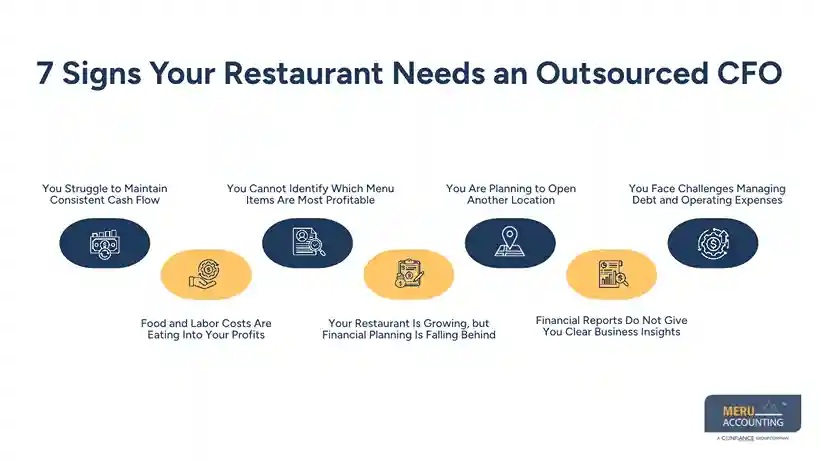
5. You Are Planning to Open Another Location
A new site needs more than a good lease and a strong menu. You need to plan for setup costs, staff, stock, rent, sales, and the time it may take to reach a profit.
An outsourced CFO can build forecasts and test different sales and cost plans before you commit to the new site.
6. Financial Reports Do Not Give You Clear Business Insights
If you get monthly reports but still cannot tell why profit went up or down, you may need more than basic accounting.
A CFO can review the data, explain key changes, and show which steps may help improve results.
7. You Face Challenges Managing Debt and Operating Expenses
Loans, rent, supplier bills, and payroll can put pressure on a restaurant’s finances. If these costs are hard to manage, an outsourced CFO can help review your debt, plan payments, and set spending limits.
This can help you make better choices while keeping enough cash on hand for daily needs.
Are Outsourced CFOs for Restaurants Worth the Investment?
Yes, they can be worth the cost when a restaurant needs expert financial help but does not need a full-time CFO. You get access to senior-level finance skills without taking on the full cost of a full-time hire.
The value comes from better planning and sound choices. For example, a CFO may find that a menu price does not cover the true cost of food, labor, and service. They may also spot a cash flow gap before it affects payroll or vendor payments.
Still, an outsourced CFO is not right for every restaurant. If your business is small, has simple finances, and only needs daily records and reports, a bookkeeper or accountant may be enough.
The best way to judge the cost is to look at what you need help with and what poor financial planning may be costing your business. Ask for a clear list of services, work hours, reports, and goals before you sign an agreement.
How to Prepare Your Restaurant for Outsourced CFO Support
You do not need perfect books before you hire a CFO. But clean and timely records can help them get started faster. Here are a few steps to take:
- Update your books: Make sure sales, bills, payroll, and bank records are up to date.
- Gather key reports: Share profit and loss reports, balance sheets, cash flow data, and sales reports.
- Set clear goals: Decide if you need help with food costs, cash flow, profit, debt, or growth plans.
- Share business details: Explain your menu, sales channels, staff setup, supplier terms, and daily costs.
- Agree on key reports: Set how often you want reports and what data they should cover.
- Keep your team involved: Make sure your bookkeeper, manager, and other staff can share the data the CFO needs.
Good records and clear goals help your CFO focus on the right issues from the start.
Get CFO Services for Restaurants with Meru Accounting
Should you raise menu prices, renegotiate supplier contracts, change staff schedules, or hold off on opening another location? These decisions affect your restaurant’s bottom line, and each one needs more than a quick look at monthly sales. At Meru Accounting, we help restaurant owners assess these choices with financial data, practical analysis, and ongoing CFO support.
Our CFO services for restaurants cover the financial areas that have a direct impact on daily operations and long-term business plans:
- Prime Cost and Margin Analysis: Review food and labor costs together, track changes in prime cost, and assess how they affect your restaurant’s gross profit.
- Menu and Sales Profitability: Analyze menu costs, selling prices, and sales mix to help identify high-margin items and areas where pricing needs attention.
- Cash Flow and Budget Planning: Forecast cash needs around payroll, rent, supplier payments, seasonal sales, and other operating expenses.
- Location-Wise Financial Reporting: Compare revenue, operating costs, and profit across restaurant locations to see which sites are performing well and which need attention.
- Restaurant Expansion Planning: Prepare financial forecasts, assess startup costs, and estimate the funding needed before opening another location.
- Ongoing Financial Reporting and Advisory: Review monthly results, explain key changes, and help owners set financial targets based on actual performance.
Our support also includes bookkeeping, accounts payable and receivable, payroll accounting, financial reporting, and accounting cleanup. This gives restaurant owners access to the financial records and CFO-level guidance needed to make informed decisions.
Whether you are working to improve margins at an existing restaurant or planning to expand your business, Meru Accounting can provide dedicated accounting and financial support that fits your needs.
Our Expert Insight
Restaurant owners often compare their food and labor costs with industry averages to judge business performance. While these benchmarks can be useful, they don’t tell the whole story. A full-service restaurant, a fast-casual outlet, and a delivery-focused kitchen have different cost structures. Applying the same targets to all three can lead to poor decisions.
For example, cutting staff hours to bring labor costs down may look good on a monthly report. But if service slows, tables turn less often, or customer orders take longer, the restaurant could lose more in sales than it saves in wages. The same applies to food costs. A lower food cost percentage isn’t always a win if it comes from smaller portions that affect customer satisfaction.
Our advice is to assess costs in the context of sales volume, service type, operating hours, and customer demand. Review the reasons behind changes before setting new cost targets. This gives restaurant owners a more useful basis for decisions than simply trying to match an industry average.
Key Takeaways
- CFO services for restaurants help owners plan cash flow, manage costs, and improve financial results.
- An outsourced CFO offers expert finance support without the cost of a full-time hire.
- Rising food and labor costs, poor cash flow, and unclear reports are signs you may need CFO support.
- Restaurant owners should review profit by menu item, sales channel, and location.
- Clean books and clear goals help an outsourced CFO deliver better results.
- The right time to hire a CFO depends on your business size, needs, and plans for growth.
FAQs
The cost depends on the restaurant’s size, number of locations, financial needs, and level of support required. Monthly advisory services may cost less than hiring a full-time CFO, as you pay for the services and hours your business needs.
A restaurant accountant handles financial records, reconciliations, tax-related work, and financial statements. A CFO uses that financial data to assess performance, plan budgets, manage financial risks, and guide business decisions.
Yes. An outsourced CFO can prepare financial forecasts, review historical performance, build budgets, and organize financial reports. These help lenders and investors assess the restaurant’s financial position and growth plans.
Key metrics include prime cost, food cost percentage, labor cost percentage, gross profit margin, average check size, sales per labor hour, and operating profit. The right mix depends on the restaurant’s service model and goals.
Yes. A single-location restaurant can benefit from outsourced CFO support when it needs better financial planning, cost control, or guidance on pricing and growth. It can access senior financial expertise without hiring a full-time CFO.
optional anymore
on running the business