
Building a solid financial base starts with setting up the right records, especially when using outsourced accounting services for structured financial management. One key step is creating a framing chart of accounts that is clear and easy to use. This helps track income, spending, and balance sheet items.
When the accounts are well-framed, it becomes easy to check where the money comes from and where it goes. In this blog, we’ll walk through the full process of framing a chart of accounts and how it helps both small and large businesses keep things simple and clean. We’ll also see how tools like a film framing chart help with layout and meaning.
What You Will Learn From This Blog
- How to structure a clear and well-organized Chart of Accounts for accurate financial tracking
- Why proper framing improves reporting, decision-making, and overall bookkeeping efficiency
- How different business types can customize their Chart of Accounts based on their needs
- Common mistakes to avoid while setting up and maintaining a Chart of Accounts
- How a well-structured system supports tax filing, audits, and business growth
Introduction to the Chart of Accounts
A chart of accounts is a list of all the accounts used by a business. These accounts are sorted to show where the money flows in and out. It includes things like income, costs, assets, and debts.
Why It Matters
- Helps keep financial records organized and easy to manage
- Makes financial reports clear, accurate, and useful for decision-making
- Supports better budgeting, planning, and control of business spending
- Assists in smooth tax filing and audit processes
- Builds trust and credibility with investors, banks, and lenders
Key Elements in a Well-Framed Chart of Accounts
A clean chart must be clear and smart. A poor setup can cause stress and wrong reports.
Core Parts to Include
Assets
Items owned by the business such as cash, tools, inventory, and equipment. These resources help the business generate future economic value and support operations.
Liabilities
Amounts the business owes, including loans, taxes, and unpaid bills. These represent future obligations that must be settled using business funds or assets.
Income
Money earned through business activities like sales and other revenue sources. It reflects the total inflow generated from core and non-core business operations.
Expenses
Costs incurred in running the business, such as rent, salaries, and utilities. These are necessary outflows required to keep the business functioning smoothly.
Equity
The owner’s residual interest in the business after deducting liabilities from assets. It represents the true net worth of the business belonging to the owner(s).
Tips for Good Framing
- A structured coding system should be used, such as the 1000 series for assets and the 2000 series for liabilities.
- Account names should remain simple, clear, and easy to understand
- Items should be grouped logically based on their nature and purpose
- Alignment with tax laws and regulatory requirements should always be maintained
- Consistency in maintaining and updating the Chart of Accounts should be followed every year
Importance of Framing Better Charts of Accounts
Improves Financial Reporting Accuracy
In outsourced accounting services, a well-structured Chart of Accounts ensures that all financial transactions are recorded correctly, leading to accurate and reliable financial statements. This also reduces errors in reporting and improves overall financial transparency.
Simplifies Data Classification
It organizes accounts into logical categories, making it easier to classify income, expenses, assets, and liabilities without confusion. This helps maintain consistency in accounting records across all departments.
Enhances Decision-Making
Better COA structure provides clear financial insights, helping management make informed business decisions based on real-time data. It also allows better tracking of performance trends over time.
Saves Time in Bookkeeping
A properly designed COA reduces duplication and confusion, allowing accountants to record and retrieve transactions quickly and efficiently. This increases productivity and reduces manual effort in day-to-day accounting work.
Supports Scalability and Growth
As the business expands, a strong COA can easily accommodate new accounts and departments without restructuring the entire system. This ensures smooth financial management during business expansion.
Ensures Compliance and Audit Readiness
A well-framed COA in outsourced accounting services helps maintain transparency and ensures the business is always ready for audits and regulatory compliance checks. It also makes it easier to provide accurate financial data to auditors when required.
Steps to Create and Frame a Chart of Accounts
You don’t have to be an expert to set up your chart when outsourced accounting services guide the process.
Step 1: List Every Account Needed
Start by noting down all the accounts your business will use. Think about income, costs, assets, and debts. A complete list builds a strong foundation for all financial tracking.
Step 2: Group Accounts by Type
Group each account into key types like revenue, expenses, liabilities, or assets. This helps when reading reports and keeps things neat and structured for everyone on your team.
Step 3: Assign a Code to Each Account
Give each account a short numeric or alpha code. This makes data entry easier and ensures you can sort or pull reports by account type with ease.
Step 4: Match Your Chart with Software
Make sure your account setup aligns with your accounting software. This reduces sync issues and ensures smooth data input and export during reporting and tax time.
Step 5: Remove Unused Accounts
Trim out any extra or unused accounts. Too many accounts clutter the chart and cause confusion. Keep only those accounts that serve your business purpose.
Step 6: Review with a Professional
Before you begin using your chart, get it reviewed by an accounting expert. They can catch errors, suggest changes, and help you avoid costly reporting problems later.
Framing the chart of accounts the right way means fewer mistakes and better reports that support smart financial decisions.
How Outsourced Accounting Services Use the Chart Of Accounts Efficiently
Setting Up Client-Specific Structures
A chart of accounts is customized based on each client’s business model. Generic reporting gets avoided through this approach. Accounting teams create tailored structures that match the client’s operations and reporting needs.
outsourced accounting services begin with understanding revenue streams, cost patterns, and reporting goals. This helps in building a structure that fits real business activity instead of using a one-size format.
Integrating With Software Tools
Connection with accounting software allows real-time recording of transactions without manual delays. A structured account system works directly with platforms like QuickBooks, Xero, or similar tools.
Automation reduces repeated data entry and keeps financial records aligned across systems. This also lowers the chances of mismatched entries between bank data and books.
Monitoring Transaction Flow
In outsourced accounting services, every transaction follows a defined structure, which keeps classification consistent across all entries. Income, expenses, assets, and liabilities are recorded in the correct heads without confusion.
Regular tracking of entries ensures that no transaction is left unclassified or incorrectly grouped. This builds cleaner books for reporting and review.
Supporting Multi-Location Businesses
A structured system can include separate tracking for different branches or locations. Each unit’s financial activity can be monitored without mixing data.
This approach makes it easier to compare performance across regions and identify cost differences or revenue patterns.
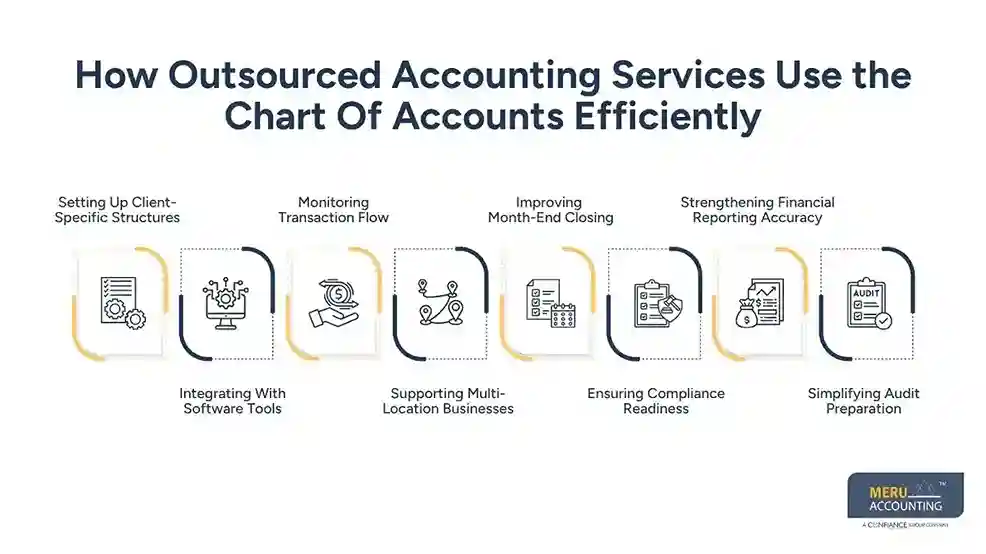
Improving Month-End Closing
A structured account system reduces confusion during reconciliation at the end of the month. Accounts remain organized, so fewer adjustments are required during closing.
Reports can be prepared faster because entries are already placed in the correct categories throughout the month.
Ensuring Compliance Readiness
Organized financial records make tax filing and audit preparation more manageable. Each transaction can be traced back to its correct account without extra effort.
This reduces risk during statutory checks and keeps records aligned with regulatory expectations.
Strengthening Financial Reporting Accuracy
A properly designed system reduces errors in grouping transactions. Financial statements such as profit and loss or balance sheets reflect clearer and more reliable numbers.
Better classification leads to improved understanding of business performance at a detailed level.
Simplifying Audit Preparation
A structured system allows easy tracing of transactions during audits. Supporting documents and entries can be matched quickly without confusion.
Audit teams spend less time on clarification when records are already well organized.
Common Mistakes in Framing Charts of Accounts and How to Avoid Them
Too Many Accounts
Don’t use accounts that serve no purpose. Keep only those that help with tracking your business. A long list may look complete, but it can slow your work.
Wrong Codes and Sequences
Keep your account codes in a clear order. This helps when sorting reports and using accounting software. It also keeps your setup clean and easy to scan.
Poor Account Labels
Use names that are easy for anyone in the team to get. Avoid jargon. Simple names help avoid confusion and support faster work and learning.
Mixing Income and Expenses
Outsourced accounting services ensure each group of accounts is separated properly to avoid mixing income and expenses. Don’t mix the money you earn with what you spend. That leads to wrong results in reports.
Skipping Annual Review
Review your chart every year. This helps you adjust as your business grows. You may take out old items or include fresh ones.
How a Film Framing Chart Mirrors Financial Framing
You might wonder how a film framing chart fits into this. In movies, a framing chart shows how shots are set for clear views. It helps shape the scene.
The Link Between Film and Finance
- Both add structure to help viewers or users understand
- Both avoid clutter and show the main focus
- A film framing chart guides what shows in each shot. A financial chart shapes what appears in reports.
- Both must follow a plan to make sense
- Both are tools that guide better results
While the fields differ, the goal is the same: a clear, clean, smart setup.
Customizing the Chart for Different Business Types
A Chart of Accounts should always be designed according to the nature of the business. Different industries require different levels of detail to ensure accurate tracking and reporting.
Freelancers
Outsourced accounting services design simple structures for freelancers to track income, basic expenses, and account balances. Tax preparation becomes easier with a clean and minimal setup.
Small Retail Shops
Retail businesses require accounts for inventory, supplier purchases, cash sales, and sales tax. Monthly performance reports become more structured and insightful.
Teams with Employees
Businesses with staff need payroll accounts, employee benefits, and salary-related tax accounts. Additional categories can include insurance and staff welfare expenses.
Service Firms
Service-based businesses benefit from project-wise cost tracking and client payment accounts. Better budgeting and profitability analysis can be achieved through job-level tracking.
Startups
Startups require accounts for investor funding, equity, and research & development expenses. Cash burn monitoring and fund utilization tracking become more transparent.
Online Stores
E-commerce businesses need accounts for channel-wise sales, shipping costs, returns, and platform fees. Operational control and profit analysis improve across digital sales channels.
Agencies
Agencies should maintain client-wise and project-wise accounts to track time, cost, and billing efficiently. Revenue tracking and project performance evaluation become more accurate.
Benefits of a Properly Framed Chart of Accounts
Faster and Clearer Reports
Well-framed charts let you pull reports fast. You don’t need to clean data each time. Numbers stay sorted and easy to read for your team.
Fewer Mistakes in Books
A good chart helps stop common entry mistakes. With clear accounts, your team knows where to post things, so errors go down.
Easier Tax Filings
With all costs sorted, tax prep gets much faster. You can track write-offs and income by type. This cuts time and avoids tax errors.
Better Planning and Budgets
A framed chart shows where you spend most. It helps you cut waste and plan for next month. Budgeting gets simple and smooth.
Proof of Business Growth
Over time, your chart shows trends. You can see gains by month or quarter. This helps you track your progress and plan growth steps.
Trust From Investors
Clear records help show control and order. If you need funds or loans, a well-framed chart helps you prove your worth.
Audit and Legal Ready
If you face an audit, a clean chart saves you. It shows that you track things well and follow the law. A well-framed chart is the root of all good records.
How Meru Accounting Helps in Structuring a Strong Chart of Accounts
Outsourced accounting becomes more effective when the Chart of Accounts is designed and managed with precision. A well-organized structure is not just about listing accounts but about aligning financial data with business goals and reporting needs.
Meru Accounting plays a key role in building and maintaining customized Chart of Accounts frameworks for businesses across industries. The focus remains on accuracy, clarity, and scalability so that financial systems can grow along with the business.
Key areas where support is provided include:
- Designing an industry-specific Chart of Accounts based on business size and nature
- Aligning account structures with accounting software like Odoo, Xero, QuickBooks, and others
- Ensuring proper classification of income, expenses, assets, and liabilities for error-free reporting
- Streamlining bookkeeping workflows to reduce manual intervention and improve efficiency
- Supporting multi-entity and multi-location reporting structures for growing businesses
- Enhancing compliance readiness for audits, tax filing, and regulatory reporting
A structured approach ensures that businesses do not just record transactions but actually gain meaningful financial insights for decision-making and long-term planning.
Our Expert Perspective
A well-framed Chart of Accounts is not just an accounting structure but a financial control system that directly influences reporting quality and decision-making speed. In practice, businesses that invest time in designing a clear and scalable COA experience fewer reconciliation issues, faster month-end closures, and stronger compliance readiness. Outsourced accounting teams can deliver significantly higher accuracy and efficiency when the COA is standardized, regularly reviewed, and aligned with both business operations and reporting goals.
Key Takeaways
- A well-framed Chart of Accounts is the foundation of accurate financial reporting and bookkeeping efficiency in outsourced accounting services.
- Proper structure reduces errors, improves clarity, and speeds up month-end and year-end closing processes.
- Outsourced accounting services benefit significantly from standardized yet customizable account frameworks.
- Industry-specific customization ensures better tracking of income, costs, and profitability.
- Regular review and cleanup of accounts prevent clutter and maintain long-term system efficiency.
- Integration with accounting software improves automation, accuracy, and real-time financial visibility.
- A strong Chart of Accounts supports compliance, audits, tax filing, and business scalability.
- Clear financial structuring ultimately leads to better decision-making and stronger business control.
FAQs
It improves accuracy in reporting, simplifies bookkeeping, supports decision-making, and ensures smooth tax filing and audits.
A film framing chart helps frame camera views. In finance, framing accounts gives structure to reports. Both bring order and focus.
It helps track costs, plan budgets, and cut mistakes. Clean charts help with taxes, audits, and plans.
Review it once a year or when your business changes. This keeps your chart useful and easy to follow.
It allows easy expansion by adding new accounts or departments without restructuring the entire system.
optional anymore
on running the business