Client billing means sending a bill to someone after they buy something from your business. It tells them how much they need to pay and when to pay it. A good client billing system helps you send bills the right way. It also helps you remember who has paid and who hasn’t.
This keeps your business neat and fair, and if you make a mistake or forget to send a bill, you might not get your money, which can also affect your ability to manage payroll and taxes on time. That’s why many people use billing tools or ask for help from experts.
Billing the right way helps your business grow strong. In this guide, you’ll learn what client billing is, how a billing system works, and why it’s so important for your business.
What You Will Learn From This Blog
By reading this blog, you will get a clear understanding of how client billing works and why it is essential for business success. Here’s what you will learn:
- What client billing means and how it works in day-to-day business operations
- How a customer billing system helps you create, send, and manage invoices easily
- Why timely and accurate billing is important for improving business cash flow
- Common problems businesses face in billing and how to avoid them
- Different types of client billing methods are used across industries
- How proper billing practices help reduce errors and improve financial clarity
- Why professional billing systems support business growth and scalability
What Is Client Billing?
Client billing is the way a business charges its customers. When someone buys something from you, you send them a bill. This bill tells them:
- What they bought
- How much does it cost
- When to pay
- How to pay (cash, card, online, etc.)
Billing helps keep everything clear. It helps both the business and the client understand what is owed and what has been paid. A customer billing system is a tool that helps you send bills, track payments, manage your money, and stay organized for payroll and taxes. It can be a computer program, an app, or an online service. Some systems even send reminders to clients who forget to pay.
Top Reasons Why Client Billing Is Important for Your Business
Ensures Timely Client Payments
A proper client billing system helps you send bills fast. When clients get bills quickly, they are more likely to pay on time. This means steady money for your business.
Improves Clarity for Everyone
A bill shows what was bought, the price, and the due date. This keeps things simple and clear. A strong customer billing method avoids confusion and fights over money.
Saves Time in Billing Process
Instead of writing each bill by hand, a customer billing system does it for you. You can send many bills in minutes. That means more time to focus on your work or customers.
Reduces Billing Errors
Typing numbers again and again can cause errors. A billing system uses saved prices and information. This helps avoid charging the wrong amount or sending bills to the wrong person.
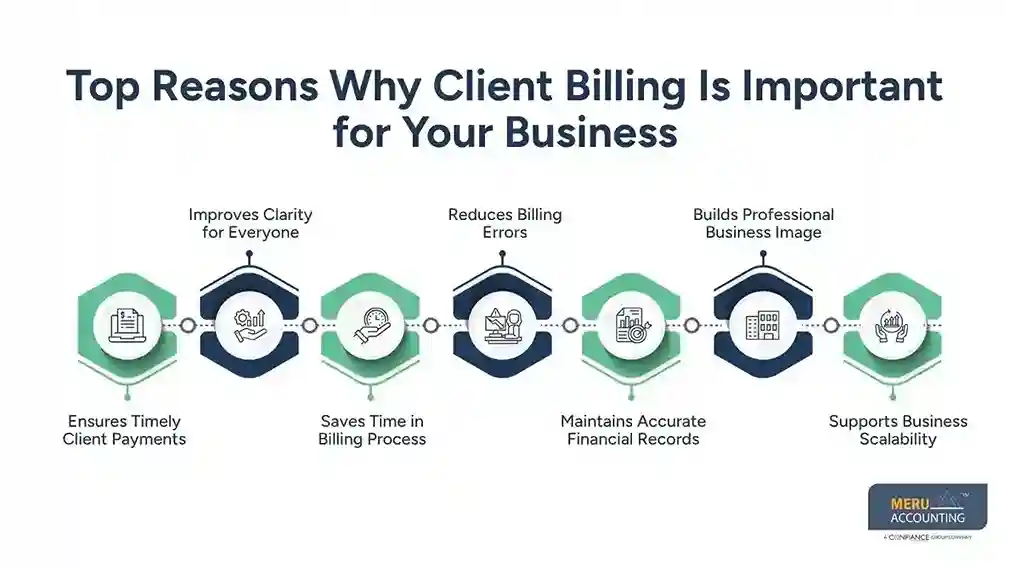
Maintains Accurate Financial Records
With a customer billing system, you always know who paid, who still owes you, and how much money you made, which makes it easier to prepare payroll and taxes correctly. This is helpful when you plan or file taxes.
Builds Professional Business Image
When you send a neat, clear bill, it shows your business is serious. Clients trust you more when you look organized and professional.
Supports Business Scalability
As your business grows, you will have more customers. A billing system can handle 10 or 1,000 clients. It keeps working no matter how big your business becomes.
Common Problems with Client Billing
Client billing is important for every business, but sometimes it can be tricky. Here are some common problems that many businesses face:
Human Mistakes
People can make errors like listing the wrong number. Even can forget to add customer details, or put the wrong date. This can cause confusion and delay payments.
Late Payments
You can go into a major loss sometimes if you forget to pay, or pay too late. As you need money to pay for supplies, workers, and bills.
Complicated Billing Systems
Businesses that charge customers every week or month (like for subscriptions) may have trouble keeping track. It’s hard to manage many bills at once without a proper system.
Using Different Formats
If your business uses different styles or steps to make bills, it can confuse customers. They may not understand the bill, and that can slow down payment.
Following Tax and Law Rules
Every place has its own rules for billing, payroll and taxes, and if a business doesn’t follow them, it might get in trouble or have to pay a fine. If a business doesn’t follow them, it might get in trouble or have to pay a fine.
Not Sending Bills on Time
When bills are sent late, customers also pay late. This makes it harder to manage your money. A billing system helps send bills right on time.
Missing Payment Records
If a business doesn’t keep track of who has paid and who hasn’t, it can lead to lost money. A proper client billing system helps record every payment.
Poor Communication with Customers
Some customers may not understand what the bill is for. If the bill is not clear, they may ask lots of questions or refuse to pay.
Types of Client Billing Systems
Different businesses use different client billing systems. It depends on how they work, what services they offer, and how they manage financial processes like payroll and taxes.
Hourly Billing
This is used by people like lawyers, designers, or helpers who charge by the hour. If they work 5 hours, they charge for 5 hours.
Fixed Fee Billing
In this system, the customer pays one set price for the whole job. This is common in building work or computer jobs. It doesn’t matter how long the job takes; the price stays the same.
Retainer Billing
This means the customer pays money first, and then the business does work over time. It’s common in law firms and creative agencies. The client pays monthly or at the start of the project.
Subscription Billing
This is for businesses like video apps, learning websites, or software tools. The customer pays every week or month to keep using the service.
Milestone Billing
Some jobs are very big. So, instead of paying all at once, the customer pays step-by-step. For example, after step one, the business sends a bill. Then, after step two, another bill.
Per Product Billing
Stores or shops use this system. When a customer buys something, they pay for each item. The bill lists each product and its price.
Usage-Based Billing
In this system, customers pay for how much they use. For example, phone or internet companies may charge you for the data you use.
Blended Billing
Sometimes, businesses use more than one type of billing. For example, they might charge a fixed fee plus extra for extra hours or services.
optional anymore
on running the business
Why Choose Meru Accounting?
Outsourcing client billing to experts like Meru Accounting can help businesses manage invoices, payments, and cash flow in a more structured and efficient way. Instead of handling billing manually, businesses get a professional system that reduces delays and improves financial control.
Accurate Invoice Management
Ensures every invoice is created correctly with proper client details, pricing, and tax information, reducing billing errors and disputes. This helps maintain strong client trust and avoids unnecessary payment delays.
Faster Billing Cycles
Helps businesses send invoices on time, which speeds up client payments and improves overall cash inflow. Faster billing also reduces the gap between service delivery and revenue realization.
Improved Cash Flow Tracking
Monitors unpaid and paid invoices in real time, helping businesses understand their actual cash position clearly. This allows better financial planning and smarter business decisions.
Automated Payment Follow-ups
Sends reminders to clients for pending payments, reducing delays and improving collection efficiency. It also helps maintain professional communication without manual effort.
Scalable Billing Support
Whether a business has 10 clients or 1,000+, the billing system can easily handle growth without losing accuracy or speed. This makes it suitable for both startups and expanding enterprises.
Integration with Accounting Systems
Connects billing data with bookkeeping and financial reporting tools, ensuring complete financial transparency for smoother payroll and taxes management. This reduces duplication of work and improves data accuracy across systems.
Reduced Administrative Workload
Businesses can focus on operations and growth while billing tasks are handled by professionals, helping them stay organized with payroll and taxes processes as well. It also frees up internal teams to focus on higher-value financial activities.
Our Expert Perspective
A well-managed client billing process plays a key role in maintaining steady cash flow and improving financial control. Expert billing support helps businesses reduce errors, track payments efficiently, and focus more on growth while ensuring smooth invoice management.
Key Takeaways
- Client billing is the process of sending invoices to customers and tracking payments, ensuring clear communication between the business and its clients.
- A well-structured billing system helps businesses send invoices on time, reduce errors, maintain accurate financial records, and simplify payroll and taxes processing.
- Timely and accurate billing directly improves business cash flow by speeding up payment collection and reducing delays.
- Different billing methods, such as hourly, fixed fee, subscription, and milestone billing, suit different business models.
- Poor billing practices can lead to late payments, missing records, and financial confusion, affecting overall stability.
- Outsourcing client billing improves efficiency by automating invoicing, payment tracking, follow-ups, and supporting smoother payroll and taxes handling.
- Professional billing support helps businesses scale smoothly while maintaining accuracy and financial control.
FAQs
Outsourced client billing is when a third-party service manages invoicing, payment tracking, and follow-ups on behalf of a business to ensure timely and accurate billing.
Timely billing ensures customers receive invoices on schedule, which increases the chances of faster payments and better financial stability.
Poor billing systems can lead to late payments, missing records, calculation errors, payroll and taxes complications, and confusion for clients.
Yes, it helps small and growing businesses manage invoices efficiently, maintain accuracy, and scale without increasing internal workload.
Common methods include hourly billing, fixed fee billing, subscription billing, milestone billing, retainer billing, and usage-based billing.