A payroll run can look simple until one wrong pay rate, missed tax item, or late filing turns it into a costly task. This is why many firms now use cloud based payroll software to manage pay, tax data, records, and reports. But there is an important question to ask before picking a tool: Should software handle the work, or should a payroll expert handle it for you?
The answer depends on your staff count, payroll rules, tax needs, and in-house skills. A small firm with ten salaried staff may do well with software alone. A firm with workers in several states, bonuses, benefits, or complex tax needs may need payroll accounting services. In some cases, the best choice is to use both.
What You Will Learn From This Blog
- How cloud based payroll software works and what tasks it can handle.
- Why firms are moving payroll work from spreadsheets to online systems.
- Which features matter when comparing payroll software.
- When software makes sense for a small or growing firm.
- When payroll accounting services may be a better fit.
- How a cloud payroll system for small business can work with an outside payroll team.
- When a hybrid payroll model can offer better control and review.
What is Cloud Based Payroll Software?
Payroll Runs Online
Think of payroll software as a shared work desk that sits online instead of on one office computer. A payroll user can log in, check employee data, enter changes, review the pay run, and keep records without moving files from one system to another.
Employee Pay Data
A payroll system can hold data such as employee names, pay rates, hours, tax details, leave, deductions, and benefits. The key point is that good software still needs good data. If a wrong pay rate is entered, the system may process the wrong amount just as quickly as the right one.
Tax and Withholding Work
Most payroll tools can calculate many tax and withholding items based on the data entered and rules built into the system. Employers still remain responsible for their payroll tax duties, including the right deposits and tax forms.
Staff Access
Online access can make payroll easier for teams that work from more than one place. Staff may also be able to view pay slips, tax forms, or other records without asking the payroll team for every file.
Payroll Reports
Reports give the owner or payroll team a view of gross pay, tax amounts, net pay, and other payroll costs. These reports can also be checked against the accounting books before the payroll period is closed.
optional anymore
on running the business
Why Businesses are Switching to Cloud Based Payroll Software
Less Manual Work
For many firms, the move starts with a spreadsheet that has simply become too hard to manage. Cloud based payroll software can replace repeated data entry with a set process for pay, tax, records, and reports.
Faster Pay Runs
Once employee data is set up, each pay run can follow the same basic path. The team can check hours, pay changes, deductions, and new staff before reviewing and approving the final figures.
Easy Remote Access
A cloud payroll system for small businesses gives approved users access to payroll data from different locations. This can be useful when an owner, bookkeeper, and payroll staff member are not in the same office.
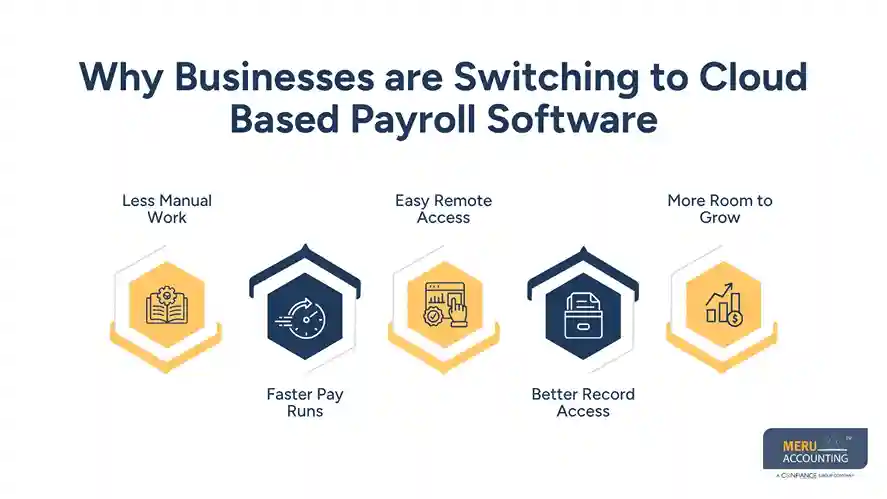
Better Record Access
Payroll records are easier to find when they sit in one system instead of being spread across email, paper files, and old spreadsheets. The IRS also requires employers to keep key employment tax records for set periods.
More Room to Grow
A payroll process that works for five employees may become hard to manage at fifty. Cloud based payroll software can give a growing firm a fixed process that can be expanded as staff counts and payroll needs rise.
Key Features to Look For in Cloud Based Payroll Software
Tax Calculation Tools
Check what taxes a cloud payroll system for small business can calculate and what tax filing work it can handle. Do not assume that every tax task is covered just because the product uses the word “payroll.”
Payroll and Accounting Links
A strong link between payroll and accounting can reduce duplicate entry. Payroll costs, taxes, benefits, and other entries can flow into the books, where they can then be checked during reconciliation.
Approval Controls
Payroll should not be a one-person process when the firm can avoid it. Look for roles that let one person enter data, another review changes, and an owner or manager approve the final run.
Employee Self-Service
Employee access can cut down on simple requests for pay slips and tax forms. Staff can view their own records while the payroll team keeps control over changes that affect pay.
Reports and Audit Trails
Good reports show what was paid and what was recorded. An audit trail can also show when a change was made and who made it, which is useful when a payroll figure needs to be checked later.
Security and Access
Payroll data is private. Before choosing cloud based payroll software, check login controls, user roles, data security, backups, access rules, and how the provider handles employee information.
When Should You Use Cloud Based Payroll Software?
You Have a Small Team
Software can be a good fit when the firm has a small staff and a fairly simple pay setup. A cloud payroll system for small business can give the owner control without the cost of building a large payroll team.
Payroll Rules are Simple
Software is often easier to manage when employees have fixed salaries or standard hourly pay. The process can become harder when there are many bonuses, commissions, tips, benefits, or special pay rules.
Your Team Knows Payroll
Someone still needs to know what the numbers mean. Cloud based payroll software works best when a staff member can review pay rates, tax data, deductions, reports, and unusual changes before payroll is approved.
You Need Direct Control
Some owners want to see every payroll run before money goes out. Software gives them a direct view of the figures and lets them decide who can enter, review, and approve payroll data.
You Run Payroll Often
Weekly or biweekly payroll creates many chances for small errors. A repeatable process inside cloud based payroll software can make each run easier to check before it is approved.
When Should You Choose Payroll Accounting Services Instead?
You Have Complex Payroll
Payroll becomes harder when a firm has bonuses, commissions, benefits, tips, multiple pay rates, or staff in different states. In such cases, payroll accounting services can bring skilled review to the process.
You Lack Payroll Staff
A small firm may not have someone who knows payroll tax rules well. Rather than making an office manager learn every payroll task, the firm can assign the work to a payroll accounting team.
You Need Tax Filing Help
Paying employees is only one part of payroll. Employers may also need to withhold, deposit, report, and pay employment taxes. Payroll accounting services can take on agreed tax and filing tasks and keep the process on track.
You Have Staff in Many States
Multi-state payroll can bring different tax rates, filing rules, and registration needs. A cloud payroll system for small business may store the data, but an experienced payroll team may still be needed to review the tax work.
You Need More Review
If one payroll error could create a high cost, a second review can be worth the added fee. Software can process the numbers, while payroll staff can question unusual changes before the pay run is closed.
Can You Combine Cloud Payroll Software With Payroll Accounting Services?
How the Hybrid Model Works
A hybrid model does not mean choosing between technology and people. The firm can use cloud based payroll software to store data and run payroll while a payroll team checks reports, tax work, and other tasks based on the service scope.
Who Manages Payroll Data and Approvals?
The roles should be clear from the start. For example, the client may enter hours and approve pay, while the payroll team reviews tax data, reports, filings, and unusual changes.
Benefits of Combining Technology With Professional Services
This model gives the firm one system for payroll data while keeping skilled people in the process. A cloud payroll system for small business can handle routine tasks while a payroll team reviews work that needs judgment.
When the Hybrid Approach Makes the Most Sense
The hybrid model can fit a firm that has grown beyond basic payroll but does not want to hire a full internal payroll team. It can also suit firms that want control of their data while using outside payroll expertise.
Keep One Clear Payroll Process
Set clear rules for who enters data, who checks it, who approves it, and who handles tax filings. This makes the process easier to follow and gives the firm a clear record if something goes wrong.
Meru Accounting’s Payroll Accounting Services
Payroll Data Review
Meru Accounting provides payroll accounting services for firms that need more than a basic software setup. The work can include checking payroll data, pay records, reports, and related accounting entries.
Tax and Compliance Checks
Payroll tax work needs careful review even when a cloud payroll system for small business is used, because missed or wrong filings can lead to added costs. Meru Accounting provides payroll services that can include tax review and related accounting work based on the firm’s needs.
Payroll and Accounting Records
Payroll does not end when employees receive their pay. Wages, payroll taxes, benefits, and other payroll costs must also be recorded accurately in the company’s accounting records. Meru Accounting provides services that connect payroll processing with accurate accounting entries and financial records.
Software-Based Payroll Support
A firm that already uses cloud based payroll software may not need to replace its current system. Meru Accounting can work with the existing payroll process and provide payroll and accounting services around it.
Our Expert Perspective
From our experience providing payroll accounting services, the main payroll risk is often not the software itself, but the data entered into it. A payroll system can calculate pay and produce reports, yet incorrect hours, pay rates, employee details, or tax settings can still lead to wrong results. We recommend reviewing key payroll changes before each pay run and keeping clear approval steps. For firms with complex payroll or staff in several states, combining payroll software with professional review can provide stronger control over the full payroll process.
Key Takeaways
- Cloud based payroll software is a good fit for firms with simple payroll and staff who can review each pay run.
- A cloud payroll system for small business can reduce manual work and give owners better access to payroll data.
- Software does not remove an employer’s duty to meet payroll tax rules.
- Payroll accounting services can make more sense when payroll is complex or hard to manage in-house.
- A hybrid model can combine software with professional payroll review.
- Before choosing a system, check its tax tools, reports, accounting links, user controls, security, and service options.
- The right choice is not always the most advanced tool; it is the setup that fits the firm’s actual payroll needs.
FAQs
Cloud based payroll software lets a firm run payroll in-house, while payroll accounting services offer expert help with pay, tax work, reports, and other payroll tasks.
Cloud based payroll software can fit firms with basic payroll, while payroll outsourcing can suit firms with more complex payroll or fewer staff.
A small business should use cloud based payroll software when it has basic payroll needs, skilled staff, and plans to run payroll in-house.
Yes, payroll accounting services can work with a cloud payroll system for small businesses to check payroll data, run reports, handle tax work, and manage other agreed tasks.
A small business can use payroll software for basic in-house payroll and payroll accounting services when payroll is more complex or needs expert review.
optional anymore
on running the business