
A commercial property rarely stays as simple as collecting rent and paying bills. One month may bring routine repairs, the next may involve a major improvement, a new loan, or a property purchase. A commercial real estate accountant helps keep these transactions properly recorded, from rental income and operating expenses to debt, capital improvements, depreciation, and the tax basis of the property.
The accounting gets more involved when you own several properties or use an LLC, partnership, or other business entity. Each property can have its own income, expenses, financing, and tax considerations, making accurate commercial real estate tax accounting important for both day-to-day financial reporting and year-end tax work. Good records also make it easier to see how each property is actually performing and what a transaction could mean for your taxes.
What You Will Learn From This Blog
- What a commercial real estate accountant does
- How commercial real estate tax accounting works
- Key tax and book items to track
- How property books differ from regular business books
- Tax issues to review before a sale or purchase
- When outside accounting support can make sense
What Does a Commercial Real Estate Accountant Do?
A commercial real estate accountant keeps the books tied to your property and tax needs. The work can cover rent, tenant charges, property costs, loans, vendor bills, and asset records. For a growing portfolio, a commercial real estate accountant can also keep each property on a clear monthly close.
A commercial real estate accountant may handle:
- Rent and other property income
- Common area charges and tenant bill-backs
- Property tax, insurance, and repairs
- Accounts payable and vendor bills
- Bank and loan account reconciliations
- Fixed asset records and depreciation
- Capital work and property improvements
- Monthly profit and loss reports
- Cash flow and balance sheet reports
- Tax-ready books
For owners with several sites, the books should show results by property. This helps you see cash flow, rising costs, and large projects.
A commercial real estate accountant may also work with a CPA or tax advisor. The goal is to keep records that support tax work and business choices.
What Is Commercial Real Estate Tax Accounting?
Commercial real estate tax accounting is the process of keeping and reviewing property records with tax rules in mind. It links the daily books to items such as depreciation, basis, interest, property costs, gains, and losses.
For example, a roof repair may be a current cost in some cases, while a major improvement may need to be added to the asset basis and spread over time through depreciation. The right treatment depends on the facts and tax rules.
The IRS says nonresidential real property generally has a 39-year recovery period under the General Depreciation System. Residential rental property generally has a 27.5-year period.
Good records matter because the tax return depends on the data behind it. A commercial real estate accountant can keep income, costs, assets, debt, and basis organized for the tax team.
Key Tax Accounting Areas for Commercial Real Estate
Rental Income
Books may need to track base rent, late fees, tenant reimbursements, parking income, and other charges. Lease terms can also affect when income is recorded.
Operating Costs
Property tax, insurance, repairs, utilities, management fees, and legal fees can affect property results. Each cost should be coded so reports stay useful and tax records are easy to review.
Repairs vs. Improvements
One of the key areas in commercial real estate tax accounting is the split between a repair and an improvement. A commercial real estate accountant can flag costs that need tax review before they are closed.
A routine repair may be treated in a different way from a project that adds value, extends useful life, or adapts a property for a new use. That difference can affect both the current deduction and future depreciation.
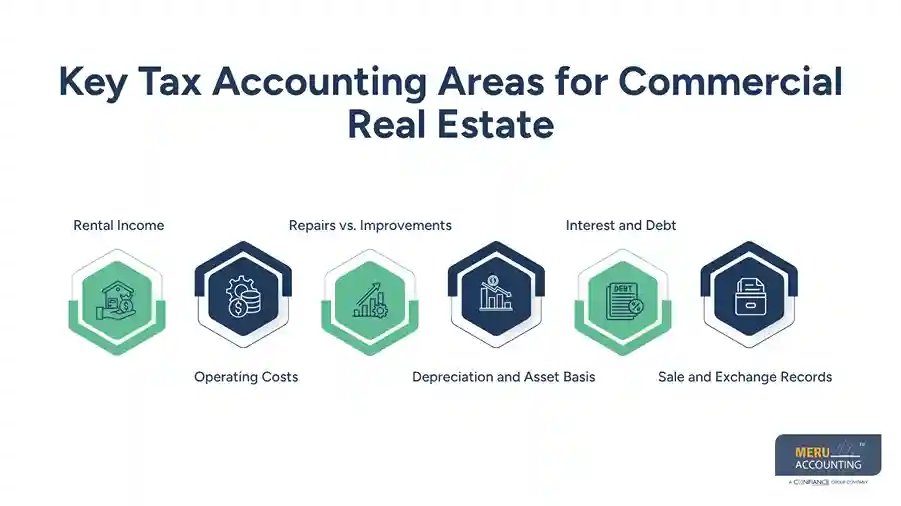
Depreciation and Asset Basis
A building is not treated the same as land. Land is not depreciated. Asset records should track purchase price, basis costs, improvements, and prior depreciation.
A commercial real estate accountant can keep an asset roll-forward that shows additions, sales, and the balance left on the books.
Interest and Debt
Loan payments include both principal and interest, and the two parts do not have the same book or tax treatment. Debt records should also tie to loan statements and year-end balances.
Business interest can be subject to Section 163(j) limits, although exceptions may apply. The IRS updated its guidance in August 2026, so current tax review matters.
Sale and Exchange Records
A property sale can involve gain, adjusted basis, selling costs, depreciation history, and other tax items. A 1031 exchange can also affect when gain is recognized.
The IRS states that Section 1031 generally applies to qualifying real property held for business or investment, not property held mainly for sale.
How Commercial Real Estate Accounting Differs From Regular Business Accounting
A normal service business may have one main operating set of books. Commercial real estate often needs a property-by-property view.
Each property can have its own rent roll, loan, tax bill, repair spend, capital work, and cash flow. Some owners also have separate entities for each asset, which creates more records to tie out.
Property accounting needs a close link between operations and tax data. A change in a lease, loan, ownership share, or property use can affect tax work.
A commercial real estate accountant can build reports for the full portfolio and each property. This helps owners spot weak cash flow, high repair spend, or rising unpaid rent.
optional anymore
on running the business
Tax Issues Commercial Property Owners Need to Track
Tax rules can vary by owner, entity, property, and use. Key items include:
Depreciation. Track placed-in-service dates, asset basis, recovery periods, and prior depreciation. Commercial buildings generally use a 39-year recovery period under GDS, while different assets may have other rules.
Passive activity rules. Rental real estate is often treated as a passive activity, but the rules have exceptions, including rules for real estate professionals and active participation. The IRS notes that material participation and active participation are not the same test.
1031 exchanges. A qualifying exchange can defer gain, but the property and transaction must meet the rules. Keep records of the old property, new property, basis, and exchange costs.
Interest limits. Some business interest may face deduction limits under Section 163(j). The rule can be complex when an owner has more than one activity.
Property sale. Before a sale, review basis, improvements, depreciation, debt, selling costs, and the ownership entity.
Partnership and LLC records. If a property is held through a pass-through entity, ownership shares, capital accounts, distributions, and K-1 data need to tie back to the books.
The IRS says taxpayers should keep records that support amounts reported on a return.
Commercial Real Estate Tax Accounting Services by Meru Accounting
Commercial real estate books need more than transactions entered and reconciled each month. The accounting team also needs to understand how property activity flows through the books, what belongs to a specific asset or entity, and which records your tax professional will need later. Meru Accounting provides the ongoing accounting support that keeps those records organized throughout the year.
Our team can handle:
- Monthly bookkeeping and account reconciliation
- Property and entity-level bookkeeping
- Income, expense, and vendor transaction management
- Accounts payable and accounts receivable support
- Loan and financing account maintenance
- Fixed-asset and depreciation record support
- Capital expenditure and improvement records
- Monthly financial reporting
- Historical bookkeeping cleanup and catch-up work
- Tax-ready books and supporting financial records
- Coordination with your existing CPA or tax team
- Work within your current accounting software and processes
For portfolios with multiple properties or entities, we can structure the books so financial activity stays properly separated rather than being lumped into one set of records. That gives your team cleaner books to work from and makes ongoing accounting easier to maintain as the portfolio changes.
Our Expert Insight
In commercial real estate, balanced books don’t always mean clean books. We look at whether the numbers make sense for the property, including unusual changes in rent, operating costs, tenant charges, or debt activity.
We also avoid treating every property the same. A retail center, office building, and warehouse can have very different income and expense patterns. Keeping the reporting consistent while accounting for those differences gives owners a more useful view of each property’s performance.
For a portfolio with multiple properties, this level of review can also bring attention to unusual activity early—before it becomes a bigger cleanup issue at year-end.
Key Takeaways
- A commercial real estate accountant handles more than rent and bills.
- Property-level books make income, costs, debt, and cash flow easier to review.
- Commercial real estate tax accounting needs careful tracking of basis, depreciation, repairs, improvements, and interest.
- Commercial buildings generally use a 39-year GDS recovery period.
- Passive activity, 1031 exchange, interest, and sale rules can affect tax work.
- Good records should be built all year, not rushed at tax time.
FAQs
Yes. They can keep income, expenses, assets, and reporting separated by property or entity, which makes a multi-property portfolio easier to track.
Major improvements that add value or extend a property’s useful life may need to be capitalized instead of treated as a current expense. The correct treatment depends on the work performed.
Nonresidential real property is generally depreciated over 39 years under the IRS General Depreciation System.
Keep the closing statement, improvement records, depreciation history, and other documents used to determine the property’s adjusted basis.
Yes, qualifying business or investment real property may be exchanged for like-kind real property under Section 1031, subject to specific IRS requirements.
optional anymore
on running the business