A commercial property may look like a profitable investment on paper, but rent checks alone don’t tell the whole story. Taxes, upkeep, loan costs, and future repairs all affect how much money an owner gets to keep. This is where commercial real estate tax benefits come into play. The right tax deductions can help offset property costs and leave more room for profit.
From office buildings and retail spaces to warehouses and rental units, commercial property owners have several ways to lower their taxable income. The challenge is knowing which expenses qualify, how depreciation works, and when a tax break makes sense. Let’s look at the key tax benefits and how investors can use them to make better property decisions.
What You Will Learn From This Blog
- What tax breaks are open to commercial property owners.
- How depreciation and business costs can lower taxable income.
- Which tax benefits for commercial property investors may apply to your assets.
- How cost segregation can speed up some tax write-offs.
- Ways to plan for property sales and future tax bills.
- Common tax errors to avoid when you own or lease business property.
What Are Commercial Real Estate Tax Benefits?
Commercial real estate tax benefits are tax breaks that let owners deduct or defer some costs tied to income-producing property. These may include loan interest, property taxes, repairs, insurance, and depreciation.
The IRS lets owners recover the cost of certain assets over time through depreciation. This means you may claim part of an asset’s cost as a tax deduction each year, even if the asset has not lost cash value in the same way.
For U.S. tax purposes, nonresidential real property is often depreciated over 39 years under the general depreciation system. Land is not depreciable, so its cost must be split from the cost of the building.
These tax breaks can apply to many types of property, such as:
- Office buildings and business parks.
- Retail stores and shopping centers.
- Warehouses and storage units.
- Hotels and other business-use buildings.
- Industrial sites and rental units.
The exact rules depend on how you use the property, who owns it, and how the costs are paid.
optional anymore
on running the business
How Commercial Real Estate Tax Benefits Help Investors Reduce Taxable Income
Taxable income is not the same as the rent you collect. You can often subtract eligible costs from rental income before you work out the amount subject to tax.
For example, an owner may earn $180,000 in rent in one year. If the owner has $35,000 in eligible running costs and $25,000 in depreciation, taxable rental income may fall to $120,000 before other tax rules apply.
This does not mean the owner has saved $60,000 in tax. It means the amount used to work out tax has fallen by that sum. The actual tax saving depends on the owner’s tax rate and other rules.
This is why commercial real estate tax benefits matter to long-term returns. A sound plan can help you track costs, claim valid write-offs, and avoid paying more tax than you owe.
10 Major Tax Benefits for Commercial Property Investors
Here are some of the main tax breaks that may apply to owners of income-producing property.
1. Depreciation Deductions
Depreciation lets you recover the cost of a building over its tax life. Most nonresidential real property uses a 39-year recovery period under the general system.
The land cost does not qualify. You must also place the property in service before you can start to claim depreciation.
2. Mortgage Interest Deduction
Interest paid on a loan used to buy or improve a business property may be deductible. The loan must have a valid link to the income-producing activity.
Some owners may face limits on the amount of business interest they can deduct. These limits can depend on income, business type, and other facts.
3. Property Tax Deductions
Property taxes paid on a commercial building may count as a business expense. Keep tax bills and proof of payment to support the claim.
Do not mix business property taxes with personal tax costs. The right records help show which costs belong to the property.
4. Operating Expense Deductions
Owners may deduct many normal costs of running a rental property. These can include insurance, utilities, cleaning, security, and fees paid to property managers.
The cost must be ordinary and necessary for the business. Personal costs do not qualify.
5. Repairs and Maintenance
Costs to fix leaks, paint walls, repair doors, or service key systems may be deductible if they keep the property in good working order.
But a major upgrade that adds value or extends the life of a building may need to be added to the asset’s cost and written off over time. The line between a repair and an upgrade matters.
6. Cost Segregation Studies
A cost segregation study reviews a building and splits its cost into asset groups with shorter tax lives. Some items, such as certain fixtures, floor covers, and site work, may have shorter recovery periods than the main building.
This may speed up deductions. A study must use sound methods and clear records to support each asset class.
7. Bonus Depreciation
Bonus depreciation may let owners write off the full cost of some eligible assets in the year they are placed in service. Under current IRS guidance, eligible property acquired and placed in service after January 19, 2025, may qualify for a 100% special depreciation allowance.
This rule does not apply to the full cost of a standard commercial building. It may apply to certain assets with a recovery period of 20 years or less. Check the purchase date, asset type, and other rules before you claim it.
8. Qualified Business Income Deduction
Some owners who earn rental income through a trade or business may qualify for the Section 199A deduction. It may let eligible taxpayers deduct up to 20% of qualified business income, subject to income limits and other tests.
Not every rental activity qualifies. The facts of the business and the owner’s tax status both matter.
9. 1031 Like-Kind Exchanges
A 1031 exchange may let an owner defer gain when they swap one investment property for another like-kind real property. The deal must meet IRS rules and strict time limits.
In most cases, the owner has 45 days to name a replacement property and 180 days to close. A qualified intermediary is often used to handle the exchange funds.
This is a tax deferral, not a tax-free sale. The gain may be due when the new property is sold without another valid exchange.
10. Deductible Losses and Passive Activity Rules
A property that runs at a loss may offer a tax benefit, but the owner may not be able to use that loss at once. Passive activity rules can limit how much loss may offset other income.
At-risk rules and other tax limits may also apply. Keep in mind that a paper loss does not always mean you can lower your current tax bill.
How Commercial Property Depreciation Works: An Example
Assume an investor buys an office building for $2 million. A land value of $400,000 is set aside, leaving a building basis of $1.6 million.
If the building uses the 39-year general recovery period, the basic annual straight-line write-off is about $41,026, before any first- or last-year timing rules.
The investor may also claim valid costs for loan interest, insurance, repairs, and other business needs. These costs can lower taxable rental income further.
This example is for learning only. The right basis, placed-in-service date, asset class, and tax method must be checked before filing.
Cost Segregation vs. Standard Depreciation: Which Saves More?
Standard depreciation spreads the cost of a commercial building over its set tax life. Cost segregation looks deeper at the building and may move some parts into shorter asset classes.
Factor | Standard Depreciation | Cost Segregation |
Method | Uses the building’s set tax life | Splits assets by type |
Timing | Spreads write-offs over time | May speed up some write-offs |
Cost | No separate study is needed | Study fees may apply |
Best fit | Simple property records | Larger or more complex assets |
Cost segregation may lead to higher early-year deductions, but it does not always mean a lower total tax bill over the full holding period. It can also affect later gains and depreciation recapture when you sell.
An investor should weigh the study cost, expected hold time, tax rate, and cash flow needs before moving ahead.
Tax Benefits of Owning Commercial Property vs. Residential Property
Both types of real estate can offer tax breaks, such as loan interest, repairs, insurance, and depreciation. The main difference is often the recovery period and the rules tied to how the property is used.
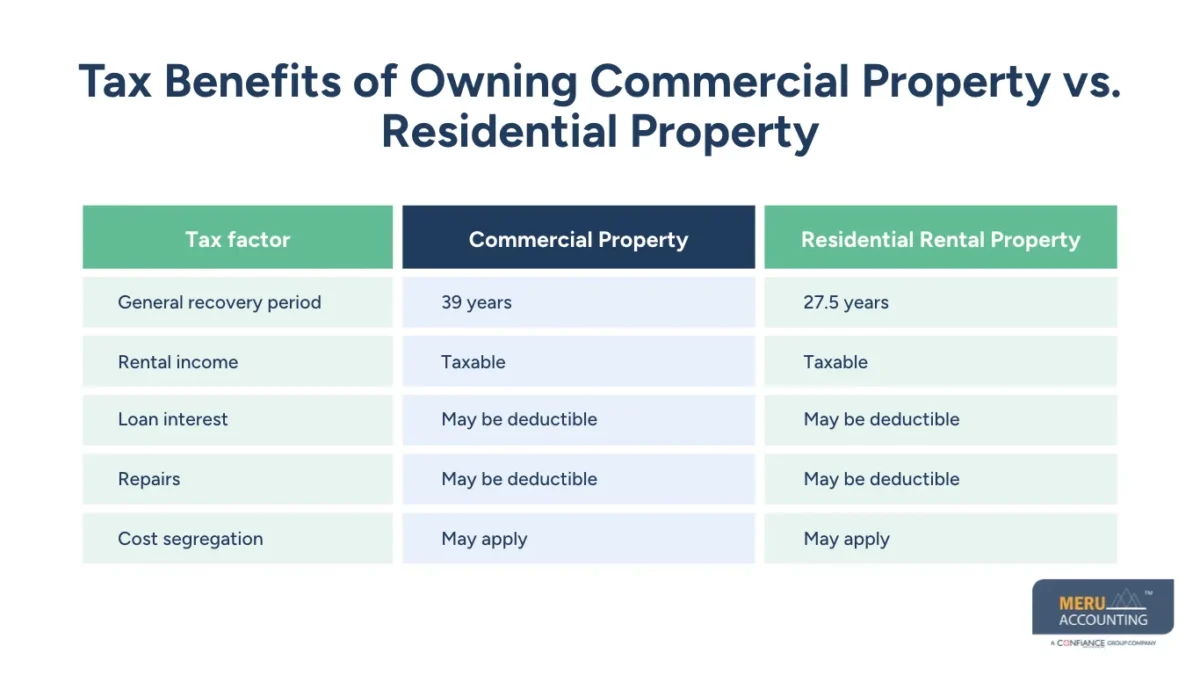
Tax factor | Commercial Property | Residential Rental Property |
General recovery period | 39 years | 27.5 years |
Rental income | Taxable | Taxable |
Loan interest | May be deductible | May be deductible |
Repairs | May be deductible | May be deductible |
Cost segregation | May apply | May apply |
The shorter recovery period for residential rental property can lead to larger annual building depreciation, based on the same depreciable cost. Still, the right choice depends on purchase price, rent, costs, risk, and the investor’s goals.
How to Qualify for Commercial Real Estate Tax Deductions
To claim a tax break, you must meet the IRS rules for the cost and the property. A good record trail is just as key as the cost itself.
Use this checklist:
- Show business use: Keep proof that the property earns rent or serves a business purpose.
- Track each cost: Save bills for repairs, insurance, taxes, and loan interest.
- Split land and building value: Land does not qualify for depreciation.
- Use the right tax life: Check the asset class and recovery period.
- Keep loan records: Save loan terms and interest statements.
- Check ownership: A person, LLC, or other entity may face different tax rules.
- File the right forms: Depreciation and other claims may need extra IRS forms.
The tax benefits for commercial property investors are not automatic. You must meet the rules and keep records that support each claim.
Tax Strategies Commercial Real Estate Investors Can Use to Maximize Returns
A good tax plan starts before you buy a property. Review the deal, likely costs, loan terms, and expected rent. This helps you see how tax costs may affect cash flow and return.
Here are a few ways to plan well:
- Review the deal before closing: Check the split between land, building, and other assets.
- Plan capital work: Know which costs may count as repairs and which may need to be added to the asset’s basis.
- Review cost segregation: See if faster write-offs make sense for the property and your tax plan.
- Plan before a sale: Review the tax impact of a sale, exchange, or change in use well in advance.
- Check each year’s tax rules: Limits and tax laws can change, so do not rely on an old tax plan.
The best tax strategy is not always the one with the largest write-off today. It should also support cash flow, future sales, and long-term gains.
Commercial Real Estate Tax Planning and Accounting Support From Meru Accounting
A commercial property tax return is only as reliable as the financial records behind it. If repair costs are mixed with capital improvements, loan interest is not tracked correctly, or expenses from several properties are lumped together, it becomes harder to support deductions and review each property’s true performance.
At Meru Accounting, we provide accounting and bookkeeping support for real estate investors, property owners, and growing real estate businesses. Our team understands the need to track property-level income, separate operating costs from asset purchases, and keep financial records ready for tax review.
Our services for commercial real estate investors include:
- Real Estate Bookkeeping: Track rental income, tenant payments, property expenses, and vendor bills for each property.
- Property Expense Tracking: Organize repairs, maintenance, insurance, utilities, property taxes, and other operating costs.
- Accounts Payable and Receivable: Manage vendor payments, outstanding rent, and tenant balances.
- Fixed Asset and Depreciation Records: Maintain asset purchase details, improvement costs, and supporting records for depreciation review.
- Tax Preparation Support: Organize financial data and supporting documents for tax return preparation and review.
- Financial Reporting: Prepare income statements, balance sheets, and property-level reports to help investors assess costs and returns.
- Catch-Up Bookkeeping and Cleanup: Correct incomplete or outdated records before tax season or a property transaction.
With experience across real estate and other industries, Meru Accounting helps investors maintain organized books and dependable financial reports. Our work gives you and your tax professional a clearer picture of property income, deductible costs, and asset investments, making tax planning and year-end reviews easier to manage.
Our Expert Insight
One area commercial property investors should pay close attention to is how they classify renovation and improvement costs. For example, replacing a few damaged roof tiles may qualify as a repair, while replacing the entire roof may need to be treated as a capital improvement. The difference matters because a repair may be deducted in the current year, while an improvement is generally added to the property’s basis and recovered through depreciation.
This distinction can have a direct impact on a property’s reported income and tax deductions. Investors should review large vendor bills, renovation contracts, and project costs before closing their books for the year. A single invoice may even include both repair work and capital improvements, which may need to be recorded separately. Getting this right helps avoid incorrect deductions and gives tax professionals better records to work with.
Key Takeaways
- Commercial real estate can offer tax breaks that lower taxable income.
- Depreciation is a key tax benefit, but land is not depreciable.
- Loan interest, property taxes, repairs, and running costs may be deductible.
- Cost segregation may speed up write-offs for some building assets.
- Bonus depreciation rules depend on the asset and date of purchase.
- A 1031 exchange may defer gain if all IRS rules are met.
- Good records and expert tax review help support valid claims.
FAQs
Commercial property owners may deduct eligible expenses such as mortgage interest, property taxes, insurance, property management fees, utilities, repairs, and maintenance. These deductions must meet IRS business expense rules. Major improvements are generally capitalized and depreciated instead of deducted at once.
No. You generally cannot deduct the full purchase price in the year you buy the property. The cost must be split between land and building. The building can be depreciated over its applicable recovery period, while land is not depreciable.
Some investors may qualify for 100% bonus depreciation on eligible property acquired and placed in service after January 19, 2025. It generally applies to qualifying assets with a recovery period of 20 years or less, not the entire commercial building.
Yes. You may still deduct eligible expenses for a property held for rental or business use, even if some units are vacant. However, personal use, property status, and the timing of expenses can affect eligibility.
The transfer may trigger tax consequences, including capital gains tax and depreciation recapture. The result depends on the sale price, adjusted tax basis, ownership structure, and prior depreciation. A qualifying 1031 exchange may defer eligible gains if all IRS requirements are met.
optional anymore
on running the business