A construction project can look profitable until the contractor checks the actual costs, unpaid bills, and money received from customers. Materials may arrive before work begins, workers need regular pay, and customers may release payments only after certain stages are complete. These gaps can make it hard to know how much a project has earned and how much it has spent. Construction accounting for dummies explains these financial steps in simple terms. It shows how contractors record project costs, send customer bills, track payments, and measure earned revenue. Unlike regular business accounts, construction accounts must track the money spent and earned on each project.
For beginners, learning basic construction accounting principles is a good way to understand these records. Whether a contractor handles one small job or several large projects, clear accounts give a better view of costs, income, and expected profit.
What You Will Learn From This Blog
- What construction accounting for dummies means and why it matters to contractors.
- How basic construction accounting principles guide daily financial records.
- How job costing tracks labor, materials, equipment, and other project costs.
- Which construction billing methods contractors use to collect payments.
- How earned revenue differs from invoices and cash received.
- How WIP reports show project costs, billings, and expected profit.
- Which simple steps can keep construction accounts clear and accurate.
Construction Accounting for Dummies: Understanding the Basics
What is Construction Accounting?
Construction accounting records the income, costs, and financial position of each building project. It covers materials, labor, equipment, subcontractor fees, customer invoices, and payments.
For anyone learning construction accounting for dummies, the main idea is simple: every project needs its own cost and income records.
How is it Different From Regular Accounting?
A retail store may record sales each day, but a construction firm may work on a project for several months or years. Costs arise at different stages, while customer payments may follow a separate schedule.
This is why construction accounting for dummies places so much focus on tracking each job rather than looking only at total business income.
Why Does Each Project Need Separate Records?
Consider a contractor working on two homes. The first job may spend more on steel and cement, while the second may have higher labor costs due to design changes.
Separate records show which job stays within budget and which one needs a cost review.
What are Contract Costs and Revenue?
Contract costs include the expenses linked to the work agreed with a customer. Contract revenue is the income earned from completing that work under the contract and the relevant accounting rules.
These figures form the base of project profit reports and are central to construction accounting for dummies.
Who Needs Construction Accounting?
General contractors, home builders, civil contractors, and subcontractors all need project-level financial records. Even a small firm with two active jobs must track labor, materials, invoices, and payments with care.
optional anymore
on running the business
Basic Construction Accounting Principles Every Beginner Should Know
Record Every Financial Transaction
Every purchase, wage payment, supplier bill, and customer invoice needs a clear record. Include the date, amount, project name, and proof of the transaction.
These basic construction accounting principles give contractors a reliable record of where their money goes.
Use Job Costing for Each Project
Job costing means assigning each expense to the project that caused it. For example, cement bought for a home project should not appear under a road construction job.
Construction accounting for dummies becomes easier when every cost has the right project code.
Understand Cash and Accrual Accounting
Cash accounting records income and expenses when money changes hands. Accrual accounting records income when earned and expenses when incurred, even if payment takes place later.
These basic construction accounting principles matter because the accounting method affects when figures appear in financial reports.
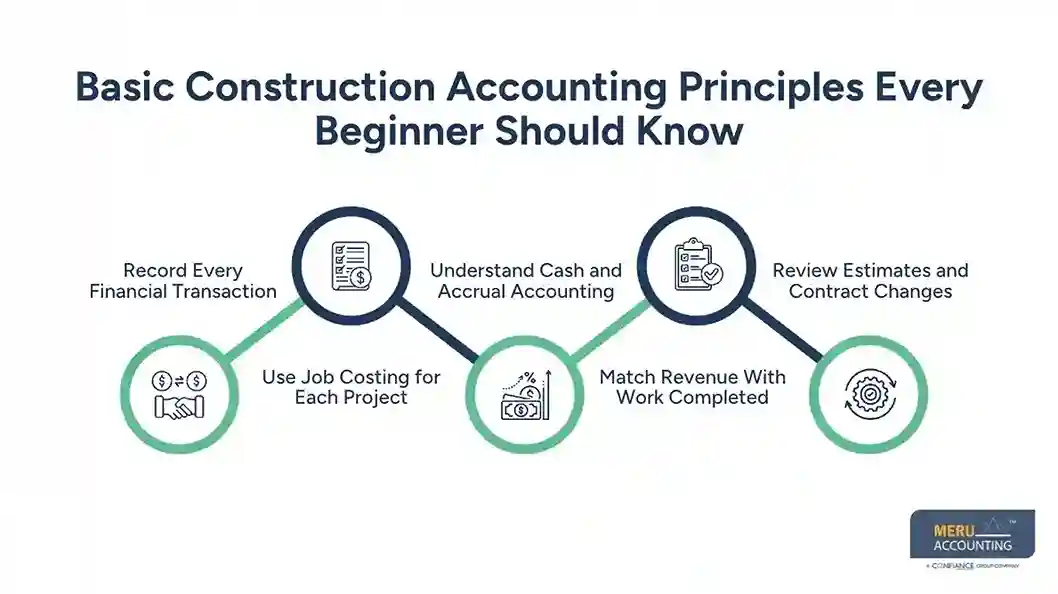
Match Revenue With Work Completed
A customer invoice does not always mean that the full amount has been earned. Revenue depends on the work performed, the contract terms, and the accounting rules that apply.
This is one of the most important concepts in construction accounting for dummies, especially for long-term projects.
Review Estimates and Contract Changes
Material price changes, extra work, and site delays can affect the project budget. Keep approved change orders and update cost estimates when new information becomes available.
Regular reviews are among the basic construction accounting principles that prevent old estimates from giving a false picture of project profit.
Understanding Construction Costs and Job Costing
Direct Material Costs
Direct material costs cover items used for a specific project, such as cement, steel, bricks, pipes, and wiring. Record these purchases against the correct job so that the project cost report reflects actual spending.
Direct Labor Costs
Direct labor includes wages and related costs for workers who perform project tasks. Time sheets should show the worker’s name, hours worked, date, and project code.
Construction accounting for dummies must include labor costs because worker time can make up a large share of total project spending.
Subcontractor Costs
Contractors often hire outside firms for plumbing, electrical work, painting, and roofing. Record each subcontractor bill under the correct project and compare it with the agreed work and rates.
Equipment and Site Costs
Equipment rental, fuel, repairs, and site expenses can add to the total job cost. Some expenses belong to one project, while shared costs may need a fair allocation method.
Indirect Costs and Overheads
Office rent, admin wages, insurance, and general office costs are indirect expenses. Contractors should use a consistent method to assign suitable overhead costs when calculating the full cost of a project.
Construction Billing Methods Explained for Beginners
Fixed-Price Billing
Under a fixed-price contract, the contractor agrees to complete the listed work for a set amount. Payments may be due at agreed stages, such as foundation work, framing, and roof completion.
Progress Billing
Progress billing means sending invoices as the project reaches agreed stages or levels of completion. It allows contractors to collect money during a long project instead of waiting until all work ends.
For beginners studying construction accounting for dummies, progress billing is an important part of understanding the link between work done and money invoiced.
Time-and-Materials Billing
Under this method, the customer pays for the labor hours and materials used, along with any agreed fee. Contractors need clear time sheets, purchase records, and rates to prepare correct bills.
Cost-Plus Billing
A cost-plus contract pays the contractor for allowed project costs plus an agreed fee or margin. The contract should state which costs can be charged and what records the customer may review.
Retainage and Final Billing
Retainage is a part of a payment held back until agreed work or contract terms are met. Contractors must track the amount, release terms, and due date so that the money does not remain unnoticed in open accounts.
How Construction Companies Recognize Earned Revenue
What Does Earned Revenue Mean?
Earned revenue is the income recorded for work performed under a contract. It is different from the amount invoiced to a customer or the cash received in the bank.
Construction accounting for dummies must make this difference clear because all three figures can be different at the same reporting date.
Percentage-of-Completion Method
Under this method, a company records revenue over time when the contract meets the required accounting conditions. A suitable measure of progress may use work completed or eligible costs incurred compared with the latest estimated total costs.
Cost-to-Cost Calculation
Suppose a project has a contract value of $500,000 and an estimated total cost of $400,000. If eligible costs incurred reach $100,000, the project is 25% complete under a cost-to-cost measure.
The related earned revenue would be $125,000, provided the method is suitable and the costs reflect work performed. This example is a useful part of construction accounting for dummies because it shows why costs and revenue must be reviewed together.
Completed Contract Method
Under this method, revenue and costs are generally recorded when the contract is complete, subject to the applicable accounting rules. Its use depends on the reporting framework and, for tax, the rules and exceptions that apply.
Why Accurate Revenue Records Matter
Recording every customer invoice as earned revenue can give a wrong view of business income. Contractors must compare work performed, contract terms, invoices, and payments before preparing their reports.
Work-in-Progress (WIP) Reports and Their Importance
A work-in-progress report shows the financial position of active projects at a given date. It may include contract value, estimated total cost, costs to date, earned revenue, and customer billings.
For beginners, WIP reporting is one of the basic construction accounting principles worth learning early.
Track Costs Against the Budget
As part of construction accounting for dummies, a WIP report compares actual project costs with the latest cost estimate. If a job spends more than planned at an early stage, the contractor can review the reason before the gap grows.
Check Underbilling and Overbilling
Underbilling occurs when the amount billed is lower than earned revenue. Overbilling occurs when the amount billed is higher than earned revenue.
These differences matter because customer billing and project progress do not always follow the same schedule.
Review Expected Project Profit
Understanding expected gross profit is another important concept covered in construction accounting for dummies, as a WIP report shows the projected profit on each active job.
Update WIP Reports Each Month
Monthly WIP reviews give owners a current view of costs, revenue, and billing gaps. Use updated estimates and check major changes with project managers before closing the report.
Practical Tips for Managing Construction Accounts Effectively
Keep Project Records in One Place
Store contracts, purchase orders, supplier bills, time sheets, and payment records in one system as part of a practical construction accounting for dummies approach. Use the same job code across all records to reduce errors.
Set a Monthly Cost Review
Compare actual spending with the project budget at least once a month. Ask site managers about large cost gaps and update estimates when there is clear proof of a change.
Check Customer and Supplier Balances
Review unpaid customer invoices and open supplier bills on a fixed schedule. Follow up on overdue amounts and compare supplier statements with your own records.
Track Every Change Order
In construction accounting for dummies, tracking extra work is essential because it can change the contract price and total project cost. Get customer approval, record the agreed amount, and update the project estimate before adding the work to the job.
Use Software and Professional Account Reviews
Construction accounting software can connect job costs, payroll, invoices, and project reports. A qualified accountant should review the accounting method, revenue entries, and tax treatment.
These steps put basic construction accounting principles into daily practice and give contractors better control over their financial records.
Why Choose Meru Accounting for Construction Accounting Services?
- Project-Wise Bookkeeping: Meru Accounting maintains organised records of project expenses, supplier bills, labor costs, and customer payments, covering key concepts of construction accounting for dummies.
- Accounts Payable and Receivable: Our accounts payable and receivable services cover supplier invoices, payment records, customer billing, and outstanding balances.
- Construction Payroll Management: We provide payroll services to maintain employee wage records, track payroll expenses, and keep payroll entries organised.
- Financial Reporting: Our financial reporting services present income, expenses, and other key figures in a clear format for regular business reviews.
- Accurate Expense Tracking: We maintain organised expense records so contractors can review material purchases, subcontractor charges, labor costs, and other project expenses.
- Accounting Services for Growing Firms: Meru Accounting provides accounting and bookkeeping services that meet the financial recordkeeping needs of construction businesses as their operations expand.
Our Expert Perspective
Understanding construction accounting for dummies requires regular reviews of project costs, customer billings, and earned revenue. Changes in material prices, labor costs, and project timelines can affect expected profit. Contractors should review monthly WIP reports, update cost estimates, track unpaid invoices, and maintain accurate financial records to keep each project’s financial position clear.
Key Takeaways
- Construction accounting tracks income and costs for each project rather than only total business spending.
- Basic construction accounting principles include proper records, job costing, and regular financial reviews.
- Direct costs include labor, materials, and subcontractor charges.
- Customer billings, earned revenue, and cash received are three different figures.
- WIP reports show project costs, expected profit, and billing differences.
- For anyone learning construction accounting for dummies, monthly reviews can reveal cost overruns and payment delays.
- Contractors should check their reporting and tax methods with a qualified accounting professional.
FAQs
Construction accounting for dummies explains how contractors track project costs, customer billings, payments, and earned revenue for each construction job.
Basic construction accounting principles include job costing, accurate expense records, revenue recognition, budget tracking, and regular financial reviews.
In construction accounting for dummies, project costs include direct labor, materials, equipment, subcontractor fees, and allocated overhead expenses.
Construction billings show the amount invoiced to customers, while earned revenue represents the income recorded for work performed under the contract.
Work-in-progress reports show project costs, earned revenue, customer billings, and expected profit, allowing contractors to review the financial status of active jobs.
optional anymore
on running the business