A $75,000 job may look like a good deal, but the true profit can change once you add labor, tools, stock, subs, and other job costs. That’s why accounting software for small construction business should do more than log sales and costs. It should help you see where your money goes and what each job is set to earn.
Many small contractors keep track of the high costs but miss the small ones that can cut into job profit. A change order may not get logged, a sub bill may go to the wrong job, or small site buys may not be added to the job cost. Over time, these gaps can make a job look more sound than it is and leave you with less cash than you had planned.
In this guide, we’ll look at what small contractors often miss in their books, why job cost data can help show true job profit, and what to look for in small contractor accounting software.
What You Will Learn From This Blog
In this blog, you will learn:
- How construction books differ from those of other small firms
- Which costs and job data small contractors often miss
- Why job cost tracking can help show true job profit
- How sales can differ from real project profit
- Which costs should be tracked with care
- What to look for in accounting software for small construction business
- When it may help to get expert accounting support
What Makes Construction Accounting Different From Regular Small Business Accounting?
Construction accounting can be more complex because income and costs often link to a specific job. A firm may have many jobs open at once, and each one can have its own labor, stock, sub costs, bills, and client terms.
A shop, for example, may track sales and general costs. A contractor may need to ask a much more exact set of questions:
- How much did this job earn?
- How much was spent on labor?
- What did the stock and tools cost?
- How much did each sub cost?
- Are job costs still in line with the first bid?
- How much has the client paid so far?
This is where accounting software for small construction business can be more useful than a basic ledger. The goal is not just to keep a record of cash in and cash out. It is to link key costs and income to the right job.
Good small contractor accounting software can also help bring bills, bank data, invoices, and reports into one place. That can make it easier to spot gaps before they turn into larger issues.
optional anymore
on running the business
What Contractors Often Overlook in Their Accounting
Many accounting gaps do not come from a lack of effort. They come from how fast a job moves. A crew may buy stock, a sub may send a bill, a client may ask for a change, and the firm may move to the next task before the cost is logged.
Here are some areas contractors often miss.
Costs by job
A cost may be in the books but linked to the wrong job or left as a general cost. That can make one job look less costly than it is.
Small purchases
Fuel, tools, site items, fees, and small stock buys may seem minor. Yet many small costs can add up over a full job.
Subcontractor costs
A sub bill needs to be tied to the right job and time frame. If not, the job may look more profitable than it is.
Change orders
A change in scope can affect both income and cost. If the new work is not tracked well, the added sales may not cover the added cost.
Unpaid bills and client dues
A firm can have strong sales on paper and still face a cash crunch if client dues are high or vendor bills are due soon.
A solid accounting software for small construction business should help reduce these gaps and make each entry easier to trace.
Why Job Costing Matters for Small Construction Businesses
Job costing is a key part of construction accounting. It means tracking the costs and income tied to each job so you can see how well it is doing.
For example, say a job is sold for $50,000. That may sound like a good deal at first. But if labor costs $16,000, stock costs $12,000, subs cost $10,000, and other job costs add $5,000, just $7,000 is left before other firm costs are added.
That’s why sales alone do not tell the full story.
With the right accounting software for small construction business, you can track costs as work moves on. This lets you compare the first job plan with the real cost. If a job starts to run over plan, you can act while the work is still in play.
Job cost data can also help with new bids. If past jobs show that a type of work costs more than you first planned, you can use that data to set a sound price for the next job.
The Difference Between Project Revenue and Actual Profit
One of the most common gaps in contractor books is the gap between revenue and profit.
Revenue is the amount billed or earned from the job. Profit is what is left after the costs tied to that work are paid and other costs are counted as needed.
For example, a contractor may bill $80,000 on a project. That does not mean the firm made $80,000. The job may have $30,000 in labor, $18,000 in stock, $15,000 in sub costs, and $7,000 in other direct costs. That leaves $10,000 before other business costs.
This is why small contractor accounting software should help you look beyond total sales. Reports should help you see income, direct job costs, unpaid bills, and other key figures.
It is also wise to check reports on a set cycle rather than only at tax time. A monthly review can show if costs are rising, if client dues are late, or if a job is not moving as planned.
Construction Expenses Contractors Shouldn't Overlook
A good cost record should cover more than large bills. Small and less obvious costs can affect job profit too.
Labor
Wages, payroll taxes, and other labor costs can make up a large part of a job. Where possible, labor should be tied to the right work or job.
Materials
Lumber, steel, concrete, fixtures, parts, and other stock should be recorded with care. The cost needs to reach the right job when the item is used for that work.
Subcontractors
Subcontractor costs can have a large impact on job profit. Bills should be checked, coded, and linked to the right project.
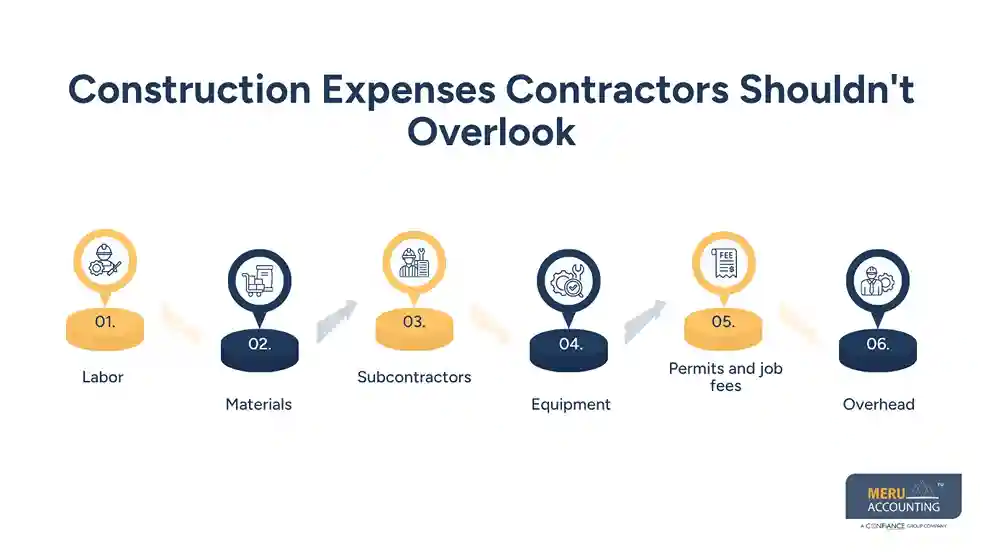
Equipment
Fuel, repairs, rentals, and other equipment costs may need review. The right way to track these costs can depend on how the equipment is used and how the firm keeps its books.
Permits and job fees
Permit fees, site fees, and other project costs can be easy to miss if they are not logged as soon as they arise.
Overhead
Not every cost belongs to one job. Rent, office pay, software, insurance, and other overhead still affect the firm’s bottom line. Contractors should know the difference between direct job costs and wider business costs.
The right accounting software for small construction business can help keep these records in order and make month-end review less of a chore.
Contractor Accounting Services for Small Construction Businesses
Your books should help you know how your jobs are doing—not add more work to your day. Meru Accounting helps small construction firms keep job costs, bills, payments, payroll, and monthly books in order, so you have clean numbers when you need them.
Our contractor accounting services include:
Job Cost & Bookkeeping Support
Keep labor, materials, subcontractor costs, and other job costs in the right place. We also handle day-to-day bookkeeping and account recs.
A/P, A/R & Payment Tracking
Stay on top of vendor bills, client invoices, payments, and open balances. This helps you keep a better view of what you owe and what is due to you.
Payroll & Monthly Accounting
We can support payroll accounting, clean-up work, and monthly book work to help keep your records up to date.
Reports & Software Support
Get clear monthly reports while keeping the tools you already use. Our team works with QuickBooks, Xero, and Zoho Books.
With outsourced accounting support, you can keep your books in good shape without adding a full-time accounting team. That means less time spent on back-office work and more time to focus on your jobs and clients.
Our Expert Insight
One thing contractors often miss is the gap between cash flow and job profit. A job can bring in cash but still have a low profit if labor, materials, or sub costs go over the bid.
We advise contractors to compare actual job costs with the first estimate while the job is still in progress. If labor or material costs start to rise, you have time to find the cause and act before profit drops more.
Good accounting software for small construction business can make this check easier, but the numbers still need a trained eye. Clean books matter, but so does knowing what the numbers say about your jobs and prices.
Key Takeaways
- Construction accounting needs more than basic income and expense tracking.
- Job costing helps show how much each project really costs.
- Revenue is not the same as job profit.
- Labor, materials, subs, equipment, fees, and overhead should be tracked with care.
- Change orders can affect both job income and costs.
- Good small contractor accounting software can bring job data, bills, invoices, and reports into one workflow.
- Software works best when books are set up, checked, and kept current.
- Professional accounting support can help contractors keep records clean as the business grows.
FAQs
It should track job income, labor, materials, sub costs, bills, invoices, payments, and other key costs. Job-level tracking is very useful.
Job costing can help when a contractor has many jobs or needs to know the profit on each one. It can also help with new bids.
There is no one best choice for each contractor. The right tool should fit the firm’s job load, report needs, workflow, and current books.
Yes. Many tools can record sub bills and link them to a set job. The setup should fit the firm’s books and report needs.
It may be time when jobs get more complex, books fall behind, costs are hard to track, or the owner needs help with cash flow, tax, or plans.
optional anymore
on running the business