A construction project can bring in a large amount of revenue and still deliver less profit than expected. One reason may be hidden in the way project costs are tracked. Construction cost accounting helps contractors see where money is going, but if shared costs such as equipment, supervision, labor, or overhead are not assigned to the right jobs, project results can be misleading.
Consider a contractor managing several jobs at once. One project may use heavy equipment for weeks, while another needs more field supervision and office support. Treating those shared costs the same way across every job can make one project look more profitable than it really is.
That is why cost allocation methods matter. A clear and consistent approach helps contractors measure job costs more accurately, understand project margins, spot cost overruns, and use past job data to make better decisions on future work.
What You Will Learn From This Blog
- What cost allocation means in construction accounting
- Why cost allocation is key to job cost and profit tracking
- Which costs may need to be split across jobs
- Common cost allocation methods used in construction
- How cost allocation can aid job bids and cost control
- When a construction company may need help from construction accountants
What Is Cost Allocation in Construction Cost Accounting?
Cost allocation is the process of assigning a cost to the job, task, or cost group that should bear that cost. In construction cost accounting, this helps link costs to the work that caused them.
Some costs are easy to assign. For example, lumber bought for one home build can be charged to that job. A subcontractor bill for work done on one site can also be tied to that job.
Other costs are shared. A field manager may work on three jobs. A piece of heavy gear may be used at more than one site. Office rent, insurance, software, and other overhead may support many jobs. These costs need a fair basis for allocation.
The goal is not to split every cost in equal parts. The goal is to use a sound basis that shows how each job uses the resource. This gives a better view of job cost and helps keep project reports useful.
Why Are Cost Allocation Methods Important in Construction?
Cost allocation methods matter because a job can look more or less profitable based on how its shared costs are tracked. Good construction cost accounting helps a contractor see the full cost of work, not just the bills that are easy to tag to a job.
1. They improve job cost accuracy
A project may use shared labor, gear, office support, and other resources. If those costs are left out, the job may seem more profitable than it is. A clear allocation method helps put the right share of each cost on the right job.
2. They help show true job profit
Revenue alone does not show if a job is doing well. A contractor needs to compare job income with all related costs. Cost allocation can help show a more accurate gross margin for each project.
3. They support better bids
Past job data can help a contractor build better bids. If old jobs include a fair share of overhead and other shared costs, the data gives a better base for future price plans.
4. They help find cost overruns
A job can go off track due to extra labor, more site time, higher material use, or added equipment hours. Good cost tracking can help show where costs rise before the job is done.
5. They improve financial reports
Project reports, income statements, and other financial data are more useful when costs are placed in the right groups. This is a core part of good construction cost accounting.
What Costs Need to Be Allocated in a Construction Company?
Not every cost needs an allocation. Costs that clearly belong to one job can often be charged directly to that job. Shared costs need a set rule.
Common costs that may need allocation include:
- Labor: Field staff who work across more than one project may need their time split by job.
- Equipment: Cranes, trucks, tools, and other gear may serve more than one site.
- Supervision: A site manager or project lead may support several jobs.
- Insurance: Some insurance costs may support many projects or the wider business.
- Office costs: Rent, utilities, software, and office support may serve the full company.
- Admin costs: Payroll, billing, bookkeeping, and other back-office work can support many jobs.
- Travel and site costs: Shared travel or site support may need to be spread across jobs.
The right method depends on the type of cost. For example, equipment may be best split by use hours, while labor may be split by hours worked. Using one rule for every cost can lead to weak job data.
Common Cost Allocation Methods Used in Construction Accounting
There is no single method that fits every contractor. The best choice depends on the cost type, project mix, and data the company can track.
Direct Cost Allocation
This is the most direct approach. A cost is charged to the job that used it. A concrete bill for Job A, for example, goes to Job A.
This method is often the best choice when the link between the cost and job is clear.
Labor-Based Allocation
Labor costs may be split based on hours worked or labor dollars tied to each project. This can work well when staff spends time across several jobs.
Accurate time sheets are key. Poor time data can make the allocation less useful.
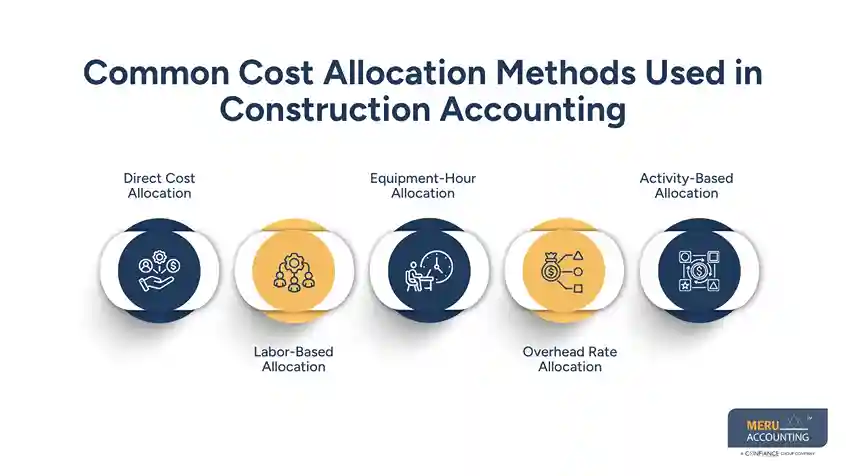
Equipment-Hour Allocation
Equipment can be assigned based on the hours used on each job. If a machine runs 60 hours on one project and 40 hours on another, its cost can be spread based on those hours.
This gives a fairer view than splitting the cost 50/50 when the jobs did not use the machine in equal amounts.
Overhead Rate Allocation
A contractor may set an overhead rate and apply it to a set base, such as labor cost. This can help spread office and other shared costs across jobs.
The rate should be reviewed from time to time. A rate based on old cost or job volume may not fit the firm’s current cost mix.
Activity-Based Allocation
Activity-based methods assign shared costs based on the work that drives those costs. A cost may be linked to labor hours, equipment use, purchase orders, site visits, or other drivers.
This can give a more detailed view, but it also needs more data and care to manage.
optional anymore
on running the business
How Cost Allocation Affects Construction Project Profitability
Profit can look very different when shared costs are handled well. A project may show a strong margin if only direct bills are counted. Once its share of supervision, equipment, or other overhead is added, the real margin may be lower.
This is why construction cost accounting should connect job costs with the broader financial records.
For example, assume a contractor has two active jobs. One uses far more equipment hours, while the other uses more office and project support. A simple 50/50 split may not show how each job uses company resources. A better method can assign each shared cost based on a sound cost driver.
This data can help construction owners:
- Compare estimated and actual costs
- Review job margins
- Spot jobs with rising costs
- Check whether bids cover overhead
- Track the effect of change orders
- Plan labor and equipment use
- Make better project decisions
Good cost data is also useful at month-end. When project costs are recorded in a clear way, construction accountants can review job reports against the general ledger and help find gaps or unusual amounts.
Meru Accounting’s Accounting for Construction Company Services
Managing job costs can get harder as a construction business takes on more work. More jobs can mean more labor records, subcontractor bills, equipment use, vendor bills, and shared overhead to track.
Meru Accounting supports accounting for construction company needs with bookkeeping and accounting work built around the client’s processes and reporting needs. Our approach can help keep project costs organized while keeping the main financial records current.
Our construction accounting services can include:
- Job cost and expense tracking
- Accounts payable and vendor bill support
- Accounts receivable and payment tracking
- Bank and account reconciliation
- Monthly financial reports
- Project and cost data review
- Payroll and related accounting support
- Tax-ready bookkeeping records
For businesses with several active jobs, construction accountants can also help review how costs are grouped and how shared costs are assigned. The aim is to make job data more useful for day-to-day decisions, not just for year-end reports.
A strong process can also help connect job records with the wider books. This gives owners a clearer view of project results, company overhead, cash flow, and overall financial health.
Our Expert Insight
A common problem we see with construction cost allocation is choosing a method because it is simple to calculate, rather than because it reflects how the work is actually performed. For example, spreading equipment costs evenly across jobs may look clean in the books, but it can distort job margins when one project uses that equipment far more than another.
The better test is whether the allocation follows a real cost driver. Labor costs may be tied to hours worked, equipment costs to usage hours, and certain overhead costs to a reasonable measure of project activity. This gives management a clearer view of which jobs are truly carrying the cost and which ones may only appear profitable because shared costs were assigned poorly.
For contractors, this also makes job-cost reports more useful for future decisions. When actual costs are compared with estimates using consistent cost drivers, construction accountants can help identify where a bid was off, where productivity changed, or where overhead is affecting margins more than expected.
Key Takeaways
- Cost allocation helps assign shared costs to the jobs that use them.
- Accurate allocation gives a better view of project cost and profit.
- Labor, equipment, supervision, insurance, and overhead may need allocation.
- The right method depends on the type of cost and the way resources are used.
- Good construction cost accounting supports better bids, job reviews, and cost control.
- Regular review helps keep allocation rules useful as a construction business grows.
- Construction accountants can help review job-cost data and improve the link between project records and financial reports.
FAQs
There is no single best method. The allocation base should match the cost, such as labor hours for labor-related overhead or equipment hours for equipment costs.
A direct cost can be traced to a specific job, such as materials bought for that project. An allocated cost is shared across jobs and assigned using a reasonable cost driver.
Yes. If too little shared overhead is assigned to a job, its reported profit margin may look higher than the actual margin.
Review them when labor rates, equipment use, overhead, or the type and size of projects change. An allocation rate based on outdated costs can distort job reports.
They can compare job costs with estimates, cost codes, time records, equipment use, subcontractor charges, and overhead allocations to find gaps or unusual variances.
optional anymore
on running the business