
A CPA for startups is often brought in when a founder is already thinking about investors, but the better time to review the numbers is before the first due diligence request arrives. Imagine an investor asks for the latest balance sheet and the founder finds three unreconciled bank accounts, old unpaid invoices, and a loan balance that does not match the lender’s statement. The issue is not just the number. It is the lack of a clear answer behind it.
That is why financial cleanup should happen before fundraising becomes urgent. The IRS says good records are needed to prepare financial statements, track income and expenses, and support tax filings. A CPA for startups can use these records to check whether the figures in the accounts match the source data.
This blog looks at the checks that can turn a messy set of accounts into financial data that a founder can explain before investor questions begin.
What You Will Learn From This Blog
- Why a CPA for startups may review the accounts before investor due diligence begins.
- Which financial areas can create questions during a fundraise.
- How to check revenue, expenses, debt, payroll, tax, and cash records.
- Which financial statements and metrics founders should know before investor meetings.
- How startup financial services can keep the cleanup work moving before and during fundraising.
Why Startups Need a CPA Before a Fundraise
Fundraising can put old accounting issues under a brighter light. A CPA for startups can review the numbers before investors start asking why a balance changed or why two reports show different revenue. This is also where startup financial services can keep routine finance work from piling up.
Find Old or Wrong Entries
A payment from two years ago may still sit in the wrong account. A duplicate expense may have gone unnoticed because the monthly total looked reasonable. An accounting professional can trace such entries and check whether they need a correction, reclassification, or supporting record.
Match Records With Source Data
A number in the ledger should have a reason behind it. Bank statements, invoices, receipts, payroll data, contracts, and payment reports can be used to trace key entries. The IRS specifically lists invoices, receipts, deposit slips, and paid bills as supporting records.
Check Tax and Debt Items
Tax dues and debt should not be treated as simple figures on a balance sheet. A financial review can compare tax records and lender statements with the accounting data so the founder knows what each liability represents. These accounting services can also keep these records organized for later review.
Build Clear Audit Trail
An investor may ask, “Where did this number come from?” A clean audit trail gives a direct path from the financial statement to the account, transaction, and source record. A CPA for startups can check whether that path is complete before the investor asks for it.
Reduce Last-Minute Work
Finding old errors during a live fundraise can pull founders into finance work when their attention is already divided. Early accounting services can give the finance team time to review old balances before the data is requested.
Startup Financial Cleanup Checklist Before Fundraising
Think of this as a financial reset rather than a quick spreadsheet check. A CPA for startups can work through each area and mark what is correct, what needs proof, and what needs a correction.
Reconcile Bank and Credit Card Accounts
Start with the accounts that show where cash actually moved. Each balance should agree with the related statement, while old deposits, duplicate charges, and unexplained items should be checked before the account is marked complete. Startup financial services can keep these reconciliations current each month.
Review Revenue and Expense Classifications
A startup may have strong sales but still show confusing reports if income and costs are coded in the wrong places. A CPA for startups can review major accounts and ask whether each entry belongs where it has been placed.
Clear Outstanding Receivables and Payables
A receivable that has been open for 18 months may not have the same value as a fresh invoice. Check old customer balances and unpaid bills, then document what is still due, disputed, written off, or already settled.
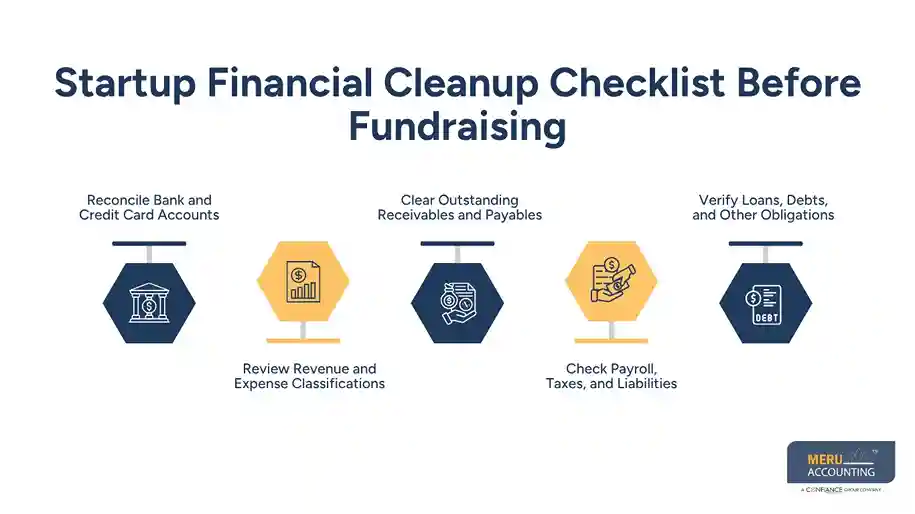
Check Payroll, Taxes, and Liabilities
Payroll records should agree with the amounts recorded in the accounts. Tax balances, benefits, payroll dues, and other liabilities also need a clear status so there are no unexplained amounts sitting on the balance sheet. Startup financial services can keep these items tracked between reviews.
Verify Loans, Debts, and Other Obligations
Do not rely on the number from last year’s spreadsheet. Compare each loan with the latest lender statement, check accrued interest, and list other obligations such as leases, notes, or credit lines that may matter to an investor. A CPA for startups can review whether these balances are recorded in the right period.
How a CPA For Startups Reviews Revenue and Expenses
This part of the review is less about adding up numbers and more about asking whether the numbers tell the same story. A CPA for startups can compare sales data, invoices, payment records, and the ledger to find gaps. Startup financial services can keep the underlying transaction data ready for this review.
Verify Revenue Recognition and Sales Records
Suppose the sales dashboard shows $500,000 in sales while the accounting report shows $460,000. That $40,000 difference needs an explanation. An accounting professional can trace the gap to timing, refunds, unpaid invoices, or another clear cause.
Identify Unusual or One-Time Expenses
A large legal bill or one-time product cost can make one month look far worse than the next. These costs should not simply disappear from the report. A CPA for startups can help identify and properly classify them so the founder can explain why the figure changed.
Separate Business and Personal Transactions
A founder may use a personal card for an urgent business purchase, especially in the early months. Such transactions should be identified and recorded correctly rather than left mixed with personal spending. IRS guidance also stresses separating business and non-business receipts and expenses.
Check Recurring Costs and Cash Burn
Look beyond the current bank balance. Monthly payroll, software, contractors, rent, marketing, and other repeat costs show how much cash the startup is using to keep operating. Startup financial services can track these costs so changes in burn are easier to spot.
Preparing Financial Statements For Investor Due Diligence
When an investor asks for financial statements, the answer should not be a rushed export from accounting software. A CPA for startups can review the statements and the records that sit behind them. Startup financial services can keep the reports and supporting data in order as the review progresses.
Balance Sheet
The balance sheet gives a point-in-time view of assets, liabilities, and equity. Cash, receivables, debt, fixed assets, and other major balances should have a clear source. A CPA for startups can compare these balances with the supporting schedules.
Income Statement
The income statement shows your revenue and expenses over a specific period. Investors may review sales growth, gross margin, operating costs, and losses, so accurate classification matters. With CPA for startups, we review major income and expense items to make sure the figures are properly classified and supported.
Cash Flow Statement
Profit and cash aren’t the same thing. The cash flow statement shows how money moved through operating, investing, and financing activities, giving you a clearer view of the company’s financial position. Through startup financial services, we can help you understand how reported results relate to the cash available to run the business.
Supporting Schedules and Reconciliations
Financial statements are easier to review when major figures have supporting schedules. Receivables, payables, debt, fixed assets, payroll, and bank balances should tie back to detailed records. The IRS notes that good records are needed to prepare accurate income statements and balance sheets.
optional anymore
on running the business
Key Financial Metrics a Startup Should Know Before a Fundraise
A founder should not need to search through five spreadsheets to answer a basic question about the business. A CPA for startups can check whether the data behind key metrics is consistent with the financial records. Startup financial services can also keep the reports used for these metrics current.
Monthly Recurring Revenue
MRR measures recurring revenue expected from active customers each month. The key is to define what counts as recurring and keep that rule the same when the metric is reported. A CPA for startups can check whether the reported figure agrees with the underlying sales data.
Gross Margin
Gross margin shows how much revenue remains after direct costs. If a startup changes which costs are treated as direct costs from month to month, the margin can move even when the business itself has not changed much.
Burn Rate and Runway
Burn rate shows how much cash the startup uses over a period, while runway estimates how long the available cash may last at that rate. Founders should know both before discussing how much capital they plan to raise.
Customer Acquisition Cost
CAC measures the cost of gaining customers. The result can change a lot depending on which sales and marketing costs are included, so the startup should use a clear and consistent method.
Lifetime Value
LTV estimates the value a customer may bring over the expected customer relationship. It is an estimate, not a promise, so founders should be able to explain the method used to calculate it.
How Startup Financial Services Support Fundraising Readiness
Startup financial services can take care of the finance work that tends to build up while founders focus on product, sales, and fundraising. A CPA for startups can review the results of this work and focus on areas that need accounting judgment or correction.
Bookkeeping and Account Reconciliation
Bookkeeping support can keep transactions recorded and bank and card accounts reconciled on a regular cycle. That means fewer old items are left sitting in the accounts when investor requests arrive.
Financial Reporting and Analysis
Monthly reports can show where revenue, costs, cash, and debt stand. Financial reporting support can also flag unusual movements, giving you time to understand them before an investor asks.
Tax and Compliance Review
Tax filings and accounting records shouldn’t tell different stories without a clear reason. Accounting support can organize the underlying financial records for review, making it easier for a CPA for startups to review tax-related information.
Ongoing Financial Cleanup
Cleanup should not be treated as a one-time project that ends after the first investor meeting. Startup financial services can keep new transactions, reconciliations, and supporting records in order while the fundraise continues.
Why Startups Choose Meru Accounting?
Meru Accounting provides startup financial services for businesses that need their accounting data reviewed, organized, and kept current before a fundraise. The work can be structured around the areas that matter most during financial due diligence.
Bookkeeping Review
Meru Accounting can review transaction coding, bank activity, receivables, payables, and account balances to identify areas that need correction or further review before they are reviewed by a CPA for startups.
Account Reconciliation
The team can compare bank and credit card activity with accounting records and identify unmatched transactions, old items, and balance differences. Startup financial services can keep this work on a regular cycle instead of waiting for fundraising.
Financial Reporting
Meru Accounting provides financial reporting based on the available accounting data, giving founders a clearer view of revenue, expenses, cash, liabilities, and other key figures. A CPA for startups can then review areas where accounting judgment is needed.
Tax and Compliance Records
Meru Accounting can organize accounting data and related records for tax and compliance review, so the financial information is easier to trace when documents are requested.
Fundraise-Ready Cleanup
Meru Accounting can focus the review on areas that may create questions during due diligence, including old balances, unreconciled accounts, unclear expense coding, and missing supporting records. Startup financial services can keep these areas in order after the initial cleanup.
Our Expert Perspective
In pre-fundraise reviews, one issue we see often is that the numbers are not always wrong; they are simply not ready to be questioned. A founder may know why revenue changed or why cash fell, but the accounting records may not show that reason clearly. This is often where a cpa for startups can spot gaps between the founder’s view of the business and what the financial statements actually show.
We also find that old balances deserve more attention than they usually get. An unreconciled bank item, an old receivable, or a loan balance that has not been checked for months may seem minor on its own. During due diligence, however, several small gaps can lead to more questions about the wider financial records.
Key Takeaways
- Reconcile bank and credit card accounts before financial data is shared with investors.
- Review revenue, expenses, receivables, payables, payroll, taxes, and debt.
- Keep source documents behind major financial figures.
- A CPA for startups can also review whether the balance sheet, income statement, and cash flow statement tell a consistent story.
- Know MRR, gross margin, burn rate, runway, CAC, and LTV before investor discussions.
- Keep financial cleanup going throughout the fundraise rather than treating it as a one-time task.
- Use startup financial services when ongoing bookkeeping, reporting, reconciliation, and cleanup need dedicated attention.
FAQs
A cpa for startups can review financial records, taxes, debt, reconciliations, and financial statements before investor due diligence begins.
A startup should prepare its balance sheet, income statement, cash flow statement, bank records, tax records, debt details, and supporting schedules before fundraising.
A cpa for startups can check bank accounts, revenue, expenses, receivables, payables, payroll, taxes, debt, and other records for errors or missing details.
Investors may review financial statements, revenue, expenses, cash, liabilities, debt, tax records, and supporting documents to assess the startup’s financial position.
Startup financial services before a fundraise may include bookkeeping, account reconciliation, financial reporting, tax record review, and ongoing financial cleanup.
optional anymore
on running the business