
Commercial real estate (CRE) firms face constant pressure to maintain profitability while managing rising operational costs. Managing multiple properties, tenant relations, financial reporting, and regulatory compliance can quickly overwhelm internal teams. CRE outsourcing strategies have emerged as an effective approach for controlling expenses and improving operational efficiency.
By utilizing external expertise, CRE firms can focus on core activities, streamline processes, and achieve better financial outcomes without adding significant overhead.
Outsourcing in CRE is not just about cost-cutting. It involves strategic delegation of specialized functions such as bookkeeping, lease administration, vendor management, and property accounting. When executed effectively, these strategies reduce unnecessary expenses, minimize errors, and allow firms to operate more efficiently.
This blog explores how CRE outsourcing strategies reduce operating costs, the areas where outsourcing is most impactful, and best practices for implementation.
What You Will Learn From This Blog
- Key reasons outsourcing has become increasingly essential for firms today.
- Critical areas where outsourcing provides the most savings.
- How outsourcing strategies contribute to reducing operating costs.
- Common challenges faced by firms that do not outsource effectively.
- Best practices for implementing outsourcing strategies.
- Cost comparison between in-house operations and outsourced services.
- How professional firms like Meru Accounting can assist CRE firms.
How Outsourcing Supports CRE Operational Efficiency
Rising Operational Pressure
Commercial real estate firms face growing challenges from increased staffing costs, software expenses, and administrative workload. Managing multiple properties, tenant obligations, and financial reporting demands significant internal resources, directly increasing operational overhead. Utilizing outsourcing in commercial real estate provides a practical way to control costs while maintaining operational efficiency.
Regulatory and Compliance Complexity
Compliance with tax regulations, lease agreements, and financial reporting standards is complex and constantly evolving, particularly for firms managing multi-state or international portfolios.
Engaging external specialists as part of CRE outsourcing strategies reduces compliance risks and ensures accurate reporting across all operations.
Focus on Core Business Activities
Shifting routine financial and administrative tasks to external teams allows firms to concentrate on strategic priorities such as acquisitions, portfolio growth, and tenant relationship management.
This approach strengthens overall business focus and supports long-term expansion.
Access to Specialized Expertise
External service providers offer deep domain knowledge in accounting, lease administration, and financial reporting.
Dependence on generalist in-house teams is reduced, while accuracy and operational effectiveness are significantly improved.
Scalability and Operational Flexibility
Firms can adjust resources according to portfolio size, occupancy changes, or seasonal workload fluctuations.
Outsourcing eliminates the need for permanent hiring during peak periods and minimizes idle staffing costs, providing a flexible and cost-efficient solution.
Key Functions Covered Under CRE Outsourcing Strategies
Bookkeeping and Financial Accounting
External teams handle transaction recording, expense tracking, and financial reporting. Consistent recordkeeping is maintained while reducing manual workload on internal teams. Accurate financial data also supports better budgeting and long-term portfolio planning.
Lease Administration
Systematic tracking of lease terms, renewals, rent escalations, and tenant agreements is included in CRE outsourcing strategies, helping prevent missed renewals and potential revenue leakage. Improved lease visibility also strengthens tenant retention and cash flow stability.
Vendor Coordination
Management of maintenance, cleaning, and security vendors is handled externally to ensure timely service delivery and stronger cost control across properties. Centralized vendor oversight also helps in negotiating better service rates and contracts.
Financial Reporting and Analysis
Detailed financial reports prepared for investors, lenders, and internal stakeholders enhance transparency and support better investment decisions. Regular reporting cycles also enable faster financial performance evaluation across properties.
Tax Compliance and Filing
Specialized professionals manage tax preparation and filings in accordance with federal, state, and local regulations, reducing the risk of penalties and compliance errors. Timely filings also help optimize tax positions and avoid interest-related charges.
Property Maintenance Coordination
External teams monitor repair schedules, service quality, and maintenance costs, helping reduce downtime and avoid unexpected operational expenses. Proactive maintenance tracking also extends asset lifespan and reduces long-term repair costs.
How CRE Outsourcing Strategies Reduce Operating Costs
Reduced Labor Costs
CRE outsourcing strategies eliminate the need for hiring multiple in-house employees. Firms pay for services as needed, lowering salary and benefits expenses
Efficiency In Routine Tasks
Specialized teams handle repetitive tasks like bookkeeping, invoice processing, and tenant billing faster and more accurately. Faster task completion reduces delays and allows internal teams to focus on higher-value responsibilities.
Technology Savings
Outsourced providers use advanced tools for accounting, reporting, and property management. Firms avoid investing in expensive software and its maintenance.
Lower Risk Of Errors
Experienced professionals reduce errors in accounting, reporting, and lease management, preventing costly mistakes and financial loss.
Flexible Resource Allocation
Outsourcing allows firms to scale services up or down according to portfolio size and seasonal demand, avoiding idle staff costs. Firms can respond quickly to new projects or market changes without major operational disruptions.
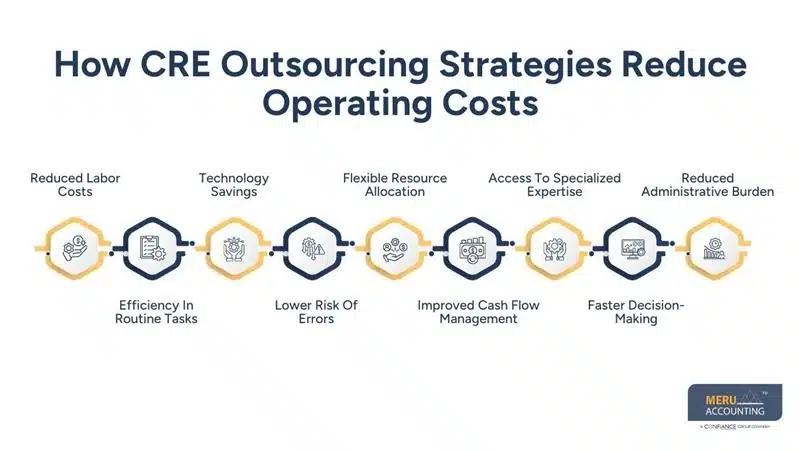
Improved Cash Flow Management
Regular and accurate financial tracking ensures timely rent collection, expense monitoring, and proper fund allocation, helping firms maintain healthy cash flow. Better cash flow visibility also enables firms to plan budgets and future investments with greater confidence.
Access To Specialized Expertise
Outsourced teams bring deep knowledge of CRE accounting, lease management, and tax regulations, enhancing the value of CRE outsourcing strategies. Expertise ensures accurate reporting and reduces exposure to costly compliance issues.
Faster Decision-Making
Real-time reports and accurate data from outsourcing partners allow management to make informed decisions quickly. Timely insights strengthen operational efficiency and improve portfolio performance.
Reduced Administrative Burden
Routine administrative tasks such as vendor coordination and document management move to external teams. Internal staff gain more time for strategy development and tenant relations, improving overall productivity.
Challenges Faced Without CRE Outsourcing Strategies
- Firms maintaining large in-house teams without utilizing CRE outsourcing strategies face high salaries, training, and technology expenses, which reduce overall profitability.
- Internal teams may lack expertise in accounting, tax regulations, or lease administration, leading to errors, penalties, and lost revenue.
- Daily operations like invoice management, tenant billing, and maintenance coordination consume significant internal resources, causing inefficiency.
- Firms cannot easily adjust internal resources for fluctuating portfolio demands without incurring extra costs, limiting scalability.
- Without professional reporting, firms may struggle to track expenses, income, or overall portfolio performance accurately, affecting financial decision-making.
- In-house teams often experience delays in processing critical tasks, slowing down operations.
- Limited access to specialized tools and technology can reduce accuracy and reporting quality.
Key Steps to Execute CRE Outsourcing Strategies Effectively
Clearly Define Roles
When implementing CRE outsourcing strategies, outline all tasks and responsibilities for both internal and external teams. Clarity ensures no overlap occurs and accountability remains clearly assigned.
Choose Experienced Partners
Select outsourcing providers with proven CRE expertise and service quality. Experienced partners reduce errors and provide faster, more reliable outcomes.
Maintain Communication
Keep internal teams informed through regular updates, meetings, and reports. Consistent communication prevents misunderstandings and keeps projects on schedule.
Establish KPIs
Measure performance using key indicators like cost, accuracy, and speed. KPIs allow firms to track progress and ensure objectives are met.
Start Small, Scale Gradually
Begin with a few functions, then expand based on successful results. Gradual implementation helps firms identify issues before scaling operations.
Focus On Security
Protect sensitive financial and tenant data through secure systems consistently. Proper security protocols also maintain compliance with legal and industry standards.
Why Choose Meru Accounting?
Meru Accounting provides specialized CRE outsourcing strategies for firms, focusing on cost reduction and operational efficiency. Our team manages property accounting, lease administration, vendor coordination, and financial reporting with precision. By partnering with Meru Accounting, CRE firms can:
- Reduce overhead costs through flexible service packages.
- Access expert teams experienced in commercial real estate accounting and compliance.
- Utilize advanced software tools without investing in infrastructure.
- Receive timely financial reports for informed decision-making.
- Focus on strategic growth while we handle day-to-day operational tasks.
Our experience working with global and regional CRE clients demonstrates measurable cost savings, improved operational efficiency, and better portfolio management outcomes.
Our Expert Perspective
From our expert perspective, CRE outsourcing strategies are most effective when they are treated as a core operational framework rather than a tactical cost-cutting measure.
At Meru Accounting, we have seen that firms achieve stronger financial control and scalability when specialized functions like accounting, lease management, and reporting are handled through structured outsourcing models.
This approach consistently helps reduce operational burden while improving accuracy, compliance, and decision-making speed.
Key Takeaways
- Outsourcing in CRE reduces labor, technology, and error-related costs.
- Critical areas for outsourcing include accounting, lease management, vendor coordination, and financial reporting.
- Firms without outsourcing face higher operational costs and inefficiencies.
- Effective implementation requires clear roles, KPIs, and communication.
- Partnering with experienced providers like Meru Accounting for CRE outsourcing strategies ensures accuracy, compliance, and operational efficiency.
FAQs
CRE firms can outsource bookkeeping, lease administration, tax compliance, vendor management, financial reporting, and property maintenance coordination.
Outsourcing lowers labor expenses, reduces errors, saves on software costs, and offers flexible resource allocation based on demand. Firms also avoid long-term hiring costs and infrastructure investments.
Yes, reputable providers follow strict data security protocols and comply with industry regulations to protect confidential information.
Absolutely. Outsourced services are flexible and can be scaled up or down based on the number of properties or business needs.
Meru Accounting offers specialized expertise in commercial real estate, delivering accurate, timely, and compliant services that help firms reduce costs and improve overall operational efficiency.