CRE outsourcing, often called Commercial Real Estate outsourcing, is becoming an important support system for real estate investment and asset management teams that handle large property portfolios and financial planning. It helps organizations reduce manual work, improve data accuracy, and manage property operations with better control.
Many global firms also combine this support model with real estate outsourcing approaches to improve financial reporting and decision support. Real estate portfolios today involve complex data, contracts, leases, vendor records, and financial planning. This support system helps organize these areas through structured processes and reporting methods.
Investment teams use it to understand property performance, reduce errors, and make better financial decisions. In many cases, real estate outsourcing also supports day-to-day operations, making teams more efficient and focused.
What You Will Learn From This Blog
- How CRE outsourcing supports investment decisions in real estate
- Why asset management teams rely on structured outsourcing support
- How financial visibility improves through organized reporting and accurate tracking of income and expenses
- The role of real estate outsourcing in cost control and data accuracy
- Key strategies used by firms to manage property portfolios better
- How firms like Meru Accounting support real estate operations
What is CRE Outsourcing and Why It Matters in Modern Real Estate Operations
Understanding The Concept In Simple Terms
CRE outsourcing refers to assigning commercial real estate tasks like reporting, lease tracking, financial analysis, and portfolio administration to external specialists.
It helps companies reduce workload while improving accuracy and consistency in property-related operations.
Role In Daily Operations
External support handles tasks such as rent tracking, contract updates, and expense monitoring. This allows internal teams to focus more on planning and strategic decision-making instead of routine work.
How It Connects With Broader Property Support Services
Different outsourcing models often work together to support overall property operations. Commercial-focused services integrate with broader support systems to manage complete portfolio requirements.
Why Companies Choose This Approach
Businesses adopt this model to improve reporting speed and reduce operational errors. It also helps manage large property portfolios efficiently without significantly increasing internal teams.
Industry Use Cases
Organizations in retail, banking, and logistics use outsourced property support for managing real estate data. Industry research from firms like CBRE and JLL highlights the growing adoption of structured outsourcing models.
How CRE Outsourcing Supports Real Estate Investment Decision-Making
Better Data For Investment Planning
Structured and reliable data helps investment teams evaluate property value with greater accuracy.
More dependable information allows decisions to become data-driven rather than assumption-based.
Performance Tracking Across Assets
Investment teams use structured support to track income, expenses, and return on assets.
This helps quickly identify underperforming properties and improve portfolio performance.
Faster Financial Analysis
External support reduces delays in financial reporting and consolidation.
As a result, investment teams gain faster insights that improve decision-making speed.
Reduced Risk In Investment Choices
Accurate and structured data helps reduce uncertainty in property selection.
Teams can compare multiple assets more effectively and avoid high-risk investment decisions.
Support From Real Estate Outsourcing Systems
Real estate outsourcing systems work alongside CRE outsourcing strategies to manage broader financial and operational data.
This combined support improves overall investment clarity and strengthens decision-making accuracy.
Why Asset Management Teams Rely on CRE Outsourcing for Operational Efficiency
Reduced Manual Workload
Asset managers often handle large volumes of property data, which can slow down core decision-making activities.
Outsourced support reduces repetitive tasks and allows teams to focus more on strategy and portfolio growth.
Structured Reporting Systems
Reports are maintained in a consistent and regularly updated format through external support systems. This improves internal communication and ensures all stakeholders work with the same information.
Improved Asset Tracking
Lease terms, renewals, and tenant details are tracked more accurately through CRE outsourcing strategies and structured support processes. This helps asset managers avoid missed deadlines and maintain better control over property performance.
Better Coordination Between Teams
Well-planned CRE outsourcing strategies and real estate outsourcing improve coordination between finance, operations, and compliance teams. These systems help reduce gaps between departments and improve overall efficiency.
Consistent Data Quality
Standardized data management ensures asset information remains clean, uniform, and easy to interpret. This reduces duplication, errors, and confusion in reporting and analysis.
What are the Key Benefits of CRE Outsourcing for Real Estate Portfolios
Improved Portfolio Visibility
CRE outsourcing strategies provide a clear view of all assets in one system. Managers can understand overall portfolio health and performance more easily.
Strong Financial Control
Financial records are updated and tracked properly through structured support systems.
Budget planning, forecasting, and financial accuracy become more consistent.
Better Use Of Resources
Teams can allocate time and resources more efficiently. Dependency on manual reporting reduces while operational productivity improves.
Scalability For Large Portfolios
As portfolios grow, workload increases significantly across reporting and management tasks.
Structured support helps handle growth without affecting performance quality.
Support From Real Estate Outsourcing Models
Real estate outsourcing supports broader portfolio management by handling non-core activities efficiently. Internal teams can focus more on strategic and high-value decisions.
How CRE Outsourcing Improves Cost Control and Financial Visibility
Accurate Expense Tracking
CRE outsourcing strategies help track expenses across properties in a structured way. Improved tracking strengthens cost control and reduces financial inconsistencies.
Reduction In Operational Waste
Better reporting systems help reduce unnecessary spending across property operations. Financial discipline improves through more controlled and transparent processes.
Real-Time Financial Insights
Structured systems support real-time updates on property performance and costs. Managers can respond quickly to financial changes and operational shifts.
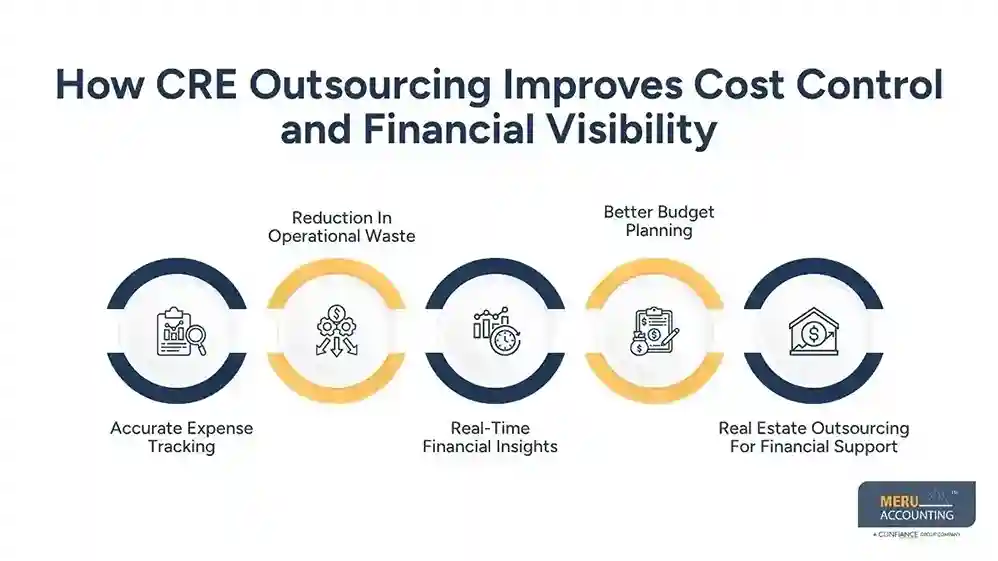
Better Budget Planning
Data-driven insights help investment teams prepare more accurate budgets for future periods. Forecasting becomes more reliable and aligned with actual portfolio performance.
Real Estate Outsourcing For Financial Support
Real estate outsourcing supports additional financial tasks like vendor payments and invoice tracking. These processes improve overall financial visibility and strengthen operational control.
Why Data Management and Reporting are Stronger With CRE Outsourcing
Centralized Data Systems
All property data is brought into one system through structured outsourcing processes. This reduces confusion and improves access across teams.
Accurate Reporting Structure
Reports generated through CRE outsourcing strategies are more consistent and reliable for decision-making. Standardized formats improve accuracy and comparability across all reports.
Reduced Data Errors
Manual entry errors are reduced through structured processes and automated workflows. Data quality improves, leading to more reliable operational and financial insights.
Easier Compliance Tracking
Compliance requirements across different properties and regions are tracked more efficiently. This helps teams stay updated and avoid regulatory gaps.
Role of Real Estate Outsourcing In Data Support
Real estate outsourcing supports data collection and entry, improving overall reporting quality.
Better data handling strengthens accuracy and efficiency in reporting systems.
How CRE Outsourcing Strategies Enhance Risk Management in Asset Management
Early Risk Identification
Structured outsourcing processes help detect issues like lease gaps or financial inconsistencies at an early stage. This allows teams to take corrective action before problems escalate and impact portfolio performance.
Stronger Compliance Control
External support ensures legal and financial requirements are followed more consistently across assets. Regular monitoring helps reduce the chances of compliance breaches and regulatory penalties.
Reduced Financial Uncertainty
Accurate and timely reporting improves clarity in investment and operational decisions. Better visibility into financial data supports more stable forecasting and planning.
Improved Tenant Risk Monitoring
Tenant payment behavior and lease performance are tracked in a more organized manner. This helps asset managers quickly identify potential risks related to occupancy and cash flow.
Operational Support For Risk Reduction
Additional operational support strengthens checks and balances across property management activities. Improved coordination between processes helps reduce errors and enhances overall risk control.
What are the Best CRE Outsourcing Strategies for Investment and Asset Teams
Standardized Reporting Methods
Structured reporting formats ensure consistency across all property assets and locations. This makes it easier to compare performance and identify trends across portfolios.
Integration With Financial Systems
Linking external reporting processes with accounting platforms improves data accuracy and workflow efficiency. It also reduces delays in financial consolidation and reporting cycles.
Regular Data Audits
Periodic reviews help maintain the accuracy and reliability of all property-related information. Errors and inconsistencies can be identified and corrected before they impact decisions.
Clear Role Definition
Well-defined responsibilities ensure smooth coordination between internal teams and external partners. This reduces confusion, overlaps, and delays in day-to-day operations.
Use Of Real Estate Outsourcing For Support Tasks
Supporting functions like documentation and vendor coordination are managed through external assistance. This allows internal teams to focus more on strategic investment and asset planning.
Why Choose Meru Accounting?
Meru Accounting provides structured financial and bookkeeping support for real estate investment and asset management teams. Our CRE outsourcing services help organizations manage property records, financial reporting, and compliance tasks with accuracy and clarity.
We support global clients, especially in the US and other markets, by offering tailored real estate outsourcing solutions that reduce manual workload and improve financial visibility. Our team works with modern accounting tools and systems to ensure smooth reporting and data management for large property portfolios.
By combining structured operational support with strong accounting practices, Meru Accounting helps teams improve cost control, reduce reporting delays, and maintain better financial discipline across real estate assets.
Key Takeaways
- CRE outsourcing strategies help improve investment decision-making with better data. Clear and structured information supports a more accurate evaluation of assets.
- Asset management teams use structured systems to reduce manual workload. Repetitive tasks are minimized, allowing teams to focus on strategic planning.
- Operational and financial tasks are supported through external service models. This improves efficiency in handling routine reporting and administrative work.
- Cost control and reporting accuracy improve with standardized processes. Better tracking and organization reduce errors and unnecessary spending.
- Risk management becomes stronger with structured systems. Early identification of issues helps teams take timely corrective actions.
- Large portfolios benefit from scalable and organized support systems. Workloads can be managed efficiently even as asset volumes increase.
FAQs
CRE outsourcing is the process of assigning commercial real estate tasks like reporting and data management to external experts to improve efficiency and accuracy.
Better financial data and organized reporting support more informed investment decisions.
Teams gain improved visibility into asset performance and operational trends.
Yes, outsourced support is useful even for small portfolios because it reduces manual work.
Improved data organization also helps maintain better accuracy and reporting quality.
One model focuses mainly on commercial property operations, while the other supports broader management activities.
Both approaches help improve efficiency and reduce operational pressure on internal teams.
Companies use structured outsourcing support to improve reporting quality and manage property operations more efficiently.
It also helps reduce administrative workload and supports better financial control.