
Distributor accounting plays a key role in helping businesses track financial activity across multiple distribution centers by bringing structure to stock, cost, and revenue management as companies expand into different regions. It consolidates scattered financial data from separate systems into a clear, center-wise view, enabling decision-makers to understand performance across all locations and improve financial visibility and planning.
While distribution accounting is sometimes used as a broader term referring to the movement of goods and cost flows across networks, distributor accounting remains the primary structured approach for detailed, location-specific financial tracking and reporting, ensuring greater accuracy, consistency, and control across all distribution centers.
What You Will Learn From This Blog
- How distributor accounting works across multiple distribution centers
- The difference between distribution accounting and center-level reporting
- Why financial visibility matters in multi-location operations
- Key challenges faced in managing financial data across centers
- Benefits of central financial control for distribution networks
- Best practices for setting up structured accounting systems
- How expert support can improve accuracy and reporting speed
What Is Distributor Accounting And Why It Matters
Distributor accounting records all financial activities linked to goods moving through different distribution centers. This includes purchases, transfers, storage costs, and sales reporting. It ensures each center is tracked with clear financial records.
Inventory movement is directly tied to financial entries, which helps connect stock levels with costs and makes it easier to understand profit and loss at each location. Without structured financial tracking systems, businesses often face gaps in financial reporting and reduced control over money flow and operational costs.
Large companies rely on it to manage data from several centers at once, avoiding confusion caused by isolated records and reducing reporting delays. This becomes especially important in multi-location operations where financial consistency is essential.
Flow-based cost tracking focuses more on the movement of goods and related expenses, while center-wise accounting ensures each location’s financial performance is recorded clearly. Both systems work together in complex operations.
With accurate records, managers can compare performance across centers and make better decisions related to pricing, stock movement, and cost control.
Role of Distribution Accounting in Multi-Center Operations
Managing Cost Allocation
Distribution accounting helps divide costs across multiple centers. This includes transport, storage, and handling expenses, ensuring each center is fairly measured.
Tracking Inter-Center Transfers
Goods often move between centers on a regular basis. Financial tracking systems record these transfers so that financial data remains balanced, accurate, and fully traceable across all locations.
Maintaining Financial Consistency
When multiple centers operate independently, errors can occur. Distributor accounting ensures all centers follow the same reporting structure.
Supporting Regional Analysis
Companies can compare regions and identify which centers are performing well and which need improvement. This helps management take faster corrective actions based on real performance data.
Improving Reporting Accuracy
Clear records reduce mistakes in financial reports and make audits easier to manage. It also ensures that financial statements remain consistent across all reporting periods.
Aligning With Compliance Needs
Many industries require strict reporting standards across regions. Compliance is maintained through keeping structured financial records across all operating locations.
How Distributor Accounting Enhances Financial Transparency Across Multiple Locations
Centralized Financial View
Distributor accounting brings all financial data into a single system. This gives managers a full view of all distribution centers at once. Decision makers can evaluate overall performance without checking multiple records.
A unified structure also reduces duplication of data entry across centers. Financial summaries become easier to prepare for leadership reviews.
Real-Time Data Access
With structured distribution accounting, companies can access updated financial records quickly, reducing delays in decision-making. Faster access also helps teams respond to cost changes more effectively.
Live updates ensure that finance teams are always working with current figures. This reduces the risk of decisions based on outdated reports.
Reduced Data Confusion
When each center records data differently, confusion arises. Standardized accounting practices ensure consistent entries across all locations. Standard formats also reduce mismatch errors across financial systems.
Stronger Audit Readiness
Auditors can review records more easily when structured accounting practices are used, as transactions are properly organized and stored.
Supporting documents remain arranged for quick verification during audits. Clear documentation reduces time spent during audit cycles and improves financial discipline.
Better Cost Monitoring
Companies can track expenses per center and identify high-cost areas through structured financial systems.
Spending patterns become easier to control across multiple locations. Detailed cost breakdowns highlight inefficiencies and support better budgeting decisions.
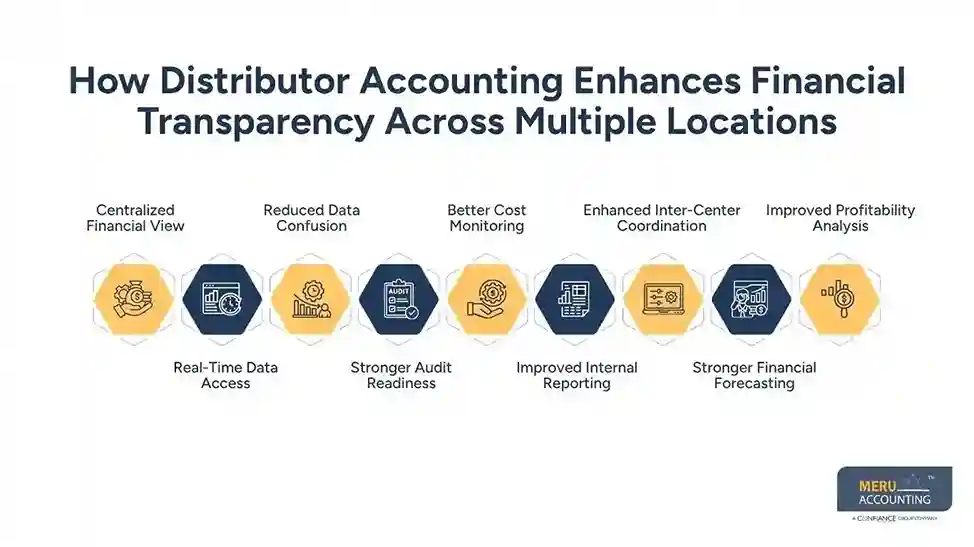
Improved Internal Reporting
Management teams rely on structured financial reports to understand performance trends across regions. Reports also support planning and forecasting activities. Regular reporting cycles improve transparency and keep all stakeholders aligned with financial goals.
Enhanced Inter-Center Coordination
Financial visibility across centers improves coordination of stock movement and cost allocation.
Teams can align operations based on shared financial data. Better coordination reduces delays in transfers and improves operational balance across locations.
Stronger Financial Forecasting
Accurate historical data from multiple centers supports more reliable forecasting. Trends in cost and revenue become easier to identify. Forecasting accuracy improves planning for demand, inventory, and resource allocation.
Improved Profitability Analysis
Profit performance can be measured at each distribution center using structured financial records. High and low-performing centers become clearly visible. Management can adjust pricing and operations based on center-level profitability insights.
Key Challenges in Managing Distribution Accounting Systems
Data Fragmentation Issues
Without proper financial tracking systems, data is often split across systems, making it hard to analyze. This leads to incomplete financial visibility across distribution centers.
Lack Of Standard Processes
Different centers may follow different methods. Structured reporting systems solve this by creating uniform reporting rules. Consistent methods also reduce confusion during the consolidation of reports.
Technology Integration Gaps
Many businesses struggle to connect different financial and inventory systems in a smooth way. Distributor accounting requires proper software alignment across all operational centers for accurate data flow.
Human Error In Reporting
Manual entries increase mistakes in financial records and reporting tasks across centers. Structured distribution accounting reduces these errors through automation tools and validation checks.
Delayed Financial Updates
Without centralized systems, updates often take longer to reach decision makers. Delays can impact timely financial planning and slow down corrective business actions.
Difficulty In Performance Comparison
Comparing centers becomes difficult when data is incomplete or inconsistent. Reliable comparison requires uniform and updated financial records across all operating locations.
Benefits Of Centralized Distributor Accounting For Businesses
- Improved inter-branch reconciliation accuracy ensures financial records match across all distribution centers without mismatches.
- Faster stock-to-finance matching helps connect inventory movement directly with accounting entries for real-time accuracy.
- Reduced inter-center accounting disputes minimize errors caused by inconsistent reporting between locations.
- Improved audit trail consistency ensures every transaction is properly tracked and verifiable during internal and external audits.
- Better allocation of shared expenses allows transport, warehousing, and handling costs to be distributed more accurately across centers.
- Enhanced transfer documentation between centers ensures smooth tracking of goods movement with clear financial records.
Best Practices For Implementing Effective Distributor Accounting Systems
Standardize Accounting Methods
All centers should follow the same distributor accounting process to avoid mismatched data. Uniform methods also make financial consolidation faster and more accurate across locations.
Use Integrated Software Tools
Modern tools help connect financial systems across locations for real-time updates. Integration reduces manual work and improves consistency in financial reporting.
Train Finance Teams Properly
Staff should understand how financial accounting systems work to ensure accurate reporting.
Proper training also reduces errors and improves confidence in daily financial tasks.
Conduct Regular Audits
Frequent checks ensure financial records remain correct and updated across all centers.
Regular audits also help detect issues early before they affect financial reports.
Maintain Clear Documentation
Every transaction should be recorded under structured accounting rules across all operations.
Proper documentation also supports quick verification during audits and internal reviews.
Monitor Performance Metrics
Tracking key indicators helps improve distribution accounting efficiency across centers. Performance tracking also supports better financial control and operational decisions.
How Meru Accounting Supports Distributor Accounting Needs
Meru Accounting helps businesses manage complex financial structures across multiple distribution centers through structured reporting systems and accurate record-keeping. We focus on bringing clarity to financial data so companies can track performance across all locations without confusion or delays.
We build multi-center financial structuring systems that connect all distribution centers under one unified reporting framework. By using modern tools, we make reporting faster and reduce manual effort. Our team also conducts detailed financial reviews to ensure accuracy in records and help businesses avoid reporting errors. Each solution is customized based on industry type and operational size to match specific business needs.
We also provide global client support, helping companies operating across different regions manage financial processes with ease. Our strong focus on compliance and accuracy ensures that all financial records follow standard accounting rules and reporting practices, making multi-location financial management more stable, clear, and organized.
Our Expert Perspective
From our practical experience in managing multi-location accounting systems, we have observed that clear financial structuring is often missing in growing distribution networks.
We believe distributor accounting provides a reliable way to bring order to scattered financial data and helps teams focus on actual performance instead of spending time correcting errors.
In our work, we have consistently seen that even simple improvements in distribution accounting setups can significantly reduce reporting delays and enhance overall financial clarity.
Key Takeaways
- Distributor accounting improves financial clarity across multiple centers
- Distribution accounting helps manage cost flow and reporting accuracy
- Central systems reduce data errors and improve decision speed
- Standard processes are essential for consistent reporting
- Real-time data access strengthens financial control
- Expert support can improve accuracy and reduce workload
FAQs
Distributor accounting is a structured system that records financial transactions across multiple distribution centers for clear reporting and control.
Distribution accounting tracks cost flow and movement of goods between centers, while distributor accounting focuses on center-wise financial records.
Clear financial visibility across all distribution centers comes from centralized records that show costs, revenue, and stock movement in real time.
Better control over inventory, cost allocation, and reporting consistency across multiple centers is achieved through structured systems.
Yes, it reduces manual errors and keeps financial data consistent across centers.