Bookkeeping tasks are very important for every small business. It helps track all the money coming in and going out. Without proper bookkeeping tasks for small businesses, owners may make poor decisions. Errors in accounts can cause losses and stress.
Bookkeeping tasks for small businesses keep records clear and updated. They help with tax filing, loan approvals, and business planning. Clean accounts also make investors and banks trust your business. This guide explains the main tasks in simple steps and shows how bookkeeping for small business owners can be managed regularly.
What You Will Learn From This Blog
After reading this blog, you will understand:
- What the essential bookkeeping tasks for small businesses are.
- Which bookkeeping tasks should be completed daily.
- How weekly bookkeeping tasks for small businesses help keep financial records updated.
- Why monthly bookkeeping reviews are important for small businesses.
- Which bookkeeping tasks should be completed at the end of the year.
- How bookkeeping software can simplify bookkeeping tasks for small businesses.
- Which common bookkeeping mistakes small businesses should avoid.
- When outsourcing bookkeeping tasks may be useful for a small business.
- How accurate bookkeeping can support business growth.
- How organized financial records can make tax preparation easier.
Quick Bookkeeping Task Checklist
Before getting into individual tasks, small business owners can use this quick checklist to identify the basic bookkeeping tasks that require regular attention:
- Record sales and income
- Record business expenses
- Save receipts and bills
- Send and track invoices
- Review accounts payable
- Review accounts receivable
- Reconcile bank accounts
- Reconcile credit cards
- Monitor payroll
- Track inventory
- Review financial statements
- Compare budgets with actual spending
- Organize tax records
- Review yearly financial performance
Following a regular schedule makes bookkeeping tasks for small businesses easier to manage. Not every task needs to be completed every day. The right schedule for bookkeeping for small business owners depends on transaction volume, business size, employees, inventory, and tax requirements.
Why Bookkeeping is Important for Small Businesses
- Proper bookkeeping tasks keep records neat and easy to check, making bookkeeping for small business owners more manageable. Good records help owners know their true finances.
- Avoids mistakes in reports and numbers. Small errors can grow if not fixed early.
- Makes taxes easier to file and follow rules. Organized records save time and prevent fines.
- Shows profit and loss in a clear way. Helps plan the next steps for business growth.
- Bookkeeping tasks for small businesses support smart planning and budgeting for the future. Owners can set goals based on real data.
Daily Bookkeeping Tasks
Daily bookkeeping tasks for small businesses do not need to take much time, but they can help keep financial records organized. Setting aside 15–30 minutes each day can help you spot errors, update expenses, maintain receipts, record cash activity, and stay on top of customer billing.
Daily Bookkeeping Task | Why It Matters |
Review new bank transactions | Spot unusual activity and potential errors promptly |
Assign categories to transactions | Keep expense records accurate and organized |
Store receipts and documents | Maintain support for business-related expenses |
Enter cash payments | Record transactions that bank feeds cannot capture |
Invoice finished work | Keep billing timely and support steady cash flow |
Review Bank Feeds
Begin your bookkeeping routine by checking the transactions that have recently flowed into your accounting software. Compare the entries with your actual business activity and look for duplicate charges, unfamiliar payments, incorrect amounts, or transactions that failed to import.
A short daily review can uncover problems while the details are still easy to remember and investigate.
Categorize Business Transactions
Review each new transaction and assign it to the correct account or expense category as part of your bookkeeping tasks for small businesses. Handling transactions regularly makes it easier to remember the purpose of each purchase and keeps your financial records organized.
For example, a recent $185 payment to a software vendor may be easy to identify while the purchase is still fresh in your mind. You may immediately remember which subscription or business service the payment covered. If you review the same transaction several months later, identifying its purpose may require additional research.
Organize Receipts
Keep receipts and other supporting records for business purchases. Keeping this documentation organized is an important part of bookkeeping for small business owners, especially when preparing records for tax purposes.
Capture receipts as soon as you make a purchase by taking a photo or scanning the document. Upload the file to your receipt management system and connect it with the relevant transaction. Taking care of receipts immediately can save significant time when preparing your records for tax filing.
Record Cash Payments
Bank and credit card feeds can automatically bring many transactions into your bookkeeping software. Cash payments, however, generally need to be entered manually.
For example, if you hand a contractor $150 in cash, add that payment to your records. Likewise, an $80 office supply purchase made with cash should also be recorded.
Because cash payments do not automatically appear in bank feeds, adding them to your daily bookkeeping routine helps prevent transactions from being overlooked.
Send Customer Invoices
Create and send an invoice once the work or service has been completed. Sending the invoice on the same day, or by the following business morning, can help keep your billing process moving.
Waiting to invoice can push back the payment date. Timely billing gives customers more time to pay and can help your small business maintain a more consistent cash flow.
Weekly Bookkeeping Tasks
Weekly bookkeeping takes a little more time than daily recordkeeping, but it helps small businesses stay informed about their finances. Regular bookkeeping tasks for small businesses can also help identify problems before they affect monthly reports.
Task | Why It Matters |
Review available cash | Understand how much money is available for expenses |
Monitor accounts receivable | Follow up on overdue invoices before delays increase |
Review accounts payable | Prepare for upcoming bills and avoid late fees |
Check transaction categories | Identify incorrect classifications before month-end |
Secure bookkeeping records | Reduce the risk of data loss or software problems |
Review Available Cash
Start by checking your current bank balance. Then review the money expected to come in and the payments scheduled to go out.
Consider:
- Pending customer payments
- Bills due within the next seven days
- Upcoming payroll
Reviewing these figures together gives you a more accurate picture of the cash available for spending than looking at the bank balance alone.
Monitor Accounts Receivable
Review an accounts receivable aging report each week. The report shows which customers have outstanding balances and how long their invoices have remained unpaid.
Invoice Status | Recommended Action |
Current | No immediate follow-up |
1–15 days overdue | Send a friendly payment reminder |
16–30 days overdue | Contact the customer directly |
31+ days overdue | Begin a stronger collection follow-up |
Regular follow-ups can help businesses collect outstanding payments sooner. Addressing an invoice shortly after it becomes overdue is generally better than allowing it to remain unpaid for several months.
Review Accounts Payable
Reviewing outstanding bills and upcoming payment obligations each week is another important part of bookkeeping tasks for small businesses. Focus on:
- Payments due this week
- Payments due next week
- Any overdue bills
Schedule payments before their due dates to avoid unnecessary late fees. Paying early may not always be necessary unless a vendor offers an early-payment discount. Grouping payments when practical can also make payment management more efficient.
Check Transaction Categories
Review a sample of recently categorized transactions to make sure each one has been assigned correctly.
Look for:
- Expenses placed in the wrong category
- Transactions with descriptions that were previously unclear
- Personal purchases recorded in business accounts
Making these checks every week helps correct errors while the transactions are still easy to understand and prevents small mistakes from carrying into the month-end records.
Secure Bookkeeping Records
Cloud-based bookkeeping platforms generally include automatic backups, but businesses should still check that their financial data is being stored and synced correctly.
Verify that:
- Financial data is syncing properly
- Records can be exported when needed
- No synchronization errors are waiting for review
Businesses using desktop bookkeeping software should also perform a manual backup at least once a week. Regular backups provide an additional layer of protection against software problems, data loss, or unexpected technical issues.
Monthly Bookkeeping Tasks
Monthly bookkeeping gives small businesses an opportunity to finalize their financial records and assess how the business performed during the month. Regular reconciliations, financial reports, and tax-related reviews can also support better planning and smoother tax preparation.
Monthly Bookkeeping Task | Suggested Deadline | Why It Matters |
Reconcile bank accounts | By the 15th | Find discrepancies and unrecorded transactions |
Reconcile credit cards | By the 15th | Confirm balances and review business charges |
Prepare a P&L statement | By the 15th | Measure profits and assess overall performance |
Prepare a balance sheet | By the 15th | Get a clear view of the business’s financial position |
Review cash flow | By the 15th | Understand how cash moved during the month |
Review expense patterns | By the 15th | Detect unexpected or unusual spending |
File sales tax, if applicable | State deadline | Reduce the risk of penalties and interest |
Reconciling Bank Accounts
Bank reconciliation should be part of every monthly bookkeeping routine. The process checks whether the transactions in your accounting records match the activity shown on your bank statement.
Basic reconciliation process:
- Obtain the latest bank statement.
- Review it against your bookkeeping records.
- Match the transactions one by one.
- Investigate any differences you find.
- Correct missing or inaccurate entries.
- Finalize the reconciliation after the balances match.
The time required can vary based on transaction volume, but a typical account may take around 15–30 minutes to reconcile.
Without regular reconciliation, errors can remain hidden even when the bookkeeping records appear complete.
Reconciling Credit Cards
Credit card accounts should also be reconciled each month. Compare the credit card statement with the transactions entered into your bookkeeping software to confirm that the records are accurate.
Review each charge carefully and identify any personal purchases that may have been mistakenly recorded as business expenses.
Generate Financial Statements
Preparing financial statements is an important part of bookkeeping tasks for small businesses because these reports summarize financial activity. Small businesses should regularly review these three core reports:
Profit & Loss Statement: Summarizes revenue and expenses to show whether the business generated a profit or loss during the period.
Balance Sheet: Provides a snapshot of business assets, liabilities, and equity at a specific point in time.
Cash Flow Statement: Tracks cash entering and leaving the business and helps explain why cash balances may change differently from reported profit.
Analyze and Review Financial Reports
Creating financial reports is not enough. Reviewing the results helps you understand changes in revenue, expenses, profitability, and cash flow.
Compare:
- Current month with the previous month
- Current month with the same month from the previous year
- Actual spending with your expected expenses
- Revenue patterns across different periods
Pay attention to unexpected increases, sudden drops, unusual expenses, or transactions that need additional review. Regular analysis can help identify financial issues before they become larger problems.
Sales Tax Filing
Businesses that collect sales tax may need to file returns monthly, quarterly, or according to another schedule based on applicable state requirements.
Keep track of filing dates and maintain organized sales tax records throughout the year. Accurate and timely filings can help reduce the risk of applicable penalties and interest.
Quarterly Bookkeeping Tasks
Quarterly bookkeeping tasks for small businesses focus on financial activities that may not require monthly attention but should be reviewed before year-end. These tasks can help small businesses keep their accounting records organized and prepare for tax obligations.
Quarterly Bookkeeping Task | Why It Matters |
Compile estimated tax information | Support accurate tax planning |
Clean up unclear transactions | Keep accounting records complete |
Count physical inventory, if applicable | Compare actual stock with records |
Check chart of accounts | Keep categories organized |
Catch up on missed bookkeeping tasks | Prevent work from accumulating |
Review profitability | Support business decisions |
Compile Estimated Tax Data
Businesses that make quarterly estimated tax payments need accurate financial information to support their tax calculations.
Close the books after each quarter and provide reliable profit information to your tax professional. Common federal estimated tax payment dates include April 15, June 15, September 15, and January 15, although applicable deadlines can vary.
Resolve Unclear Transactions
Review transactions sitting in categories such as “Ask My Accountant.” Research unclear purchases and contact vendors when additional information is required.
Every transaction should eventually have an appropriate category and supporting information.
Perform a Physical Inventory Count
Businesses that carry inventory should periodically compare physical stock with accounting records.
Count available inventory and investigate differences caused by:
- Shrinkage
- Damage
- Obsolescence
- Data entry errors
Accurate inventory records can improve financial reporting and help identify inventory losses.
Check the Chart of Accounts
Review your chart of accounts every quarter to make sure it still reflects how your business operates.
Look for:
- Unused categories
- Duplicate categories
- Categories that should be combined
- New expense types that require separate accounts
A clean chart of accounts makes transaction categorization and financial reporting easier.
Catch Up on Missed Bookkeeping Tasks
Use the end of each quarter to address unfinished bookkeeping work. Check for unreconciled accounts, uncategorized transactions, missing receipts, and incomplete records.
Catching up before the next quarter starts prevents small bookkeeping tasks from becoming a large backlog.
Review Profitability by Product or Service
Review revenue and expenses by major product, service, or business segment where your accounting system supports that level of tracking.
The information can help you identify profitable areas, high-cost services, and opportunities to adjust pricing or spending.
Year-End Bookkeeping Tasks
Year-end bookkeeping tasks help close the fiscal year, verify financial records, and prepare information for tax filing. Completing these tasks before handing records to a CPA can make tax preparation more organized.
Year-End Bookkeeping Task | Suggested Deadline | Why It Matters |
Complete December reconciliation | January 15 | Start the new year with clean records |
Verify all transactions | January 15 | Make sure records are complete |
Collect contractor W-9s | January 15 | Support information reporting |
Prepare and file applicable 1099s | January 31 | Meet applicable reporting deadlines |
Compile tax documents | February 15 | Make CPA handoff easier |
Close the books | After tax preparation | Protect prior-year records |
Complete December Reconciliation
Perform the final bank and credit card reconciliations for the year. Review all accounts carefully and investigate differences before closing the accounting period.
Year-end reconciliation provides a final opportunity to identify missing transactions, duplicate entries, or incorrect balances.
Verify All Transactions Are Recorded
Before finalizing the year, confirm that:
- All December transactions are recorded
- Cash transactions are included
- Bank feed imports are complete
- Credit card transactions are recorded
- Intercompany transfers are balanced, if applicable
A final review can prevent missing information from carrying into the next financial year.
Collect W-9s and Prepare 1099s
If your business pays qualifying contractors, review your information reporting requirements and collect required W-9 information.
For applicable payments of $600 or more, Form 1099-NEC may be required. Check current IRS requirements and filing deadlines because reporting rules can change.
Collecting W-9 information before year-end can reduce the need for last-minute follow-ups with contractors.
Compile the Tax Package
Prepare the financial information your CPA or tax professional needs, such as:
- Final Profit & Loss statement
- Final Balance Sheet
- Supporting schedules
- Prior-year carryforward information
- Documentation for major transactions
- Vehicle records
- Home office calculations, where applicable
Organized bookkeeping records can make tax preparation easier and reduce the time spent resolving missing information.
Close the Books
Once year-end tax work is complete, close the prior accounting period according to your bookkeeping procedures.
Closing the books helps prevent accidental changes to historical records and keeps the new financial year separate from the previous one.
How Often Should a Small Business Do Bookkeeping?
Small businesses should perform basic bookkeeping tasks throughout the week rather than waiting until the end of the month or year.
A simple schedule can include:
- Daily: Record transactions, categorize expenses, save receipts, and send invoices.
- Weekly: Review cash flow, unpaid invoices, bills, and transaction accuracy.
- Monthly: Reconcile accounts and review financial statements.
- Quarterly: Review estimated tax information, inventory, accounts, and profitability.
- Yearly: Complete year-end reconciliations, tax records, reporting requirements, and closing procedures.
Following a consistent bookkeeping schedule can reduce errors, improve financial visibility, and make tax preparation easier for small-business owners.
Best Tools for Bookkeeping Tasks
- QuickBooks – Easy for small businesses to use. Tracks income, expenses, and creates simple reports.
- Xero – Cloud-based, simple, and quick for updates. Owners can access accounts anytime from anywhere.
- FreshBooks – Ideal for service businesses and freelancers. Makes invoicing and expense tracking very easy.
- Zoho Books – Affordable and simple for startups. Supports small firms with smart accounting features.
- Wave – Free software for very small businesses. Basic bookkeeping and invoice tracking at zero cost.
Common Bookkeeping Mistakes Small Businesses Make
Small businesses can face accounting problems when bookkeeping tasks are delayed or completed inconsistently. Understanding common mistakes can help owners improve their processes.
Mixing Personal and Business Expenses
Using the same account for personal and business spending can make records difficult to understand. Keep separate business bank and credit card accounts whenever possible.
Failing to Reconcile Accounts
Skipping reconciliation can leave missing transactions, duplicate entries, or unexplained differences unnoticed. Reconcile bank and credit card accounts regularly and investigate differences promptly.
Forgetting Small Expenses
Small cash purchases can be easy to overlook. However, many small expenses can affect financial reports when added together. Recording expenses promptly and saving receipts are simple but important steps in bookkeeping for small business owners.
Ignoring Unpaid Invoices
Late customer payments can create cash flow problems even when sales look strong. Review accounts receivable regularly and follow up on overdue invoices.
Delaying Bookkeeping
Waiting several months to complete bookkeeping tasks for small businesses can make errors harder to identify. Set aside specific times for daily, weekly, and monthly bookkeeping tasks.
Using Incorrect Expense Categories
Putting expenses into the wrong accounts can affect financial reports and make spending analysis less useful. Use consistent categories and seek professional guidance when classification is unclear.
Tips for Managing Bookkeeping Tasks for Small Businesses
Record Transactions Daily
Write down sales, bills, and payments each day. These bookkeeping tasks for small businesses keep your accounts correct and easy to check.
Use Simple Accounting Software
Use easy software to track money and bills and make bookkeeping for small business owners more efficient. It cuts mistakes and makes it clear where your money goes.
Hire a Bookkeeper or Outsource
Get help from a bookkeeper if needed. They save time, reduce errors, and help you see your finances clearly.
Review Financial Statements Monthly
Look at your reports each month as part of your bookkeeping tasks for small businesses. This helps you make smart choices and plan for growth.
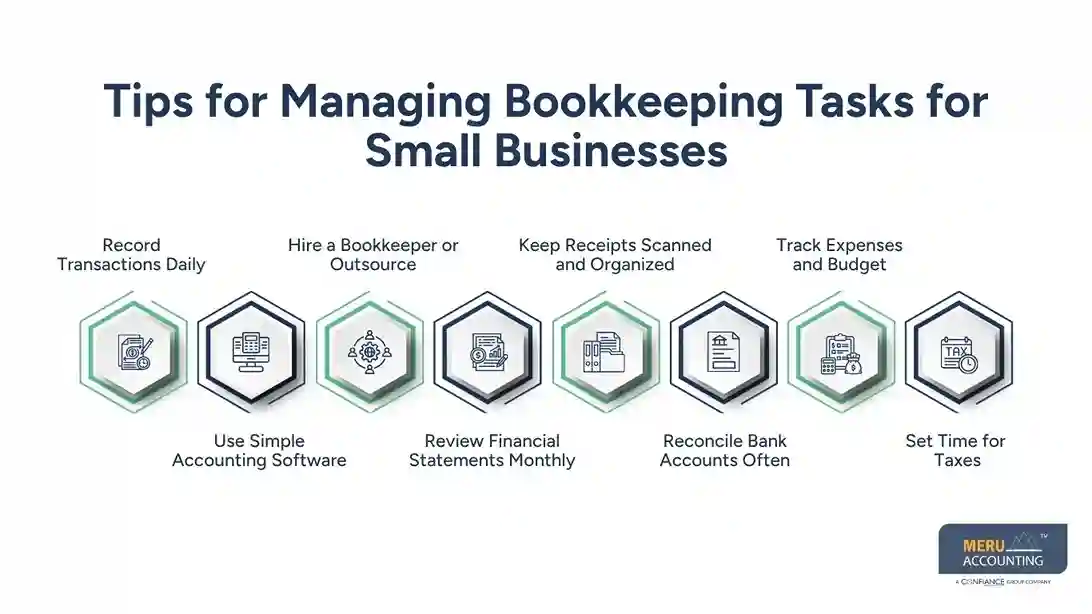
Keep Receipts Scanned and Organized
Scan all bills and receipts and save them on your computer. This stops losses and makes taxes easier to do.
Reconcile Bank Accounts Often
Check your bank records and your books each week. This keeps all numbers correct and stops fraud or mistakes.
Track Expenses and Budget
Write down all costs and compare with your plan. It helps control spending and keep your money safe.
Set Time for Taxes
Keep tax papers ready all year. It stops the last-minute rush and avoids fines.
Benefits of Outsourcing Bookkeeping Tasks
- Outsourcing bookkeeping tasks for small businesses saves time for owners to focus on work. More time can be spent on sales and growth.
- Provides expert handling of accounts and reports. Professionals reduce errors and maintain clear records.
- Ensures taxes and rules are followed properly. Compliance avoids fines, penalties, and legal issues.
- Makes reports easier to read and understand. Clear reports improve planning and decision-making.
- Reduces stress during busy tax or audit periods. Owners can rely on experts for smooth management.
How Bookkeeping Supports Business Growth
- Regular bookkeeping tasks for small businesses show true profits and losses clearly. This helps owners make smart financial choices.
- Highlights extra costs to reduce waste. Cutting expenses can improve profit margins fast.
- Supports the correct pricing of products and services. Owners can avoid losses by checking costs first.
- Builds trust with investors and banks. Clear reports help get loans and attract investment.
- Keeps the business ready for audits or checks. Proper records make compliance easy and stress-free.
Real-Life Examples of Bookkeeping Tasks
- A bakery records daily cash and card sales. This helps track profits and manage ingredient costs.
- A freelancer tracks invoices and client payments each week. Timely follow-ups ensure steady and reliable income.
- A retailer checks stock every month to avoid shortages. This prevents too much or too little inventory and extra costs.
- A small IT firm uses software to track payroll. Employees receive correct pay on time each month.
Bookkeeping is key to small business success and plays an important role in bookkeeping for small business owners. It includes keeping track of sales, expenses, invoices, payroll, stock, and taxes. Each step helps ensure money is tracked and reports are correct. Good bookkeeping helps businesses grow and avoid errors.
Meru Accounting offers expert bookkeeping services for small businesses. We keep accounts correct, clear, and ready for tax filing. Our team uses modern tools for fast and easy record-keeping. Working with Meru Accounting saves time, cuts stress, and helps businesses grow. With our support, small business owners gain clear and confident control over finances.
Our Expert Perspective
Small businesses should complete bookkeeping tasks for small businesses regularly rather than delaying them while focusing on daily operations. Recording transactions, reconciling accounts, tracking unpaid invoices, and organizing documents helps reduce errors and gives owners clear information for budgeting, taxes, cash flow, and business decisions. The bookkeeping schedule should match transaction volume and business needs, while professional support can help businesses manage records accurately when bookkeeping becomes difficult to handle internally.
Key Takeaways
- Record sales, expenses, payments, and other transactions regularly.
- Reconcile bank and credit card accounts to identify differences.
- Track accounts receivable to monitor unpaid customer invoices.
- Review accounts payable to manage upcoming business payments.
- Keep receipts, invoices, bills, and tax records organized.
- Review financial statements to understand business performance.
- Complete bookkeeping tasks on a daily, weekly, monthly, and yearly schedule.
- Avoid mixing personal and business expenses.
- Use bookkeeping software to reduce manual record-keeping work.
- Consider professional bookkeeping support when internal resources are limited.