
As companies grow, financial decisions get more complex. What once worked with simple sheets and basic books no longer gives the clarity needed to scale with trust. Fast growth brings uneven cash flow, rising costs, new market risk, and a need for clear forecasts. These changes also increase the risk of wrong assumptions, which can affect cash position, profit margins, and long-term plans. In such stages, even small errors in financial judgment can lead to larger business impact, which makes structured financial oversight essential.
This is where financial analysis and budgeting plays a key role. It is not just about tracking income and costs. It is about knowing business health, planning next steps, and making data-based choices that support steady growth. It also helps firms set realistic targets, manage working capital, and stay prepared for both expected and unexpected changes. A well-structured approach ensures that financial data is not just recorded, but actively used to guide business direction.
As work grows, many firms find it hard to manage this in-house. That is why more firms now rely on outside teams who build clear systems, strong forecast models, and well-structured budget plans. In this blog, we explain why scaling companies rely on outsourced financial analysis and budgeting and how it supports more accurate forecasting.
What You Will Learn From This Blog
In this blog, you will learn:
- Why money tasks get hard during growth
- How financial analysis and budgeting helps with clear forecasts
- The value of using outside finance teams
- How this choice helps reduce risk and improve choices
- A real case with real estate financial analysis
- How Meru Accounting supports firms at this stage
What Is Financial Analysis and Budgeting in Growing Companies?
In growing firms, financial analysis and budgeting means the process of reviewing money data, building clear budgets, and planning future results using past and live data.
It often includes:
- Review of income and costs
- Cash flow planning
- Profit tracking
- Budget setup and checks
- Forecast of future results
- Plan for risk or growth cases
For scaling firms, this is not a choice. It is a core part of smart business control.
Without clear financial analysis and budgeting, firms may rely on guesswork. This can lead to poor plans and unstable growth.
Why Financial Analysis and Budgeting Become Complex During Scaling
When a firm is small, money tracking is simple. As it grows, the work becomes more complex. The volume of data goes up, and financial decisions start to involve more factors, which makes simple methods less reliable. This shift needs more clear processes to keep accuracy and control.
Here are key reasons:
More Transactions
More clients, vendors, and work steps lead to more data to track and review. This raises the risk of errors if systems are not well managed. It also needs timely recording and regular checks to make sure that financial data stays accurate and complete.
Many Income Sources
Firms add new products or services, which makes profit tracking harder. Each income stream may have different cost plans and margins, which need to be checked on their own to know true performance. Without proper tracking, it becomes hard to see which areas are driving growth.
Growing Team Costs
Wages, benefits, and admin costs rise and need close checks. Payroll plans may also become more complex with different roles, rewards, and rule needs. Regular review is needed to make sure that these costs stay in line with business growth and do not affect profit.
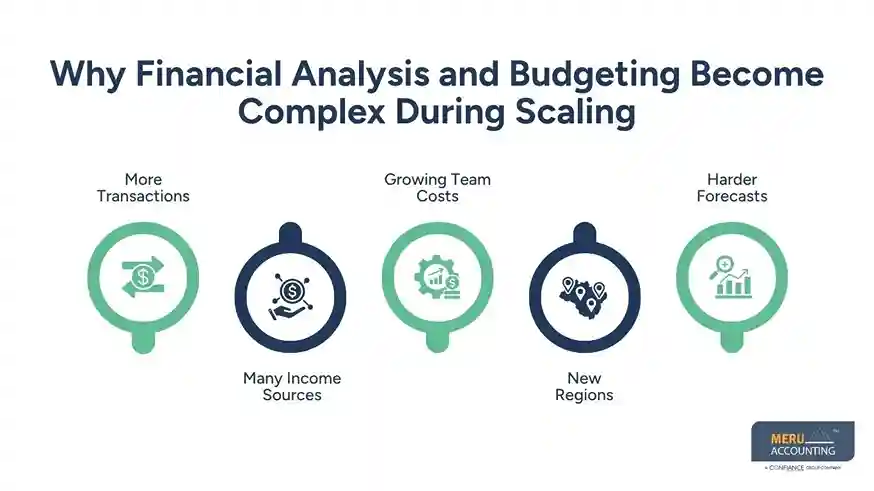
New Regions
Work in new areas brings new tax rules, laws, and cost changes. Firms must make sure that they follow local rules and keep proper financial records for each place. This adds one more layer of work and raises the need for clear reports and rule checks.
Harder Forecasts
Future plans get less certain due to market shifts and growth risk. Changes in demand, pricing, or costs can affect plans. This makes it key to review ideas often and update forecasts based on current data rather than fixed plans.
In addition to these factors, scaling firms often face issues in keeping data in sync across systems and teams. Delays in reports or lack of link between teams can reduce the trust in financial data. Clear processes, regular reviews, and proper checks become key to avoid such issues.
At this stage, basic books are not enough. Firms need strong financial analysis and budgeting systems to stay in control. These systems help make sure that financial data is accurate, timely, and useful for decisions, which is key for managing growth in a stable and informed way.
Key Benefits of Outsourcing Financial Analysis and Budgeting Functions
Outsourcing is not just about saving cost. It is a smart move for firms that plan to grow.
Skilled Finance Experts
Outside teams bring deep skill in models, forecasts, and industry data. They often work across different industries, which helps them apply tested methods and practical insights. This experience supports better financial planning and reduces the chances of basic errors in analysis.
More Accurate Plans
Experts help reduce errors and build plans based on real data. They use structured approaches to review past performance and align it with current business conditions. This improves the reliability of budgets and forecasts, which is important for making informed decisions.
Lower Cost
Hiring a full in-house team can be high cost. Outsourcing gives access to skill at a lower cost. It also reduces expenses related to training, software, and employee benefits, while still maintaining a high level of financial oversight.
Flexible Support
As the firm grows, support can scale up or down with ease. Businesses can increase the level of financial support during peak periods or expansion phases without long hiring processes. This flexibility helps maintain efficiency without overcommitting resources.
Clear Reports and Insights
Modern firms use tools that give real-time views of finance data. Outsourced teams often provide structured reports that are easy to understand and use for decision-making. Regular reporting also ensures that management stays updated on financial performance.
How Outsourced Teams Improve Forecasting Accuracy
Clear forecasts are one of the main needs for scaling firms. Outside finance teams improve this in many ways:
Data-Based Models
They build models using past data, trends, and work inputs. These models are designed to reflect actual business activity, which improves the relevance of forecasts. They also review data quality before using it, which helps avoid errors caused by incomplete or incorrect records.
Scenario Plans
They create best case, worst case, and base case plans. This approach helps firms prepare for different outcomes and reduces the impact of sudden changes. It also supports better risk management by showing how financial results may vary under different conditions.
Ongoing Updates
Forecasts are not fixed. They are checked and updated on a regular basis. This ensures that plans stay aligned with current business performance and market conditions. Regular updates also help in identifying trends early and making timely adjustments.
Linked Data Sources
Sales, ops, and cost data are joined to give a full view. This integration reduces gaps in information and improves the overall accuracy of forecasts. It also ensures that all key business areas are considered during financial planning.
Industry Benchmarks
Teams compare firm data with industry norms to guide plans. This helps in setting realistic targets and understanding where the business stands in comparison to others. It also provides useful context for evaluating performance and making improvements.
This clear method ensures that financial analysis and budgeting leads to better and more reliable forecasts.
Industry Use Case: Real Estate Financial Analysis in Scaling Portfolios
A strong case of complex financial management is the real estate sector.
As real estate firms grow, they manage:
- Many properties
- Rent income streams
- Repair and running costs
- New buys and asset plans
- Market-based value shifts
This is where real estate financial analysis plays a key role.
It helps firms:
- Track profit for each property
- Forecast rent income
- Review return on each asset
- Manage cash flow across assets
- Find weak assets
Without clear financial analysis and budgeting, real estate firms may face overgrowth or weak asset choices.
Outsourcing the same can help reduce this risk by giving clear reports and strong forecast plans.
Meru Accounting’s Real Estate Financial Analysis and Budgeting Services
At Meru Accounting, we know that scaling firms need more than basic bookkeeping. They need clear financial insight that supports growth.
Our real estate financial analysis and budgeting services help property owners, builders, and real estate firms manage assets with clarity.
We provide:
- Clear reports for each property
- Cash flow plans and budget support
- Asset return review
- Cost tracking and control insight
- Full portfolio reports
- Finance plans for growth
Our aim is to turn complex data into clear insight that helps better choices.
With our skills in financial analysis and budgeting, firms can focus on growth while we manage the financial base with care and accuracy.
Our Expert Perspective
From our experience, financial complexity rises faster than most firms expect during growth. Many businesses continue to rely on basic reports, which can lead to gaps in planning and unclear forecasts. A practical approach is to ensure that financial data is reviewed on a regular basis, key assumptions are clearly defined, and forecasts are updated based on current performance. This improves reliability and helps avoid decisions based on outdated or incomplete information.
It is also important to maintain proper documentation and internal checks so that financial reports remain consistent and verifiable. This supports better control, reduces risk of errors, and builds trust with stakeholders. In our view, firms that treat financial analysis and budgeting as an ongoing process are better prepared to manage uncertainty and make informed decisions during scaling.
Key Takeaways
- Finance work gets complex as firms scale
- Financial analysis and budgeting helps with clear forecasts and growth plans
- Outsourcing gives expert help without high in-house cost
- Forecasts improve with strong models and regular checks
- Real estate needs deep finance insight
- Real estate financial analysis helps manage many assets
- Meru Accounting helps firms grow with clear financial control
FAQs
It helps firms track results, control costs, and build clear forecasts for steady growth.
Outside experts use strong models, scenario plans, and real-time data to improve forecast accuracy.
Yes, it lowers the need for a full in-house team while still giving expert insight.
It is used to review asset results, manage cash flow, and guide smart asset choices.
Yes, small firms gain clear insight, better plans, and more accurate forecasts.